

325
10.5. Renormalizability
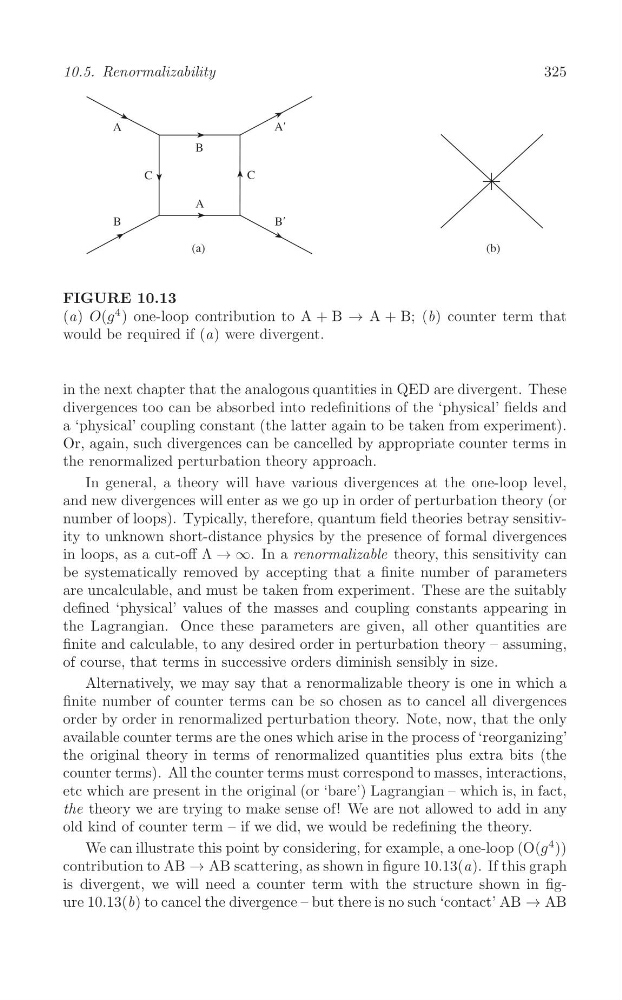
FIGURE 10.13
(a) O(g
4 ) one-loop contribution to A + B → A + B; (b) counter term that
would be required if (a) were divergent.
in the next chapter that the analogous quantities in QED are divergent. These
divergences too can be absorbed into redefinitions of the ‘physical’ fields and
a ‘physical’ coupling constant (the latter again to be taken from experiment).
Or, again, such divergences can be cancelled by appropriate counter terms in
the renormalized perturbation theory approach.
In general, a theory will have various divergences at the one-loop level,
and new divergences will enter as we go up in order of perturbation theory (or
number of loops). Typically, therefore, quantum field theories betray sensitivity to unknown short-distance physics by the presence of formal divergences
in loops, as a cut-off Λ → ∞. In a renormalizable theory, this sensitivity can
be systematically removed by accepting that a finite number of parameters
are uncalculable, and must be taken from experiment. These are the suitably
defined ‘physical’ values of the masses and coupling constants appearing in
the Lagrangian. Once these parameters are given, all other quantities are
finite and calculable, to any desired order in perturbation theory – assuming,
of course, that terms in successive orders diminish sensibly in size.
Alternatively, we may say that a renormalizable theory is one in which a
finite number of counter terms can be so chosen as to cancel all divergences
order by order in renormalized perturbation theory. Note, now, that the only
available counter terms are the ones which arise in the process of ‘reorganizing’
the original theory in terms of renormalized quantities plus extra bits (the
counter terms). All the counter terms must correspond to masses, interactions,
etc which are present in the original (or ‘bare’) Lagrangian – which is, in fact,
the theory we are trying to make sense of! We are not allowed to add in any
old kind of counter term – if we did, we would be redefining the theory.
We can illustrate this point by considering, for example, a one-loop (O(g 4 ))
contribution to AB → AB scattering, as shown in figure 10.13(a). If this graph
is divergent, we will need a counter term with the structure shown in figure 10.13(b) to cancel the divergence – but there is no such ‘contact’ AB → AB
10.5. Renormalizability
FIGURE 10.13
(a) O(g
4 ) one-loop contribution to A + B → A + B; (b) counter term that
would be required if (a) were divergent.
in the next chapter that the analogous quantities in QED are divergent. These
divergences too can be absorbed into redefinitions of the ‘physical’ fields and
a ‘physical’ coupling constant (the latter again to be taken from experiment).
Or, again, such divergences can be cancelled by appropriate counter terms in
the renormalized perturbation theory approach.
In general, a theory will have various divergences at the one-loop level,
and new divergences will enter as we go up in order of perturbation theory (or
number of loops). Typically, therefore, quantum field theories betray sensitivity to unknown short-distance physics by the presence of formal divergences
in loops, as a cut-off Λ → ∞. In a renormalizable theory, this sensitivity can
be systematically removed by accepting that a finite number of parameters
are uncalculable, and must be taken from experiment. These are the suitably
defined ‘physical’ values of the masses and coupling constants appearing in
the Lagrangian. Once these parameters are given, all other quantities are
finite and calculable, to any desired order in perturbation theory – assuming,
of course, that terms in successive orders diminish sensibly in size.
Alternatively, we may say that a renormalizable theory is one in which a
finite number of counter terms can be so chosen as to cancel all divergences
order by order in renormalized perturbation theory. Note, now, that the only
available counter terms are the ones which arise in the process of ‘reorganizing’
the original theory in terms of renormalized quantities plus extra bits (the
counter terms). All the counter terms must correspond to masses, interactions,
etc which are present in the original (or ‘bare’) Lagrangian – which is, in fact,
the theory we are trying to make sense of! We are not allowed to add in any
old kind of counter term – if we did, we would be redefining the theory.
We can illustrate this point by considering, for example, a one-loop (O(g 4 ))
contribution to AB → AB scattering, as shown in figure 10.13(a). If this graph
is divergent, we will need a counter term with the structure shown in figure 10.13(b) to cancel the divergence – but there is no such ‘contact’ AB → AB