

324
10. Loops and Renormalization I: The ABC Theory
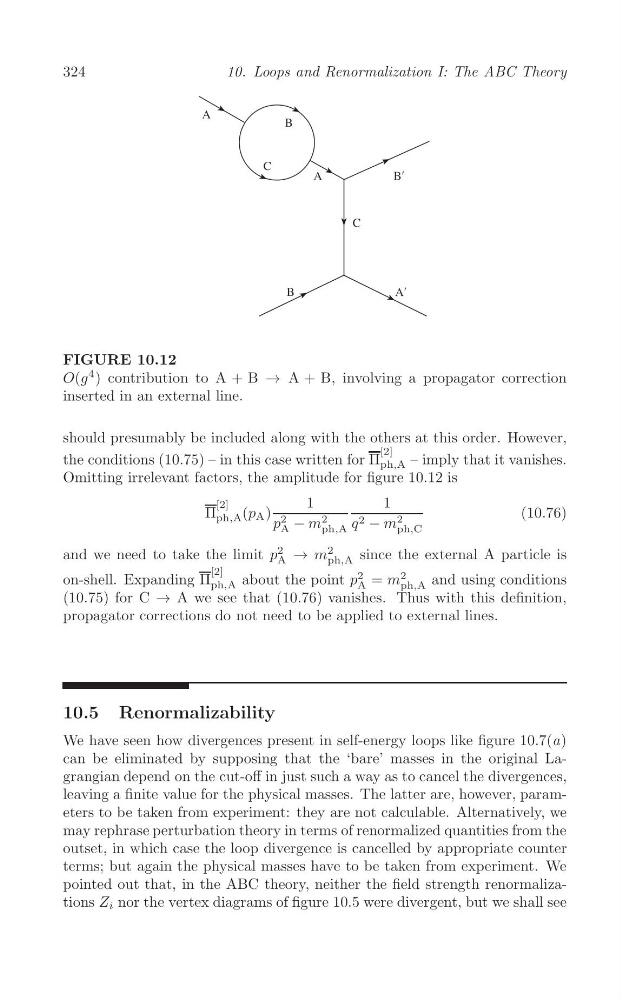
FIGURE 10.12
O(g
4 ) contribution to A + B → A + B, involving a propagator correction
inserted in an external line.
should presumably be included along with the others at this order. However,
[2]
the conditions (10.75) – in this case written for Π
– imply that it vanishes.
ph,A
Omitting irrelevant factors, the amplitude for figure 10.12 is
[2]
1
1
Π
(10.76)
ph,A (p A ) 2
2
2
p − m
q 2 − m
A
ph,A
ph,C
2
2
and we need to take the limit p → m
since the external A particle is
A
ph,A
[2]
2
2
on-shell. Expanding Π ph,A about the point p = m
and using conditions
A
ph,A
(10.75) for C → A we see that (10.76) vanishes. Thus with this definition,
propagator corrections do not need to be applied to external lines.
10.5 Renormalizability
We have seen how divergences present in self-energy loops like figure 10.7(a)
can be eliminated by supposing that the ‘bare’ masses in the original Lagrangian depend on the cut-off in just such a way as to cancel the divergences,
leaving a finite value for the physical masses. The latter are, however, parameters to be taken from experiment: they are not calculable. Alternatively, we
may rephrase perturbation theory in terms of renormalized quantities from the
outset, in which case the loop divergence is cancelled by appropriate counter
terms; but again the physical masses have to be taken from experiment. We
pointed out that, in the ABC theory, neither the field strength renormalizations Z i nor the vertex diagrams of figure 10.5 were divergent, but we shall see
10. Loops and Renormalization I: The ABC Theory
FIGURE 10.12
O(g
4 ) contribution to A + B → A + B, involving a propagator correction
inserted in an external line.
should presumably be included along with the others at this order. However,
[2]
the conditions (10.75) – in this case written for Π
– imply that it vanishes.
ph,A
Omitting irrelevant factors, the amplitude for figure 10.12 is
[2]
1
1
Π
(10.76)
ph,A (p A ) 2
2
2
p − m
q 2 − m
A
ph,A
ph,C
2
2
and we need to take the limit p → m
since the external A particle is
A
ph,A
[2]
2
2
on-shell. Expanding Π ph,A about the point p = m
and using conditions
A
ph,A
(10.75) for C → A we see that (10.76) vanishes. Thus with this definition,
propagator corrections do not need to be applied to external lines.
10.5 Renormalizability
We have seen how divergences present in self-energy loops like figure 10.7(a)
can be eliminated by supposing that the ‘bare’ masses in the original Lagrangian depend on the cut-off in just such a way as to cancel the divergences,
leaving a finite value for the physical masses. The latter are, however, parameters to be taken from experiment: they are not calculable. Alternatively, we
may rephrase perturbation theory in terms of renormalized quantities from the
outset, in which case the loop divergence is cancelled by appropriate counter
terms; but again the physical masses have to be taken from experiment. We
pointed out that, in the ABC theory, neither the field strength renormalizations Z i nor the vertex diagrams of figure 10.5 were divergent, but we shall see