

317
C
10.3. Dealing with the bad news: a simple example
Then we can evaluate the integral straightforwardly and move on to the next
stage.
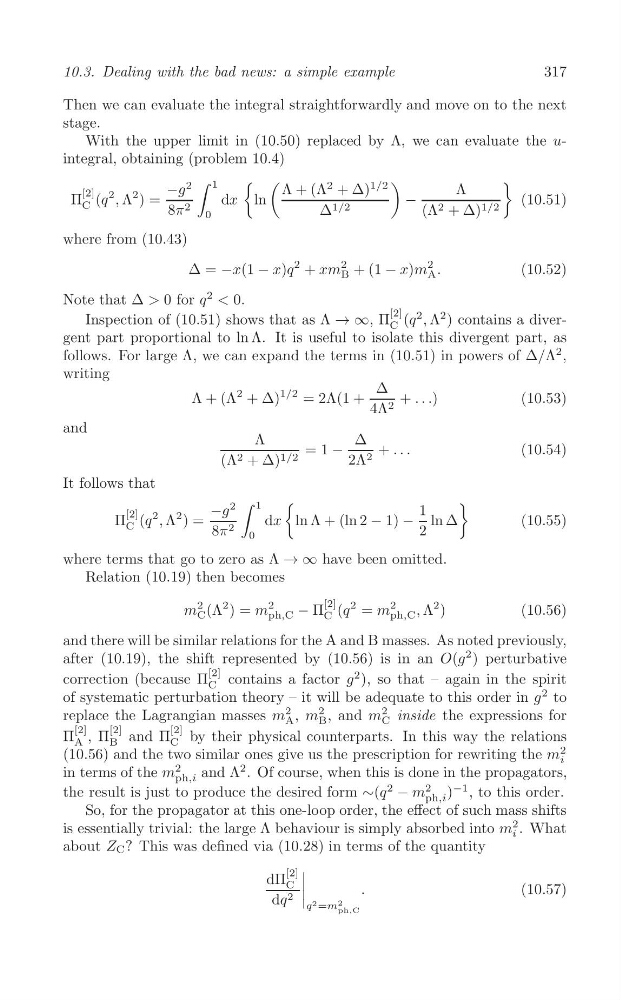
With the upper limit in (10.50) replaced by Λ, we can evaluate the uintegral, obtaining (problem 10.4)
∫
( (
)
)
2
1
[2]
−g
Λ + (Λ
2 + Δ)
1/2
Λ
2
Π (q , Λ
2 ) =
dx ln
−
(10.51)
8π 2
0
Δ 1/2
(Λ 2 + Δ) 1/2
where from (10.43)
2
2
2
Δ = −x(1 − x)q + xm B + (1 − x)m A .
(10.52)
2
Note that Δ > 0 for q < 0.
2
Inspection of (10.51) shows that as Λ → ∞, Π
[2] (q , Λ
2 ) contains a diverC
gent part proportional to ln Λ. It is useful to isolate this divergent part, as
follows. For large Λ, we can expand the terms in (10.51) in powers of Δ/Λ
2 ,
writing
Λ + (Λ
2 + Δ)
1/2 = 2Λ(1 +
Δ + . . .)
(10.53)
4Λ 2
and
Λ
Δ
= 1 −
+ . . .
(10.54)
(Λ 2 + Δ) 1/2
2Λ 2
It follows that
∫
(
)
[2] 2
−g
2
1
1
Π (q , Λ
2 ) =
dx ln Λ + (ln 2 − 1) − ln Δ
(10.55)
C
8π 2
2
0
where terms that go to zero as Λ → ∞ have been omitted.
Relation (10.19) then becomes
2
2
[2] 2
2
m C (Λ
2 ) = m ph,C − Π C (q = m ph,C , Λ
2 )
(10.56)
and there will be similar relations for the A and B masses. As noted previously,
after (10.19), the shift represented by (10.56) is in an O(g
2 ) perturbative
correction (because Π
[2] contains a factor g
2 ), so that – again in the spirit
C
2
of systematic perturbation theory – it will be adequate to this order in g to
2
2
2
replace the Lagrangian masses m A , m , and m inside the expressions for
B
C
[2]
[2]
[2]
Π , Π and Π by their physical counterparts. In this way the relations
A
B
C
2
(10.56) and the two similar ones give us the prescription for rewriting the m i
2
in terms of the m ph,i and Λ
2 . Of course, when this is done in the propagators,
2
the result is just to produce the desired form ∼(q
2
− m ph,i )
−1 , to this order.
So, for the propagator at this one-loop order, the effect of such mass shifts
2
is essentially trivial: the large Λ behaviour is simply absorbed into m i . What
about Z C ? This was defined via (10.28) in terms of the quantity
[2]
dΠ C
.
(10.57)
|
|
|
|
dq 2
2
q 2 =m ph,C
C
10.3. Dealing with the bad news: a simple example
Then we can evaluate the integral straightforwardly and move on to the next
stage.
With the upper limit in (10.50) replaced by Λ, we can evaluate the uintegral, obtaining (problem 10.4)
∫
( (
)
)
2
1
[2]
−g
Λ + (Λ
2 + Δ)
1/2
Λ
2
Π (q , Λ
2 ) =
dx ln
−
(10.51)
8π 2
0
Δ 1/2
(Λ 2 + Δ) 1/2
where from (10.43)
2
2
2
Δ = −x(1 − x)q + xm B + (1 − x)m A .
(10.52)
2
Note that Δ > 0 for q < 0.
2
Inspection of (10.51) shows that as Λ → ∞, Π
[2] (q , Λ
2 ) contains a diverC
gent part proportional to ln Λ. It is useful to isolate this divergent part, as
follows. For large Λ, we can expand the terms in (10.51) in powers of Δ/Λ
2 ,
writing
Λ + (Λ
2 + Δ)
1/2 = 2Λ(1 +
Δ + . . .)
(10.53)
4Λ 2
and
Λ
Δ
= 1 −
+ . . .
(10.54)
(Λ 2 + Δ) 1/2
2Λ 2
It follows that
∫
(
)
[2] 2
−g
2
1
1
Π (q , Λ
2 ) =
dx ln Λ + (ln 2 − 1) − ln Δ
(10.55)
C
8π 2
2
0
where terms that go to zero as Λ → ∞ have been omitted.
Relation (10.19) then becomes
2
2
[2] 2
2
m C (Λ
2 ) = m ph,C − Π C (q = m ph,C , Λ
2 )
(10.56)
and there will be similar relations for the A and B masses. As noted previously,
after (10.19), the shift represented by (10.56) is in an O(g
2 ) perturbative
correction (because Π
[2] contains a factor g
2 ), so that – again in the spirit
C
2
of systematic perturbation theory – it will be adequate to this order in g to
2
2
2
replace the Lagrangian masses m A , m , and m inside the expressions for
B
C
[2]
[2]
[2]
Π , Π and Π by their physical counterparts. In this way the relations
A
B
C
2
(10.56) and the two similar ones give us the prescription for rewriting the m i
2
in terms of the m ph,i and Λ
2 . Of course, when this is done in the propagators,
2
the result is just to produce the desired form ∼(q
2
− m ph,i )
−1 , to this order.
So, for the propagator at this one-loop order, the effect of such mass shifts
2
is essentially trivial: the large Λ behaviour is simply absorbed into m i . What
about Z C ? This was defined via (10.28) in terms of the quantity
[2]
dΠ C
.
(10.57)
|
|
|
|
dq 2
2
q 2 =m ph,C