

313
10.2. The vertex correction
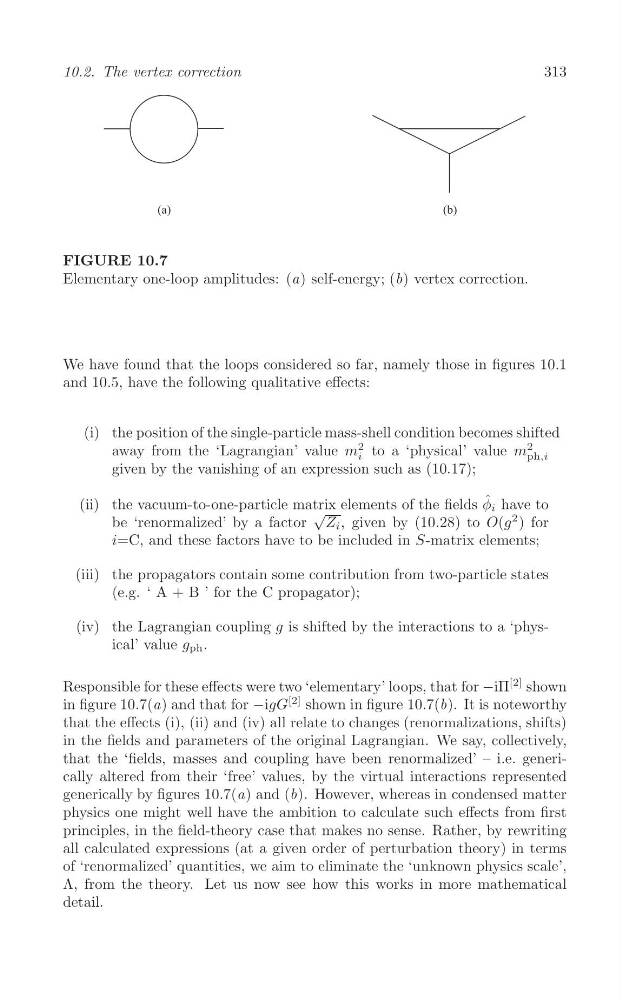
FIGURE 10.7
Elementary one-loop amplitudes: (a) self-energy; (b) vertex correction.
We have found that the loops considered so far, namely those in figures 10.1
and 10.5, have the following qualitative effects:
(i) the position of the single-particle mass-shell condition becomes shifted
2
2
away from the ‘Lagrangian’ value m to a ‘physical’ value m
i
ph,i
given by the vanishing of an expression such as (10.17);
(ii) the vacuum-to-one-particle matrix elements of the fields φ ˆ i have to
√
be ‘renormalized’ by a factor Z i , given by (10.28) to O(g
2 ) for
i=C, and these factors have to be included in S-matrix elements;
(iii) the propagators contain some contribution from two-particle states
(e.g. ‘ A + B ’ for the C propagator);
(iv) the Lagrangian coupling g is shifted by the interactions to a ‘physical’ value g ph .
Responsible for these effects were two ‘elementary’ loops, that for −iΠ
[2] shown
in figure 10.7(a) and that for −igG
[2] shown in figure 10.7(b). It is noteworthy
that the effects (i), (ii) and (iv) all relate to changes (renormalizations, shifts)
in the fields and parameters of the original Lagrangian. We say, collectively,
that the ‘fields, masses and coupling have been renormalized’ – i.e. generically altered from their ‘free’ values, by the virtual interactions represented
generically by figures 10.7(a) and (b). However, whereas in condensed matter
physics one might well have the ambition to calculate such effects from first
principles, in the field-theory case that makes no sense. Rather, by rewriting
all calculated expressions (at a given order of perturbation theory) in terms
of ‘renormalized’ quantities, we aim to eliminate the ‘unknown physics scale’,
Λ, from the theory. Let us now see how this works in more mathematical
detail.
10.2. The vertex correction
FIGURE 10.7
Elementary one-loop amplitudes: (a) self-energy; (b) vertex correction.
We have found that the loops considered so far, namely those in figures 10.1
and 10.5, have the following qualitative effects:
(i) the position of the single-particle mass-shell condition becomes shifted
2
2
away from the ‘Lagrangian’ value m to a ‘physical’ value m
i
ph,i
given by the vanishing of an expression such as (10.17);
(ii) the vacuum-to-one-particle matrix elements of the fields φ ˆ i have to
√
be ‘renormalized’ by a factor Z i , given by (10.28) to O(g
2 ) for
i=C, and these factors have to be included in S-matrix elements;
(iii) the propagators contain some contribution from two-particle states
(e.g. ‘ A + B ’ for the C propagator);
(iv) the Lagrangian coupling g is shifted by the interactions to a ‘physical’ value g ph .
Responsible for these effects were two ‘elementary’ loops, that for −iΠ
[2] shown
in figure 10.7(a) and that for −igG
[2] shown in figure 10.7(b). It is noteworthy
that the effects (i), (ii) and (iv) all relate to changes (renormalizations, shifts)
in the fields and parameters of the original Lagrangian. We say, collectively,
that the ‘fields, masses and coupling have been renormalized’ – i.e. generically altered from their ‘free’ values, by the virtual interactions represented
generically by figures 10.7(a) and (b). However, whereas in condensed matter
physics one might well have the ambition to calculate such effects from first
principles, in the field-theory case that makes no sense. Rather, by rewriting
all calculated expressions (at a given order of perturbation theory) in terms
of ‘renormalized’ quantities, we aim to eliminate the ‘unknown physics scale’,
Λ, from the theory. Let us now see how this works in more mathematical
detail.