

+ −
9.5. e e annihilation into hadrons
289
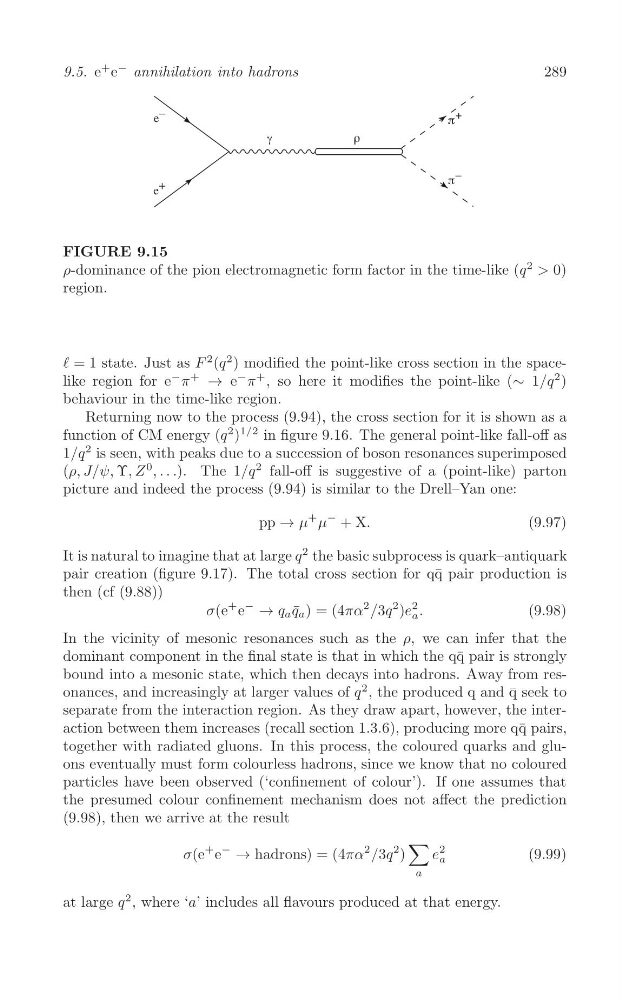
FIGURE 9.15
2
ρ-dominance of the pion electromagnetic form factor in the time-like (q > 0)
region.
e = 1 state. Just as F
2 (q
2 ) modified the point-like cross section in the spacelike region for e
− π
+
→ e
− π
+ , so here it modifies the point-like (∼ 1/q
2 )
behaviour in the time-like region.
Returning now to the process (9.94), the cross section for it is shown as a
function of CM energy (q
2 )
1/2 in figure 9.16. The general point-like fall-off as
1/q
2 is seen, with peaks due to a succession of boson resonances superimposed
(ρ, J/ψ, Υ, Z
0 , . . .). The 1/q
2 fall-off is suggestive of a (point-like) parton
picture and indeed the process (9.94) is similar to the Drell–Yan one:
pp → μ
+ μ
− + X.
(9.97)
It is natural to imagine that at large q
2 the basic subprocess is quark–antiquark
pair creation (figure 9.17). The total cross section for q¯ q pair production is
then (cf (9.88))
2
σ(e
+ e
−
→ q a q ¯ a ) = (4πα
2 /3q
2 )e a .
(9.98)
In the vicinity of mesonic resonances such as the ρ, we can infer that the
dominant component in the final state is that in which the q¯ q pair is strongly
bound into a mesonic state, which then decays into hadrons. Away from resonances, and increasingly at larger values of q
2 , the produced q and q seek to
¯
separate from the interaction region. As they draw apart, however, the interaction between them increases (recall section 1.3.6), producing more q¯ q pairs,
together with radiated gluons. In this process, the coloured quarks and gluons eventually must form colourless hadrons, since we know that no coloured
particles have been observed (‘confinement of colour’). If one assumes that
the presumed colour confinement mechanism does not affect the prediction
(9.98), then we arrive at the result
∑
2
σ(e
+ e
−
→ hadrons) = (4πα
2 /3q
2 )
e
(9.99)
a
a
at large q
2 , where ‘a’ includes all flavours produced at that energy.
9.5. e e annihilation into hadrons
289
FIGURE 9.15
2
ρ-dominance of the pion electromagnetic form factor in the time-like (q > 0)
region.
e = 1 state. Just as F
2 (q
2 ) modified the point-like cross section in the spacelike region for e
− π
+
→ e
− π
+ , so here it modifies the point-like (∼ 1/q
2 )
behaviour in the time-like region.
Returning now to the process (9.94), the cross section for it is shown as a
function of CM energy (q
2 )
1/2 in figure 9.16. The general point-like fall-off as
1/q
2 is seen, with peaks due to a succession of boson resonances superimposed
(ρ, J/ψ, Υ, Z
0 , . . .). The 1/q
2 fall-off is suggestive of a (point-like) parton
picture and indeed the process (9.94) is similar to the Drell–Yan one:
pp → μ
+ μ
− + X.
(9.97)
It is natural to imagine that at large q
2 the basic subprocess is quark–antiquark
pair creation (figure 9.17). The total cross section for q¯ q pair production is
then (cf (9.88))
2
σ(e
+ e
−
→ q a q ¯ a ) = (4πα
2 /3q
2 )e a .
(9.98)
In the vicinity of mesonic resonances such as the ρ, we can infer that the
dominant component in the final state is that in which the q¯ q pair is strongly
bound into a mesonic state, which then decays into hadrons. Away from resonances, and increasingly at larger values of q
2 , the produced q and q seek to
¯
separate from the interaction region. As they draw apart, however, the interaction between them increases (recall section 1.3.6), producing more q¯ q pairs,
together with radiated gluons. In this process, the coloured quarks and gluons eventually must form colourless hadrons, since we know that no coloured
particles have been observed (‘confinement of colour’). If one assumes that
the presumed colour confinement mechanism does not affect the prediction
(9.98), then we arrive at the result
∑
2
σ(e
+ e
−
→ hadrons) = (4πα
2 /3q
2 )
e
(9.99)
a
a
at large q
2 , where ‘a’ includes all flavours produced at that energy.