

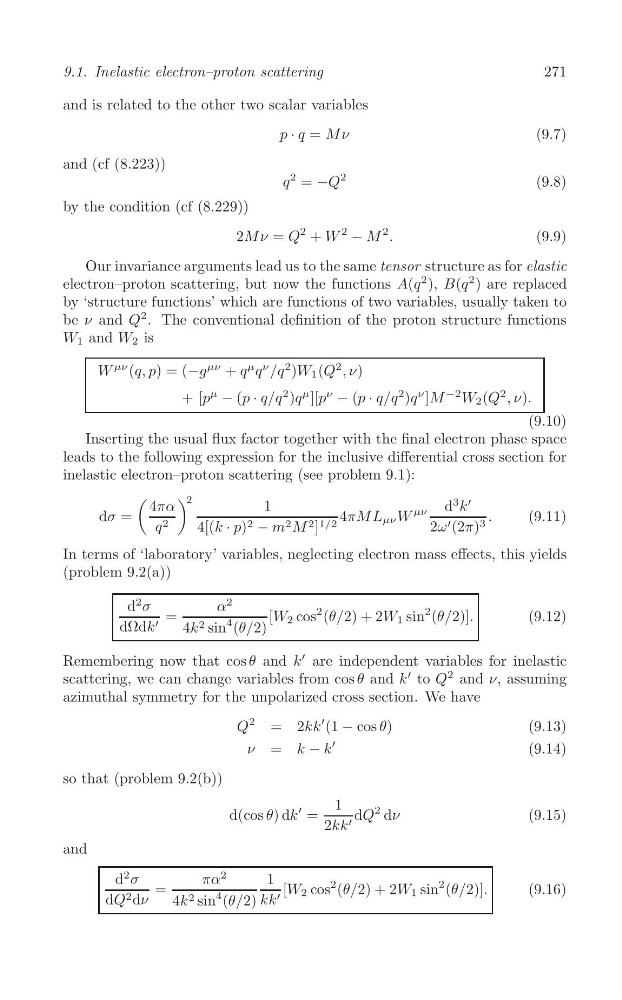
271
9.1. Inelastic electron–proton scattering
and is related to the other two scalar variables
p · q = M ν
(9.7)
and (cf (8.223))
q
2 = −Q
2
(9.8)
by the condition (cf (8.229))
2M ν = Q
2 + W
2
− M
2 .
(9.9)
Our invariance arguments lead us to the same tensor structure as for elastic
electron–proton scattering, but now the functions A(q
2 ), B(q
2 ) are replaced
by ‘structure functions’ which are functions of two variables, usually taken to
be ν and Q
2 . The conventional definition of the proton structure functions
W 1 and W 2 is
μν
μ
W
μν (q, p) = (−g + q q
ν /q
2 )W 1 (Q
2 , ν)
+ [p
μ
− (p · q/q
2 )q
μ ][p
ν
− (p · q/q
2 )q
ν ]M
−2 W 2 (Q
2 , ν).
(9.10)
Inserting the usual flux factor together with the final electron phase space
leads to the following expression for the inclusive differential cross section for
inelastic electron–proton scattering (see problem 9.1):
(
) 2
d
3 k
′
dσ =
4πM L μν W
μν
.
(9.11)
4πα
1
q 2
4[(k · p) 2 − m 2 M 2 ] 1/2
2ω ′ (2π) 3
In terms of ‘laboratory’ variables, neglecting electron mass effects, this yields
(problem 9.2(a))
d
2 σ
α
2
=
[W 2 cos
2 (θ/2) + 2W 1 sin
2 (θ/2)].
(9.12)
dΩdk ′
4k 2 sin
4 (θ/2)
Remembering now that cos θ and k
′ are independent variables for inelastic
scattering, we can change variables from cos θ and k
′ to Q
2 and ν, assuming
azimuthal symmetry for the unpolarized cross section. We have
Q
2 = 2kk
′ (1 − cos θ)
(9.13)
ν = k − k
′
(9.14)
so that (problem 9.2(b))
d(cos θ) dk
′ =
1 dQ
2 dν
(9.15)
2kk ′
and
d
2 σ
πα
2
1
=
[W 2 cos
2 (θ/2) + 2W 1 sin
2 (θ/2)].
(9.16)
dQ 2 dν
4k 2 sin
4 (θ/2) kk ′
9.1. Inelastic electron–proton scattering
and is related to the other two scalar variables
p · q = M ν
(9.7)
and (cf (8.223))
q
2 = −Q
2
(9.8)
by the condition (cf (8.229))
2M ν = Q
2 + W
2
− M
2 .
(9.9)
Our invariance arguments lead us to the same tensor structure as for elastic
electron–proton scattering, but now the functions A(q
2 ), B(q
2 ) are replaced
by ‘structure functions’ which are functions of two variables, usually taken to
be ν and Q
2 . The conventional definition of the proton structure functions
W 1 and W 2 is
μν
μ
W
μν (q, p) = (−g + q q
ν /q
2 )W 1 (Q
2 , ν)
+ [p
μ
− (p · q/q
2 )q
μ ][p
ν
− (p · q/q
2 )q
ν ]M
−2 W 2 (Q
2 , ν).
(9.10)
Inserting the usual flux factor together with the final electron phase space
leads to the following expression for the inclusive differential cross section for
inelastic electron–proton scattering (see problem 9.1):
(
) 2
d
3 k
′
dσ =
4πM L μν W
μν
.
(9.11)
4πα
1
q 2
4[(k · p) 2 − m 2 M 2 ] 1/2
2ω ′ (2π) 3
In terms of ‘laboratory’ variables, neglecting electron mass effects, this yields
(problem 9.2(a))
d
2 σ
α
2
=
[W 2 cos
2 (θ/2) + 2W 1 sin
2 (θ/2)].
(9.12)
dΩdk ′
4k 2 sin
4 (θ/2)
Remembering now that cos θ and k
′ are independent variables for inelastic
scattering, we can change variables from cos θ and k
′ to Q
2 and ν, assuming
azimuthal symmetry for the unpolarized cross section. We have
Q
2 = 2kk
′ (1 − cos θ)
(9.13)
ν = k − k
′
(9.14)
so that (problem 9.2(b))
d(cos θ) dk
′ =
1 dQ
2 dν
(9.15)
2kk ′
and
d
2 σ
πα
2
1
=
[W 2 cos
2 (θ/2) + 2W 1 sin
2 (θ/2)].
(9.16)
dQ 2 dν
4k 2 sin
4 (θ/2) kk ′