

270
9. Deep Inelastic Electron–Nucleon Scattering and the Parton Model
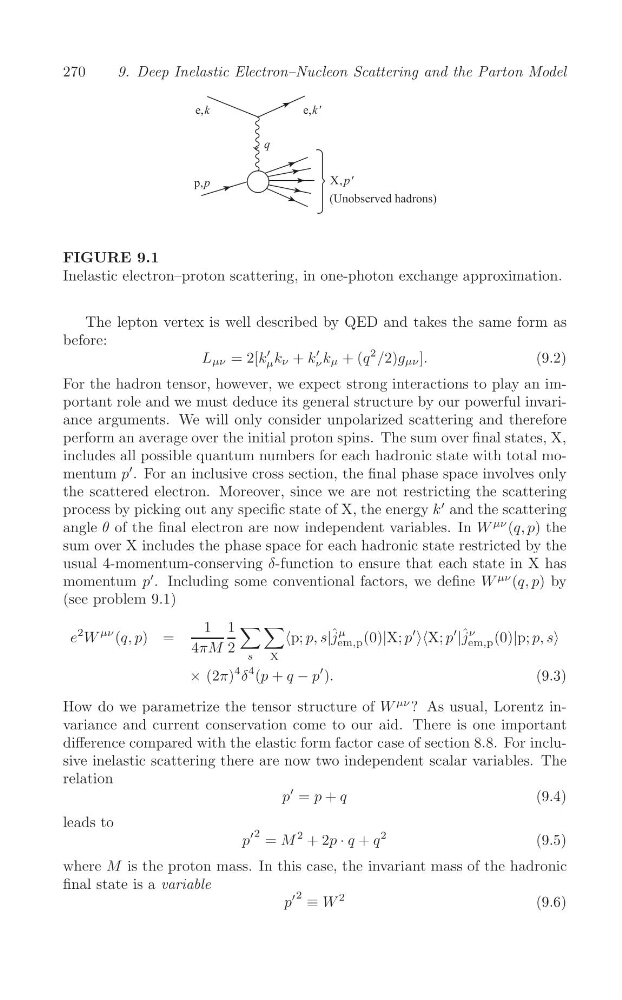
FIGURE 9.1
Inelastic electron–proton scattering, in one-photon exchange approximation.
The lepton vertex is well described by QED and takes the same form as
before:
L μν = 2[k μ
′ k ν + k ν
′ k μ + (q
2 /2)g μν ].
(9.2)
For the hadron tensor, however, we expect strong interactions to play an important role and we must deduce its general structure by our powerful invariance arguments. We will only consider unpolarized scattering and therefore
perform an average over the initial proton spins. The sum over final states, X,
includes all possible quantum numbers for each hadronic state with total momentum p
′ . For an inclusive cross section, the final phase space involves only
the scattered electron. Moreover, since we are not restricting the scattering
process by picking out any specific state of X, the energy k
′ and the scattering
angle θ of the final electron are now independent variables. In W
μν (q, p) the
sum over X includes the phase space for each hadronic state restricted by the
usual 4-momentum-conserving δ-function to ensure that each state in X has
momentum p
′ . Including some conventional factors, we define W
μν (q, p) by
(see problem 9.1)
∑ ∑
1 1
′
e
2 W
μν (q, p) =
(0)|X; p >
| ˆ j
ν
(0)|p; p, s>
em,p
em,p
4πM 2 s X
× (2π)
4 δ
4 (p + q − p
′ ).
(9.3)
How do we parametrize the tensor structure of W
μν ? As usual, Lorentz invariance and current conservation come to our aid. There is one important
difference compared with the elastic form factor case of section 8.8. For inclusive inelastic scattering there are now two independent scalar variables. The
relation
′
p = p + q
(9.4)
leads to
p
′ 2 = M
2 + 2p · q + q
2
(9.5)
where M is the proton mass. In this case, the invariant mass of the hadronic
final state is a variable
′ 2
p ≡ W
2
(9.6)
9. Deep Inelastic Electron–Nucleon Scattering and the Parton Model
FIGURE 9.1
Inelastic electron–proton scattering, in one-photon exchange approximation.
The lepton vertex is well described by QED and takes the same form as
before:
L μν = 2[k μ
′ k ν + k ν
′ k μ + (q
2 /2)g μν ].
(9.2)
For the hadron tensor, however, we expect strong interactions to play an important role and we must deduce its general structure by our powerful invariance arguments. We will only consider unpolarized scattering and therefore
perform an average over the initial proton spins. The sum over final states, X,
includes all possible quantum numbers for each hadronic state with total momentum p
′ . For an inclusive cross section, the final phase space involves only
the scattered electron. Moreover, since we are not restricting the scattering
process by picking out any specific state of X, the energy k
′ and the scattering
angle θ of the final electron are now independent variables. In W
μν (q, p) the
sum over X includes the phase space for each hadronic state restricted by the
usual 4-momentum-conserving δ-function to ensure that each state in X has
momentum p
′ . Including some conventional factors, we define W
μν (q, p) by
(see problem 9.1)
∑ ∑
1 1
′
e
2 W
μν (q, p) =
(0)|X; p >
| ˆ j
ν
(0)|p; p, s>
em,p
em,p
4πM 2 s X
× (2π)
4 δ
4 (p + q − p
′ ).
(9.3)
How do we parametrize the tensor structure of W
μν ? As usual, Lorentz invariance and current conservation come to our aid. There is one important
difference compared with the elastic form factor case of section 8.8. For inclusive inelastic scattering there are now two independent scalar variables. The
relation
′
p = p + q
(9.4)
leads to
p
′ 2 = M
2 + 2p · q + q
2
(9.5)
where M is the proton mass. In this case, the invariant mass of the hadronic
final state is a variable
′ 2
p ≡ W
2
(9.6)