

259
8.8. Electron–proton elastic scattering and nucleon form factors
8.8.2 Current conservation
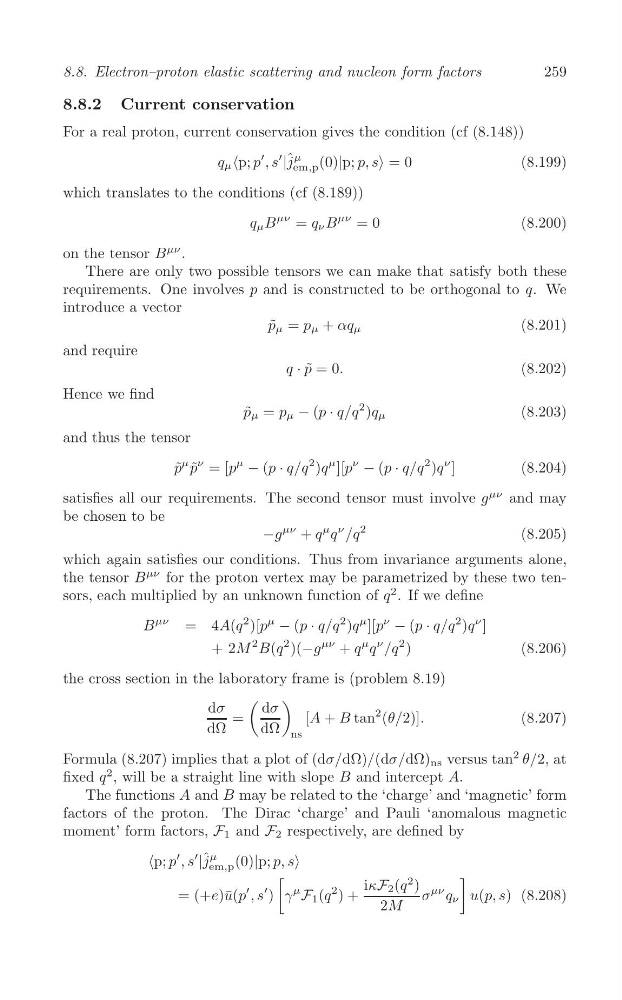
For a real proton, current conservation gives the condition (cf (8.148))
′
q μ
| ˆ j
μ
(0)|p; p, s> = 0
(8.199)
em,p
which translates to the conditions (cf (8.189))
q μ B
μν
q ν B
μν
=
= 0
(8.200)
on the tensor B
μν .
There are only two possible tensors we can make that satisfy both these
requirements. One involves p and is constructed to be orthogonal to q. We
introduce a vector
p ˜ μ = p μ + αq μ
(8.201)
and require
q · p ˜ = 0.
(8.202)
Hence we find
p ˜ μ = p μ − (p · q/q
2 )q μ
(8.203)
and thus the tensor
p ˜
μ p ˜
ν = [p
μ
− (p · q/q
2 )q
μ ][p
ν
− (p · q/q
2 )q
ν ]
(8.204)
μν
satisfies all our requirements. The second tensor must involve g and may
be chosen to be
μν
μ
−g + q q
ν /q
2
(8.205)
which again satisfies our conditions. Thus from invariance arguments alone,
the tensor B
μν for the proton vertex may be parametrized by these two tensors, each multiplied by an unknown function of q
2 . If we define
B
μν
ν ]
= 4A(q
2 )[p
μ
− (p · q/q
2 )q
μ ][p
ν
− (p · q/q
2 )q
μν
μ
+ 2M
2 B(q
2 )(−g + q q
ν /q
2 )
(8.206)
the cross section in the laboratory frame is (problem 8.19)
(
)
dσ
dσ
=
[A + B tan
2 (θ/2)].
(8.207)
dΩ
dΩ ns
Formula (8.207) implies that a plot of (dσ/dΩ)/(dσ/dΩ) ns versus tan
2 θ/2, at
fixed q
2 , will be a straight line with slope B and intercept A.
The functions A and B may be related to the ‘charge’ and ‘magnetic’ form
factors of the proton. The Dirac ‘charge’ and Pauli ‘anomalous magnetic
moment’ form factors, F 1 and F 2 respectively, are defined by
′
| ˆ j
μ
(0)|p; p, s>
em,p
[
]
iκF 2 (q
2 )
′
σ
μν
= (+e)¯ u(p , s
′ ) γ
μ
F 1 (q
2 ) +
q ν u(p, s) (8.208)
2M
8.8. Electron–proton elastic scattering and nucleon form factors
8.8.2 Current conservation
For a real proton, current conservation gives the condition (cf (8.148))
′
q μ
| ˆ j
μ
(0)|p; p, s> = 0
(8.199)
em,p
which translates to the conditions (cf (8.189))
q μ B
μν
q ν B
μν
=
= 0
(8.200)
on the tensor B
μν .
There are only two possible tensors we can make that satisfy both these
requirements. One involves p and is constructed to be orthogonal to q. We
introduce a vector
p ˜ μ = p μ + αq μ
(8.201)
and require
q · p ˜ = 0.
(8.202)
Hence we find
p ˜ μ = p μ − (p · q/q
2 )q μ
(8.203)
and thus the tensor
p ˜
μ p ˜
ν = [p
μ
− (p · q/q
2 )q
μ ][p
ν
− (p · q/q
2 )q
ν ]
(8.204)
μν
satisfies all our requirements. The second tensor must involve g and may
be chosen to be
μν
μ
−g + q q
ν /q
2
(8.205)
which again satisfies our conditions. Thus from invariance arguments alone,
the tensor B
μν for the proton vertex may be parametrized by these two tensors, each multiplied by an unknown function of q
2 . If we define
B
μν
ν ]
= 4A(q
2 )[p
μ
− (p · q/q
2 )q
μ ][p
ν
− (p · q/q
2 )q
μν
μ
+ 2M
2 B(q
2 )(−g + q q
ν /q
2 )
(8.206)
the cross section in the laboratory frame is (problem 8.19)
(
)
dσ
dσ
=
[A + B tan
2 (θ/2)].
(8.207)
dΩ
dΩ ns
Formula (8.207) implies that a plot of (dσ/dΩ)/(dσ/dΩ) ns versus tan
2 θ/2, at
fixed q
2 , will be a straight line with slope B and intercept A.
The functions A and B may be related to the ‘charge’ and ‘magnetic’ form
factors of the proton. The Dirac ‘charge’ and Pauli ‘anomalous magnetic
moment’ form factors, F 1 and F 2 respectively, are defined by
′
| ˆ j
μ
(0)|p; p, s>
em,p
[
]
iκF 2 (q
2 )
′
σ
μν
= (+e)¯ u(p , s
′ ) γ
μ
F 1 (q
2 ) +
q ν u(p, s) (8.208)
2M