

258
8. Elementary Processes in Scalar and Spinor Electrodynamics
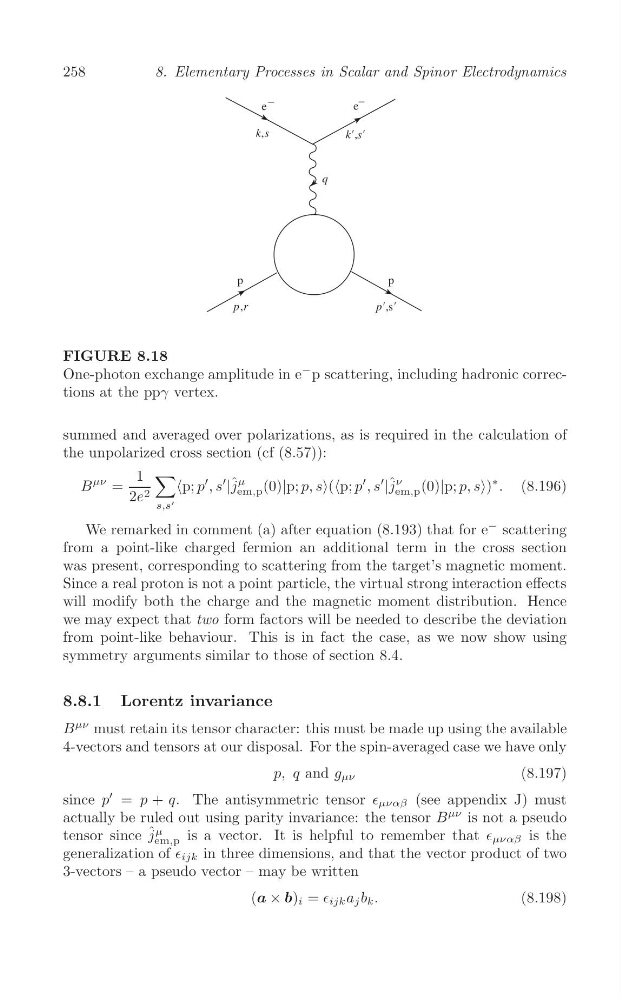
FIGURE 8.18
One-photon exchange amplitude in e
− p scattering, including hadronic corrections at the ppγ vertex.
summed and averaged over polarizations, as is required in the calculation of
the unpolarized cross section (cf (8.57)):
∑
1
B
μν
′
′
=
| ˆ j
μ
(0)|p; p, s>(
| ˆ j
ν
(0)|p; p, s>)
∗ . (8.196)
em,p
em,p
2e 2
s,s '
We remarked in comment (a) after equation (8.193) that for e
− scattering
from a point-like charged fermion an additional term in the cross section
was present, corresponding to scattering from the target’s magnetic moment.
Since a real proton is not a point particle, the virtual strong interaction effects
will modify both the charge and the magnetic moment distribution. Hence
we may expect that two form factors will be needed to describe the deviation
from point-like behaviour. This is in fact the case, as we now show using
symmetry arguments similar to those of section 8.4.
8.8.1 Lorentz invariance
B
μν must retain its tensor character: this must be made up using the available
4-vectors and tensors at our disposal. For the spin-averaged case we have only
p, q and g μν
(8.197)
′
since p = p + q. The antisymmetric tensor ∈ μναβ (see appendix J) must
actually be ruled out using parity invariance: the tensor B
μν is not a pseudo
tensor since ˆ j
μ
is a vector. It is helpful to remember that ∈ μναβ is the
em,p
generalization of ∈ ijk in three dimensions, and that the vector product of two
3-vectors – a pseudo vector – may be written
(a × b) i = ∈ ijk a j b k .
(8.198)
8. Elementary Processes in Scalar and Spinor Electrodynamics
FIGURE 8.18
One-photon exchange amplitude in e
− p scattering, including hadronic corrections at the ppγ vertex.
summed and averaged over polarizations, as is required in the calculation of
the unpolarized cross section (cf (8.57)):
∑
1
B
μν
′
′
=
| ˆ j
μ
(0)|p; p, s>(
| ˆ j
ν
(0)|p; p, s>)
∗ . (8.196)
em,p
em,p
2e 2
s,s '
We remarked in comment (a) after equation (8.193) that for e
− scattering
from a point-like charged fermion an additional term in the cross section
was present, corresponding to scattering from the target’s magnetic moment.
Since a real proton is not a point particle, the virtual strong interaction effects
will modify both the charge and the magnetic moment distribution. Hence
we may expect that two form factors will be needed to describe the deviation
from point-like behaviour. This is in fact the case, as we now show using
symmetry arguments similar to those of section 8.4.
8.8.1 Lorentz invariance
B
μν must retain its tensor character: this must be made up using the available
4-vectors and tensors at our disposal. For the spin-averaged case we have only
p, q and g μν
(8.197)
′
since p = p + q. The antisymmetric tensor ∈ μναβ (see appendix J) must
actually be ruled out using parity invariance: the tensor B
μν is not a pseudo
tensor since ˆ j
μ
is a vector. It is helpful to remember that ∈ μναβ is the
em,p
generalization of ∈ ijk in three dimensions, and that the vector product of two
3-vectors – a pseudo vector – may be written
(a × b) i = ∈ ijk a j b k .
(8.198)