

227
8.2. Coulomb scattering of charged spin1 particles
2
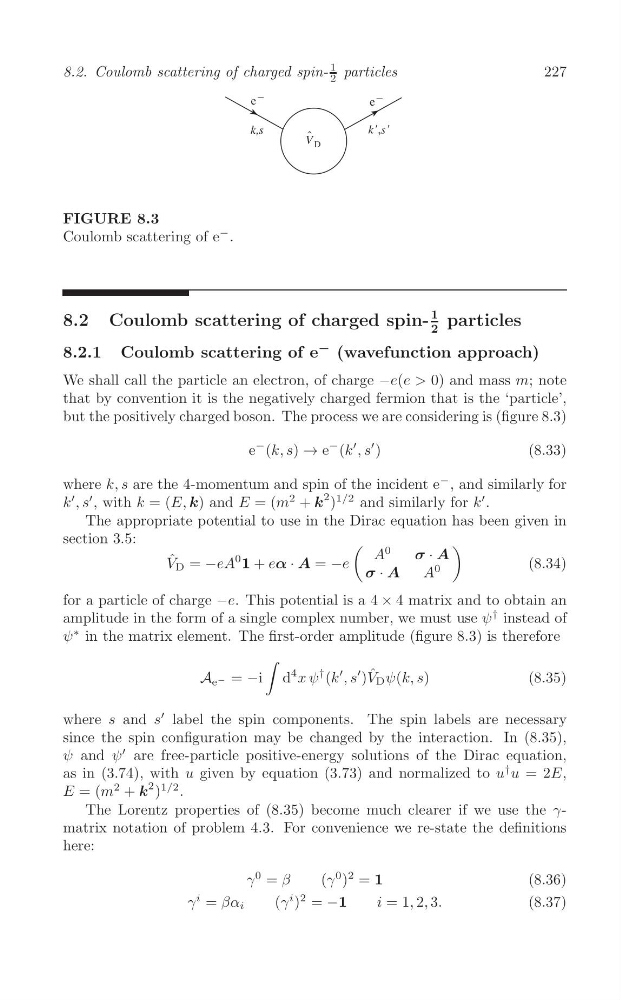
FIGURE 8.3
Coulomb scattering of e
− .
8.2 Coulomb scattering of charged spin1
2
particles
8.2.1 Coulomb scattering of e − (wavefunction approach)
We shall call the particle an electron, of charge −e(e > 0) and mass m; note
that by convention it is the negatively charged fermion that is the ‘particle’,
but the positively charged boson. The process we are considering is (figure 8.3)
e
− (k, s) → e
− (k
′ , s
′ )
(8.33)
where k, s are the 4-momentum and spin of the incident e
− , and similarly for
2
)
1/2
k
′ , s
′ , with k = (E, k) and E = (m + k
2
and similarly for k
′ .
The appropriate potential to use in the Dirac equation has been given in
section 3.5:
(
)
A
0
σ · A
ˆ
V D = −eA
0 1 + eα · A = −e
(8.34)
σ · A
A
0
for a particle of charge −e. This potential is a 4 × 4 matrix and to obtain an
amplitude in the form of a single complex number, we must use ψ
† instead of
ψ
∗ in the matrix element. The first-order amplitude (figure 8.3) is therefore
∫
A e − = −i d
4 x ψ
† (k
′ , s
′ )V ˆ D ψ(k, s)
(8.35)
′
where s and s label the spin components. The spin labels are necessary
since the spin configuration may be changed by the interaction. In (8.35),
ψ and ψ
′ are free-particle positive-energy solutions of the Dirac equation,
as in (3.74), with u given by equation (3.73) and normalized to u
† u = 2E,
2
)
1/2
E = (m + k
2
.
The Lorentz properties of (8.35) become much clearer if we use the γmatrix notation of problem 4.3. For convenience we re-state the definitions
here:
γ
0 = β
(γ
0 )
2 = 1
(8.36)
γ
i = βα i
(γ
i )
2 = −1
i = 1, 2, 3.
(8.37)
8.2. Coulomb scattering of charged spin1 particles
2
FIGURE 8.3
Coulomb scattering of e
− .
8.2 Coulomb scattering of charged spin1
2
particles
8.2.1 Coulomb scattering of e − (wavefunction approach)
We shall call the particle an electron, of charge −e(e > 0) and mass m; note
that by convention it is the negatively charged fermion that is the ‘particle’,
but the positively charged boson. The process we are considering is (figure 8.3)
e
− (k, s) → e
− (k
′ , s
′ )
(8.33)
where k, s are the 4-momentum and spin of the incident e
− , and similarly for
2
)
1/2
k
′ , s
′ , with k = (E, k) and E = (m + k
2
and similarly for k
′ .
The appropriate potential to use in the Dirac equation has been given in
section 3.5:
(
)
A
0
σ · A
ˆ
V D = −eA
0 1 + eα · A = −e
(8.34)
σ · A
A
0
for a particle of charge −e. This potential is a 4 × 4 matrix and to obtain an
amplitude in the form of a single complex number, we must use ψ
† instead of
ψ
∗ in the matrix element. The first-order amplitude (figure 8.3) is therefore
∫
A e − = −i d
4 x ψ
† (k
′ , s
′ )V ˆ D ψ(k, s)
(8.35)
′
where s and s label the spin components. The spin labels are necessary
since the spin configuration may be changed by the interaction. In (8.35),
ψ and ψ
′ are free-particle positive-energy solutions of the Dirac equation,
as in (3.74), with u given by equation (3.73) and normalized to u
† u = 2E,
2
)
1/2
E = (m + k
2
.
The Lorentz properties of (8.35) become much clearer if we use the γmatrix notation of problem 4.3. For convenience we re-state the definitions
here:
γ
0 = β
(γ
0 )
2 = 1
(8.36)
γ
i = βα i
(γ
i )
2 = −1
i = 1, 2, 3.
(8.37)