

226
8. Elementary Processes in Scalar and Spinor Electrodynamics
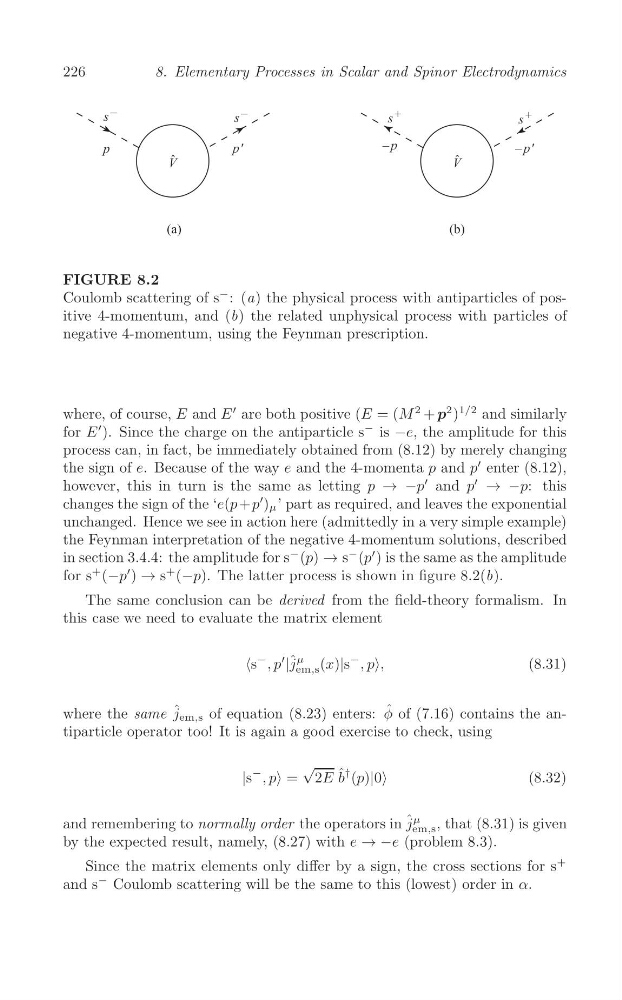
FIGURE 8.2
Coulomb scattering of s
− : (a) the physical process with antiparticles of positive 4-momentum, and (b) the related unphysical process with particles of
negative 4-momentum, using the Feynman prescription.
′
where, of course, E and E are both positive (E = (M
2 + p
2 )
1/2 and similarly
for E
′ ). Since the charge on the antiparticle s
− is −e, the amplitude for this
process can, in fact, be immediately obtained from (8.12) by merely changing
′
the sign of e. Because of the way e and the 4-momenta p and p enter (8.12),
′
′
however, this in turn is the same as letting p → −p and p → −p: this
changes the sign of the ‘e(p+ p
′ ) μ ’ part as required, and leaves the exponential
unchanged. Hence we see in action here (admittedly in a very simple example)
the Feynman interpretation of the negative 4-momentum solutions, described
in section 3.4.4: the amplitude for s
− (p) → s
− (p
′ ) is the same as the amplitude
for s
+ (−p
′ ) → s
+ (−p). The latter process is shown in figure 8.2(b).
The same conclusion can be derived from the field-theory formalism. In
this case we need to evaluate the matrix element
−
−
| ˆ j
μ
(x)|s , p>,
(8.31)
em,s
where the same ˆ j em,s of equation (8.23) enters: φ ˆ of (7.16) contains the antiparticle operator too! It is again a good exercise to check, using
√
−
|s , p> = 2E ˆ b
† (p)|0>
(8.32)
and remembering to normally order the operators in ˆ j
μ
, that (8.31) is given
em,s
by the expected result, namely, (8.27) with e → −e (problem 8.3).
Since the matrix elements only differ by a sign, the cross sections for s
+
and s
− Coulomb scattering will be the same to this (lowest) order in α.
8. Elementary Processes in Scalar and Spinor Electrodynamics
FIGURE 8.2
Coulomb scattering of s
− : (a) the physical process with antiparticles of positive 4-momentum, and (b) the related unphysical process with particles of
negative 4-momentum, using the Feynman prescription.
′
where, of course, E and E are both positive (E = (M
2 + p
2 )
1/2 and similarly
for E
′ ). Since the charge on the antiparticle s
− is −e, the amplitude for this
process can, in fact, be immediately obtained from (8.12) by merely changing
′
the sign of e. Because of the way e and the 4-momenta p and p enter (8.12),
′
′
however, this in turn is the same as letting p → −p and p → −p: this
changes the sign of the ‘e(p+ p
′ ) μ ’ part as required, and leaves the exponential
unchanged. Hence we see in action here (admittedly in a very simple example)
the Feynman interpretation of the negative 4-momentum solutions, described
in section 3.4.4: the amplitude for s
− (p) → s
− (p
′ ) is the same as the amplitude
for s
+ (−p
′ ) → s
+ (−p). The latter process is shown in figure 8.2(b).
The same conclusion can be derived from the field-theory formalism. In
this case we need to evaluate the matrix element
−
−
| ˆ j
μ
(x)|s , p>,
(8.31)
em,s
where the same ˆ j em,s of equation (8.23) enters: φ ˆ of (7.16) contains the antiparticle operator too! It is again a good exercise to check, using
√
−
|s , p> = 2E ˆ b
† (p)|0>
(8.32)
and remembering to normally order the operators in ˆ j
μ
, that (8.31) is given
em,s
by the expected result, namely, (8.27) with e → −e (problem 8.3).
Since the matrix elements only differ by a sign, the cross sections for s
+
and s
− Coulomb scattering will be the same to this (lowest) order in α.