

212
7. Quantum Field Theory III
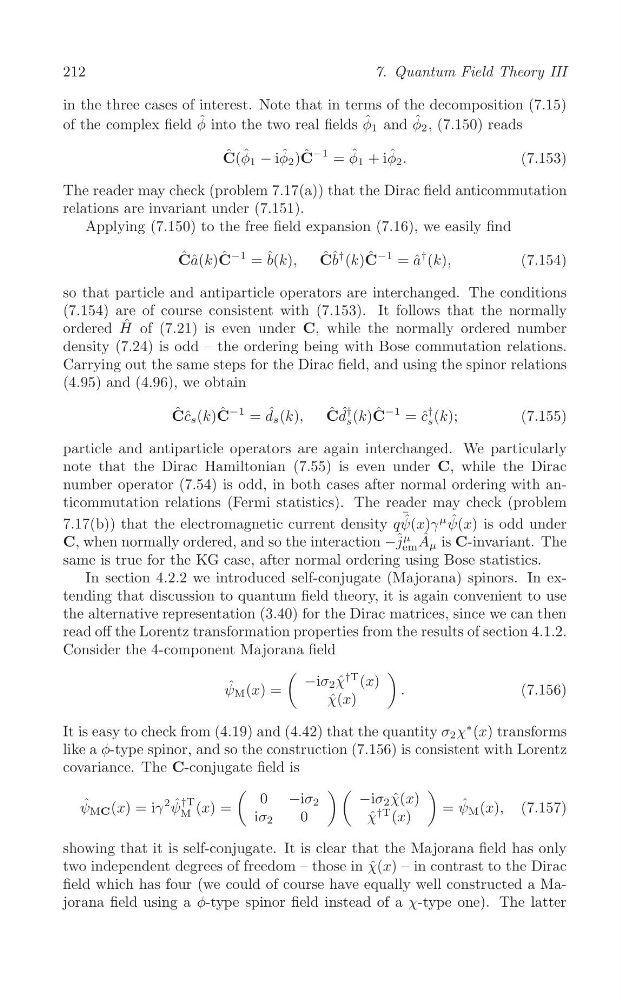
in the three cases of interest. Note that in terms of the decomposition (7.15)
of the complex field φ ˆ into the two real fields φ ˆ 1 and φ ˆ 2 , (7.150) reads
C
−1
C ˆ (φ ˆ 1 − iφ ˆ 2 ) ˆ
= φ ˆ 1 + iφ ˆ 2 .
(7.153)
The reader may check (problem 7.17(a)) that the Dirac field anticommutation
relations are invariant under (7.151).
Applying (7.150) to the free field expansion (7.16), we easily find
C ˆ a ˆ(k)C ˆ −1 = ˆ b(k),
C ˆ ˆ b
† (k)C ˆ −1 = ˆ
a
† (k),
(7.154)
so that particle and antiparticle operators are interchanged. The conditions
(7.154) are of course consistent with (7.153). It follows that the normally
ordered H ˆ of (7.21) is even under C, while the normally ordered number
density (7.24) is odd – the ordering being with Bose commutation relations.
Carrying out the same steps for the Dirac field, and using the spinor relations
(4.95) and (4.96), we obtain
ˆ
C
−1
ˆ
ˆ
†
Cc ˆ s (k) ˆ
= d s (k),
Cd ˆ † (k)C ˆ −1 = ˆ
c (k);
(7.155)
s
s
particle and antiparticle operators are again interchanged. We particularly
note that the Dirac Hamiltonian (7.55) is even under C, while the Dirac
number operator (7.54) is odd, in both cases after normal ordering with anticommutation relations (Fermi statistics). The reader may check (problem
¯
7.17(b)) that the electromagnetic current density qψ ˆ (x)γ
μ ψ ˆ (x) is odd under
C, when normally ordered, and so the interaction − ˆ j
μ A ˆ μ is C-invariant. The
em
same is true for the KG case, after normal ordering using Bose statistics.
In section 4.2.2 we introduced self-conjugate (Majorana) spinors. In extending that discussion to quantum field theory, it is again convenient to use
the alternative representation (3.40) for the Dirac matrices, since we can then
read off the Lorentz transformation properties from the results of section 4.1.2.
Consider the 4-component Majorana field
(
)
ˆ
−iσ 2 χ ˆ
†T (x)
ψ M (x) =
.
(7.156)
χ ˆ(x)
It is easy to check from (4.19) and (4.42) that the quantity σ 2 χ
∗ (x) transforms
like a φ-type spinor, and so the construction (7.156) is consistent with Lorentz
covariance. The C-conjugate field is
(
) (
)
†T
0 −iσ 2
−iσ 2 χ ˆ(x)
ψ ˆ MC (x) = iγ
2 ψ ˆ (x) =
= ψ ˆ M (x), (7.157)
M
iσ 2
0
χ ˆ
†T (x)
showing that it is self-conjugate. It is clear that the Majorana field has only
two independent degrees of freedom – those in ˆ
χ(x) – in contrast to the Dirac
field which has four (we could of course have equally well constructed a Majorana field using a φ-type spinor field instead of a χ-type one). The latter
7. Quantum Field Theory III
in the three cases of interest. Note that in terms of the decomposition (7.15)
of the complex field φ ˆ into the two real fields φ ˆ 1 and φ ˆ 2 , (7.150) reads
C
−1
C ˆ (φ ˆ 1 − iφ ˆ 2 ) ˆ
= φ ˆ 1 + iφ ˆ 2 .
(7.153)
The reader may check (problem 7.17(a)) that the Dirac field anticommutation
relations are invariant under (7.151).
Applying (7.150) to the free field expansion (7.16), we easily find
C ˆ a ˆ(k)C ˆ −1 = ˆ b(k),
C ˆ ˆ b
† (k)C ˆ −1 = ˆ
a
† (k),
(7.154)
so that particle and antiparticle operators are interchanged. The conditions
(7.154) are of course consistent with (7.153). It follows that the normally
ordered H ˆ of (7.21) is even under C, while the normally ordered number
density (7.24) is odd – the ordering being with Bose commutation relations.
Carrying out the same steps for the Dirac field, and using the spinor relations
(4.95) and (4.96), we obtain
ˆ
C
−1
ˆ
ˆ
†
Cc ˆ s (k) ˆ
= d s (k),
Cd ˆ † (k)C ˆ −1 = ˆ
c (k);
(7.155)
s
s
particle and antiparticle operators are again interchanged. We particularly
note that the Dirac Hamiltonian (7.55) is even under C, while the Dirac
number operator (7.54) is odd, in both cases after normal ordering with anticommutation relations (Fermi statistics). The reader may check (problem
¯
7.17(b)) that the electromagnetic current density qψ ˆ (x)γ
μ ψ ˆ (x) is odd under
C, when normally ordered, and so the interaction − ˆ j
μ A ˆ μ is C-invariant. The
em
same is true for the KG case, after normal ordering using Bose statistics.
In section 4.2.2 we introduced self-conjugate (Majorana) spinors. In extending that discussion to quantum field theory, it is again convenient to use
the alternative representation (3.40) for the Dirac matrices, since we can then
read off the Lorentz transformation properties from the results of section 4.1.2.
Consider the 4-component Majorana field
(
)
ˆ
−iσ 2 χ ˆ
†T (x)
ψ M (x) =
.
(7.156)
χ ˆ(x)
It is easy to check from (4.19) and (4.42) that the quantity σ 2 χ
∗ (x) transforms
like a φ-type spinor, and so the construction (7.156) is consistent with Lorentz
covariance. The C-conjugate field is
(
) (
)
†T
0 −iσ 2
−iσ 2 χ ˆ(x)
ψ ˆ MC (x) = iγ
2 ψ ˆ (x) =
= ψ ˆ M (x), (7.157)
M
iσ 2
0
χ ˆ
†T (x)
showing that it is self-conjugate. It is clear that the Majorana field has only
two independent degrees of freedom – those in ˆ
χ(x) – in contrast to the Dirac
field which has four (we could of course have equally well constructed a Majorana field using a φ-type spinor field instead of a χ-type one). The latter