

211
7.5. P, C and T in quantum field theory
for the electromagnetic fields. In (7.144) - (7.146) a simple choice of phase
factor has been made.
There is however one new feature in the quantum field case, which is that
the commutation or anticommutation relations must be left unchanged by
the transformation, if it is to be an invariance of the theory. Evidently for P
the only non-trivial case is the Dirac field, and it is easy to check that the
anticommutation relations (7.44) and (7.45) are invariant under (7.145).
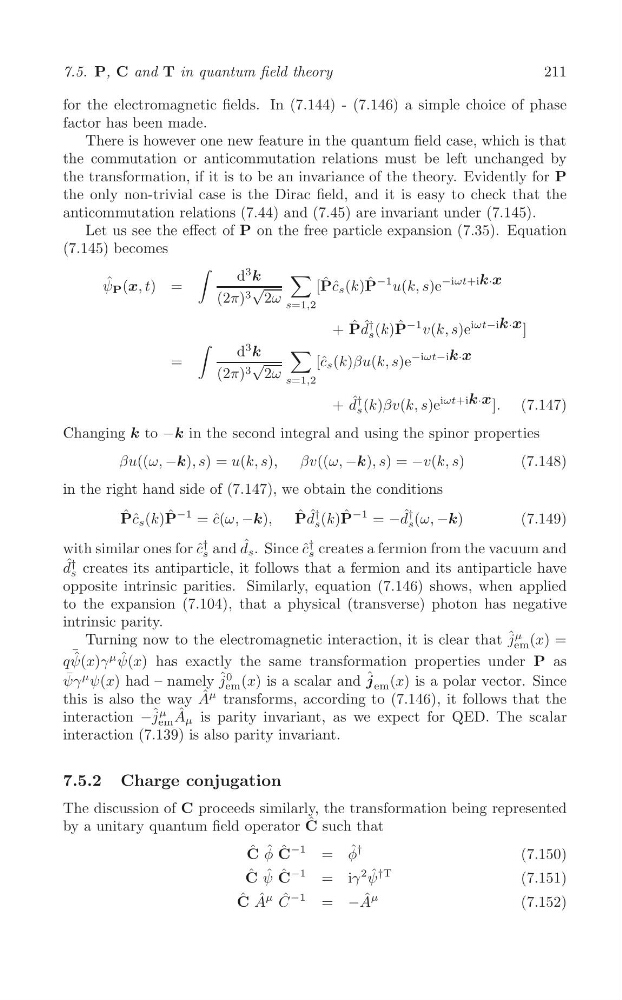
Let us see the effect of P on the free particle expansion (7.35). Equation
(7.145) becomes
∫
∑
ˆ
√
[ ˆ (k)P ˆ −1
(2π) 3 2ω
ψ P (x, t) =
d
3
k
Pc ˆ s
u(k, s)e
−iωt+ik·x
s=1,2
+ P ˆ d ˆ † (k)P ˆ −1 v(k, s)e
iωt−ik·x ]
s
∫
d
3
k
∑
=
√
[ˆ c s (k)βu(k, s)e
−iωt−ik·x
(2π) 3 2ω s=1,2
+ d ˆ † (k)βv(k, s)e
iωt+ik·x ]. (7.147)
s
Changing k to −k in the second integral and using the spinor properties
βu((ω, −k), s) = u(k, s),
βv((ω, −k), s) = −v(k, s)
(7.148)
in the right hand side of (7.147), we obtain the conditions
P
−1
d
†
P ˆ c ˆ s (k)P ˆ −1 = ˆ
c(ω, −k), P ˆ d ˆ
s
† (k) ˆ = − ˆ
s (ω, −k)
(7.149)
†
†
with similar ones for c ˆ and d ˆ s . Since ˆ
c creates a fermion from the vacuum and
s
s
d ˆ† creates its antiparticle, it follows that a fermion and its antiparticle have
s
opposite intrinsic parities. Similarly, equation (7.146) shows, when applied
to the expansion (7.104), that a physical (transverse) photon has negative
intrinsic parity.
Turning now to the electromagnetic interaction, it is clear that ˆ j
μ (x) =
em
¯ ˆ
qψ(x)γ
μ ψ ˆ (x) has exactly the same transformation properties under P as
¯
ψγ
μ ψ(x) had – namely ˆ j
0 (x) is a scalar and j ˆ (x) is a polar vector. Since
em
em
this is also the way A ˆ μ transforms, according to (7.146), it follows that the
j
μ ˆ
interaction − ˆ em A μ is parity invariant, as we expect for QED. The scalar
interaction (7.139) is also parity invariant.
7.5.2 Charge conjugation
The discussion of C proceeds similarly, the transformation being represented
by a unitary quantum field operator C ˆ such that
C ˆ φ ˆ C ˆ −1 = φ ˆ †
(7.150)
C
−1
ψ
†T
C ˆ ψ ˆ ˆ
= iγ
2 ˆ
(7.151)
C ˆ A ˆ μ C ˆ −1 = −A ˆ μ
(7.152)
7.5. P, C and T in quantum field theory
for the electromagnetic fields. In (7.144) - (7.146) a simple choice of phase
factor has been made.
There is however one new feature in the quantum field case, which is that
the commutation or anticommutation relations must be left unchanged by
the transformation, if it is to be an invariance of the theory. Evidently for P
the only non-trivial case is the Dirac field, and it is easy to check that the
anticommutation relations (7.44) and (7.45) are invariant under (7.145).
Let us see the effect of P on the free particle expansion (7.35). Equation
(7.145) becomes
∫
∑
ˆ
√
[ ˆ (k)P ˆ −1
(2π) 3 2ω
ψ P (x, t) =
d
3
k
Pc ˆ s
u(k, s)e
−iωt+ik·x
s=1,2
+ P ˆ d ˆ † (k)P ˆ −1 v(k, s)e
iωt−ik·x ]
s
∫
d
3
k
∑
=
√
[ˆ c s (k)βu(k, s)e
−iωt−ik·x
(2π) 3 2ω s=1,2
+ d ˆ † (k)βv(k, s)e
iωt+ik·x ]. (7.147)
s
Changing k to −k in the second integral and using the spinor properties
βu((ω, −k), s) = u(k, s),
βv((ω, −k), s) = −v(k, s)
(7.148)
in the right hand side of (7.147), we obtain the conditions
P
−1
d
†
P ˆ c ˆ s (k)P ˆ −1 = ˆ
c(ω, −k), P ˆ d ˆ
s
† (k) ˆ = − ˆ
s (ω, −k)
(7.149)
†
†
with similar ones for c ˆ and d ˆ s . Since ˆ
c creates a fermion from the vacuum and
s
s
d ˆ† creates its antiparticle, it follows that a fermion and its antiparticle have
s
opposite intrinsic parities. Similarly, equation (7.146) shows, when applied
to the expansion (7.104), that a physical (transverse) photon has negative
intrinsic parity.
Turning now to the electromagnetic interaction, it is clear that ˆ j
μ (x) =
em
¯ ˆ
qψ(x)γ
μ ψ ˆ (x) has exactly the same transformation properties under P as
¯
ψγ
μ ψ(x) had – namely ˆ j
0 (x) is a scalar and j ˆ (x) is a polar vector. Since
em
em
this is also the way A ˆ μ transforms, according to (7.146), it follows that the
j
μ ˆ
interaction − ˆ em A μ is parity invariant, as we expect for QED. The scalar
interaction (7.139) is also parity invariant.
7.5.2 Charge conjugation
The discussion of C proceeds similarly, the transformation being represented
by a unitary quantum field operator C ˆ such that
C ˆ φ ˆ C ˆ −1 = φ ˆ †
(7.150)
C
−1
ψ
†T
C ˆ ψ ˆ ˆ
= iγ
2 ˆ
(7.151)
C ˆ A ˆ μ C ˆ −1 = −A ˆ μ
(7.152)