

208
7. Quantum Field Theory III
e -
e -
e +
e +
γ
γ
e
+
e
+
γ
γ
e
-
e -
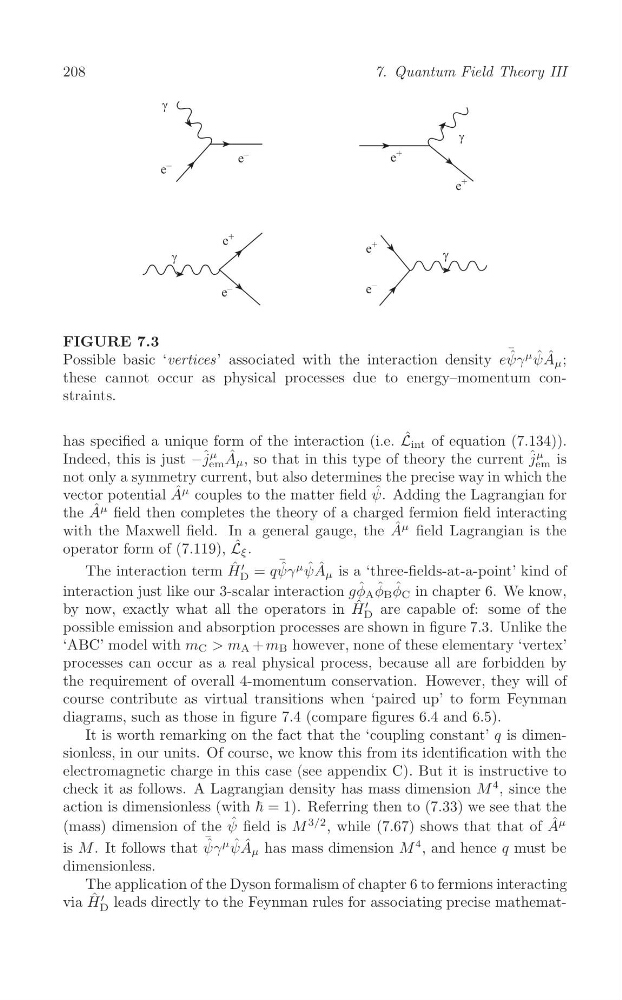
FIGURE 7.3
¯ ˆ ψ ˆ
Possible basic ‘vertices’ associated with the interaction density eψγ
μ ˆ A μ ;
these cannot occur as physical processes due to energy–momentum constraints.
has specified a unique form of the interaction (i.e. L ˆ int of equation (7.134)).
Indeed, this is just − ˆ j
μ A ˆ μ , so that in this type of theory the current ˆ j
μ is
em
em
not only a symmetry current, but also determines the precise way in which the
vector potential A ˆ μ couples to the matter field ψ ˆ . Adding the Lagrangian for
the A ˆ μ field then completes the theory of a charged fermion field interacting
with the Maxwell field. In a general gauge, the A ˆ μ field Lagrangian is the
operator form of (7.119), L ˆ ξ .
¯
H
′
ˆ ψ ˆ
The interaction term ˆ = qψγ
μ ˆ A μ is a ‘three-fields-at-a-point’ kind of
D
ˆ ˆ ˆ
interaction just like our 3-scalar interaction gφ A φ B φ C in chapter 6. We know,
by now, exactly what all the operators in H ˆ ′ are capable of: some of the
D
possible emission and absorption processes are shown in figure 7.3. Unlike the
‘ABC’ model with m C > m A + m B however, none of these elementary ‘vertex’
processes can occur as a real physical process, because all are forbidden by
the requirement of overall 4-momentum conservation. However, they will of
course contribute as virtual transitions when ‘paired up’ to form Feynman
diagrams, such as those in figure 7.4 (compare figures 6.4 and 6.5).
It is worth remarking on the fact that the ‘coupling constant’ q is dimensionless, in our units. Of course, we know this from its identification with the
electromagnetic charge in this case (see appendix C). But it is instructive to
check it as follows. A Lagrangian density has mass dimension M
4 , since the
action is dimensionless (with ħ = 1). Referring then to (7.33) we see that the
(mass) dimension of the ψ ˆ field is M
3/2 , while (7.67) shows that that of A ˆ μ
¯ ˆ ψ ˆ
is M . It follows that ψγ
μ ˆ A μ has mass dimension M
4 , and hence q must be
dimensionless.
The application of the Dyson formalism of chapter 6 to fermions interacting
via H ˆ ′ leads directly to the Feynman rules for associating precise mathematD
7. Quantum Field Theory III
e -
e -
e +
e +
γ
γ
e
+
e
+
γ
γ
e
-
e -
FIGURE 7.3
¯ ˆ ψ ˆ
Possible basic ‘vertices’ associated with the interaction density eψγ
μ ˆ A μ ;
these cannot occur as physical processes due to energy–momentum constraints.
has specified a unique form of the interaction (i.e. L ˆ int of equation (7.134)).
Indeed, this is just − ˆ j
μ A ˆ μ , so that in this type of theory the current ˆ j
μ is
em
em
not only a symmetry current, but also determines the precise way in which the
vector potential A ˆ μ couples to the matter field ψ ˆ . Adding the Lagrangian for
the A ˆ μ field then completes the theory of a charged fermion field interacting
with the Maxwell field. In a general gauge, the A ˆ μ field Lagrangian is the
operator form of (7.119), L ˆ ξ .
¯
H
′
ˆ ψ ˆ
The interaction term ˆ = qψγ
μ ˆ A μ is a ‘three-fields-at-a-point’ kind of
D
ˆ ˆ ˆ
interaction just like our 3-scalar interaction gφ A φ B φ C in chapter 6. We know,
by now, exactly what all the operators in H ˆ ′ are capable of: some of the
D
possible emission and absorption processes are shown in figure 7.3. Unlike the
‘ABC’ model with m C > m A + m B however, none of these elementary ‘vertex’
processes can occur as a real physical process, because all are forbidden by
the requirement of overall 4-momentum conservation. However, they will of
course contribute as virtual transitions when ‘paired up’ to form Feynman
diagrams, such as those in figure 7.4 (compare figures 6.4 and 6.5).
It is worth remarking on the fact that the ‘coupling constant’ q is dimensionless, in our units. Of course, we know this from its identification with the
electromagnetic charge in this case (see appendix C). But it is instructive to
check it as follows. A Lagrangian density has mass dimension M
4 , since the
action is dimensionless (with ħ = 1). Referring then to (7.33) we see that the
(mass) dimension of the ψ ˆ field is M
3/2 , while (7.67) shows that that of A ˆ μ
¯ ˆ ψ ˆ
is M . It follows that ψγ
μ ˆ A μ has mass dimension M
4 , and hence q must be
dimensionless.
The application of the Dyson formalism of chapter 6 to fermions interacting
via H ˆ ′ leads directly to the Feynman rules for associating precise mathematD