

205
7.3. The Maxwell field A
μ (x)
We call this a pseudo completeness relation because of the minus sign appearing in the first term: its origin in the evaluation of this vev is precisely the
‘wrong sign commutator’ for the ˆ
α 0 mode, (7.108).
Thus the gauge choice (7.70) can be made to work in quantum field theory
via the condition (7.111). But other choices are possible too. In particular, a
useful generalization of the Lagrangian (7.97) is
L ξ = −
1 F μν F
μν
−
1 (∂ μ A
μ )
2
(7.119)
4
2ξ
where ξ is a constant, the ‘gauge parameter’. L ξ leads to the equation of
motion (problem 7.14)
(
)
1 ∂ μ ∂ ν A
ν = 0.
(7.120)
❗g μν − ∂ μ ∂ ν + ξ
In momentum–space this becomes (problem 7.14)
(
)
−k
2
1 k μ k ν A ˜ ν = 0.
(7.121)
g μν + k μ k ν − ξ
The inverse of the matrix acting on A ˜ ν exists, and gives us the more general
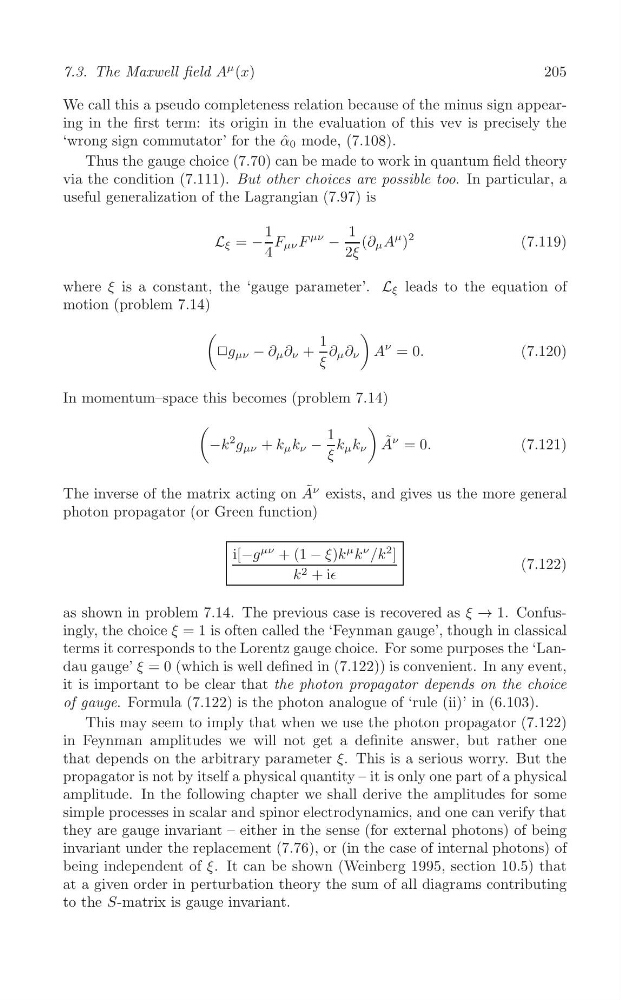
photon propagator (or Green function)
i[−g
μν + (1 − ξ)k
μ k
ν /k
2 ]
(7.122)
k 2 + i∈
as shown in problem 7.14. The previous case is recovered as ξ → 1. Confusingly, the choice ξ = 1 is often called the ‘Feynman gauge’, though in classical
terms it corresponds to the Lorentz gauge choice. For some purposes the ‘Landau gauge’ ξ = 0 (which is well defined in (7.122)) is convenient. In any event,
it is important to be clear that the photon propagator depends on the choice
of gauge. Formula (7.122) is the photon analogue of ‘rule (ii)’ in (6.103).
This may seem to imply that when we use the photon propagator (7.122)
in Feynman amplitudes we will not get a definite answer, but rather one
that depends on the arbitrary parameter ξ. This is a serious worry. But the
propagator is not by itself a physical quantity – it is only one part of a physical
amplitude. In the following chapter we shall derive the amplitudes for some
simple processes in scalar and spinor electrodynamics, and one can verify that
they are gauge invariant – either in the sense (for external photons) of being
invariant under the replacement (7.76), or (in the case of internal photons) of
being independent of ξ. It can be shown (Weinberg 1995, section 10.5) that
at a given order in perturbation theory the sum of all diagrams contributing
to the S-matrix is gauge invariant.
7.3. The Maxwell field A
μ (x)
We call this a pseudo completeness relation because of the minus sign appearing in the first term: its origin in the evaluation of this vev is precisely the
‘wrong sign commutator’ for the ˆ
α 0 mode, (7.108).
Thus the gauge choice (7.70) can be made to work in quantum field theory
via the condition (7.111). But other choices are possible too. In particular, a
useful generalization of the Lagrangian (7.97) is
L ξ = −
1 F μν F
μν
−
1 (∂ μ A
μ )
2
(7.119)
4
2ξ
where ξ is a constant, the ‘gauge parameter’. L ξ leads to the equation of
motion (problem 7.14)
(
)
1 ∂ μ ∂ ν A
ν = 0.
(7.120)
❗g μν − ∂ μ ∂ ν + ξ
In momentum–space this becomes (problem 7.14)
(
)
−k
2
1 k μ k ν A ˜ ν = 0.
(7.121)
g μν + k μ k ν − ξ
The inverse of the matrix acting on A ˜ ν exists, and gives us the more general
photon propagator (or Green function)
i[−g
μν + (1 − ξ)k
μ k
ν /k
2 ]
(7.122)
k 2 + i∈
as shown in problem 7.14. The previous case is recovered as ξ → 1. Confusingly, the choice ξ = 1 is often called the ‘Feynman gauge’, though in classical
terms it corresponds to the Lorentz gauge choice. For some purposes the ‘Landau gauge’ ξ = 0 (which is well defined in (7.122)) is convenient. In any event,
it is important to be clear that the photon propagator depends on the choice
of gauge. Formula (7.122) is the photon analogue of ‘rule (ii)’ in (6.103).
This may seem to imply that when we use the photon propagator (7.122)
in Feynman amplitudes we will not get a definite answer, but rather one
that depends on the arbitrary parameter ξ. This is a serious worry. But the
propagator is not by itself a physical quantity – it is only one part of a physical
amplitude. In the following chapter we shall derive the amplitudes for some
simple processes in scalar and spinor electrodynamics, and one can verify that
they are gauge invariant – either in the sense (for external photons) of being
invariant under the replacement (7.76), or (in the case of internal photons) of
being independent of ξ. It can be shown (Weinberg 1995, section 10.5) that
at a given order in perturbation theory the sum of all diagrams contributing
to the S-matrix is gauge invariant.