

185
7.1. The complex scalar field
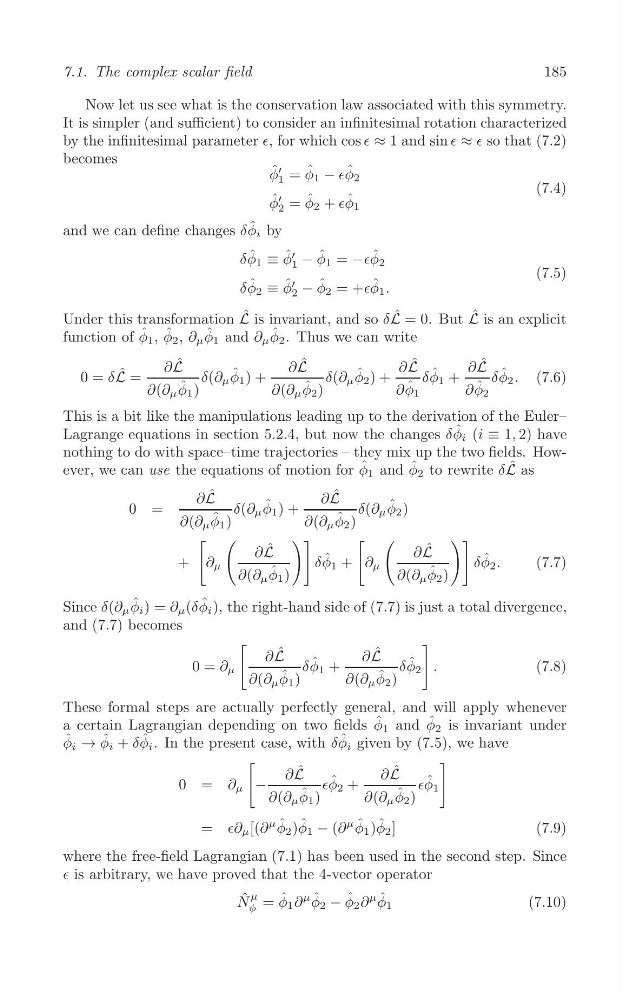
Now let us see what is the conservation law associated with this symmetry.
It is simpler (and sufficient) to consider an infinitesimal rotation characterized
by the infinitesimal parameter ∈, for which cos ∈ ≈ 1 and sin ∈ ≈ ∈ so that (7.2)
becomes
φ ˆ′
ˆ
=
1
φ 1 − ∈φ ˆ 2
(7.4)
φ ˆ′
φ ˆ 2 + ∈ ˆ
=
2
φ 1
and we can define changes δφ ˆ i by
δφ ˆ 1 ≡ φ ˆ ′
1 − φ ˆ 1 = −∈φ ˆ 2
(7.5)
δφ ˆ 2 ≡ φ ˆ′
2 − φ ˆ 2 = +∈φ ˆ 1 .
Under this transformation L ˆ is invariant, and so δL ˆ = 0. But L ˆ is an explicit
function of φ ˆ 1 , φ ˆ 2 , ∂ μ φ ˆ 1 and ∂ μ φ ˆ 2 . Thus we can write
∂L ˆ
∂L ˆ
∂L ˆ
∂L ˆ
0 = δL ˆ =
δ(∂ μ φ ˆ 1 ) +
δ(∂ μ φ ˆ 2 ) +
δφ ˆ 1 +
δφ ˆ 2 . (7.6)
∂(∂ μ φ ˆ 1 )
∂(∂ μ φ ˆ 2 )
∂φ ˆ 1
∂φ ˆ 2
This is a bit like the manipulations leading up to the derivation of the Euler–
Lagrange equations in section 5.2.4, but now the changes δφ ˆ i (i ≡ 1, 2) have
nothing to do with space–time trajectories – they mix up the two fields. However, we can use the equations of motion for φ ˆ 1 and φ ˆ 2 to rewrite δL ˆ as
∂L ˆ
∂L ˆ
ˆ
ˆ
0 =
δ(∂ μ φ 1 ) +
δ(∂ μ φ 2 )
ˆ
ˆ
∂(∂ μ φ 1 )
∂(∂ μ φ 2 )
[ (
)]
[ (
)]
∂ ˆ
∂ ˆ
+ ∂ μ
L
δφ ˆ 1 + ∂ μ
L
δφ ˆ 2 .
(7.7)
ˆ
ˆ
∂(∂ μ φ 1 )
∂(∂ μ φ 2 )
Since δ(∂ μ φ ˆ i ) = ∂ μ (δφ ˆ i ), the right-hand side of (7.7) is just a total divergence,
and (7.7) becomes
[
]
∂L ˆ
∂L ˆ
0 = ∂ μ
δφ ˆ 1 +
δφ ˆ 2 .
(7.8)
ˆ
ˆ
∂(∂ μ φ 1 )
∂(∂ μ φ 2 )
These formal steps are actually perfectly general, and will apply whenever
a certain Lagrangian depending on two fields φ ˆ 1 and φ ˆ 2 is invariant under
φ ˆ i → φ ˆ i + δφ ˆ i . In the present case, with δφ ˆ i given by (7.5), we have
[
]
∂L ˆ
∂L ˆ
0 = ∂ μ −
∈φ ˆ 2 +
∈φ ˆ 1
ˆ
ˆ
∂(∂ μ φ 1 )
∂(∂ μ φ 2 )
= ∈∂ μ [(∂
μ φ ˆ 2 )φ ˆ 1 − (∂
μ φ ˆ 1 )φ ˆ 2 ]
(7.9)
where the free-field Lagrangian (7.1) has been used in the second step. Since
∈ is arbitrary, we have proved that the 4-vector operator
μ
N ˆ
φ = φ ˆ 1 ∂
μ φ ˆ 2 − φ ˆ 2 ∂
μ φ ˆ 1
(7.10)
7.1. The complex scalar field
Now let us see what is the conservation law associated with this symmetry.
It is simpler (and sufficient) to consider an infinitesimal rotation characterized
by the infinitesimal parameter ∈, for which cos ∈ ≈ 1 and sin ∈ ≈ ∈ so that (7.2)
becomes
φ ˆ′
ˆ
=
1
φ 1 − ∈φ ˆ 2
(7.4)
φ ˆ′
φ ˆ 2 + ∈ ˆ
=
2
φ 1
and we can define changes δφ ˆ i by
δφ ˆ 1 ≡ φ ˆ ′
1 − φ ˆ 1 = −∈φ ˆ 2
(7.5)
δφ ˆ 2 ≡ φ ˆ′
2 − φ ˆ 2 = +∈φ ˆ 1 .
Under this transformation L ˆ is invariant, and so δL ˆ = 0. But L ˆ is an explicit
function of φ ˆ 1 , φ ˆ 2 , ∂ μ φ ˆ 1 and ∂ μ φ ˆ 2 . Thus we can write
∂L ˆ
∂L ˆ
∂L ˆ
∂L ˆ
0 = δL ˆ =
δ(∂ μ φ ˆ 1 ) +
δ(∂ μ φ ˆ 2 ) +
δφ ˆ 1 +
δφ ˆ 2 . (7.6)
∂(∂ μ φ ˆ 1 )
∂(∂ μ φ ˆ 2 )
∂φ ˆ 1
∂φ ˆ 2
This is a bit like the manipulations leading up to the derivation of the Euler–
Lagrange equations in section 5.2.4, but now the changes δφ ˆ i (i ≡ 1, 2) have
nothing to do with space–time trajectories – they mix up the two fields. However, we can use the equations of motion for φ ˆ 1 and φ ˆ 2 to rewrite δL ˆ as
∂L ˆ
∂L ˆ
ˆ
ˆ
0 =
δ(∂ μ φ 1 ) +
δ(∂ μ φ 2 )
ˆ
ˆ
∂(∂ μ φ 1 )
∂(∂ μ φ 2 )
[ (
)]
[ (
)]
∂ ˆ
∂ ˆ
+ ∂ μ
L
δφ ˆ 1 + ∂ μ
L
δφ ˆ 2 .
(7.7)
ˆ
ˆ
∂(∂ μ φ 1 )
∂(∂ μ φ 2 )
Since δ(∂ μ φ ˆ i ) = ∂ μ (δφ ˆ i ), the right-hand side of (7.7) is just a total divergence,
and (7.7) becomes
[
]
∂L ˆ
∂L ˆ
0 = ∂ μ
δφ ˆ 1 +
δφ ˆ 2 .
(7.8)
ˆ
ˆ
∂(∂ μ φ 1 )
∂(∂ μ φ 2 )
These formal steps are actually perfectly general, and will apply whenever
a certain Lagrangian depending on two fields φ ˆ 1 and φ ˆ 2 is invariant under
φ ˆ i → φ ˆ i + δφ ˆ i . In the present case, with δφ ˆ i given by (7.5), we have
[
]
∂L ˆ
∂L ˆ
0 = ∂ μ −
∈φ ˆ 2 +
∈φ ˆ 1
ˆ
ˆ
∂(∂ μ φ 1 )
∂(∂ μ φ 2 )
= ∈∂ μ [(∂
μ φ ˆ 2 )φ ˆ 1 − (∂
μ φ ˆ 1 )φ ˆ 2 ]
(7.9)
where the free-field Lagrangian (7.1) has been used in the second step. Since
∈ is arbitrary, we have proved that the 4-vector operator
μ
N ˆ
φ = φ ˆ 1 ∂
μ φ ˆ 2 − φ ˆ 2 ∂
μ φ ˆ 1
(7.10)