

Problems
179
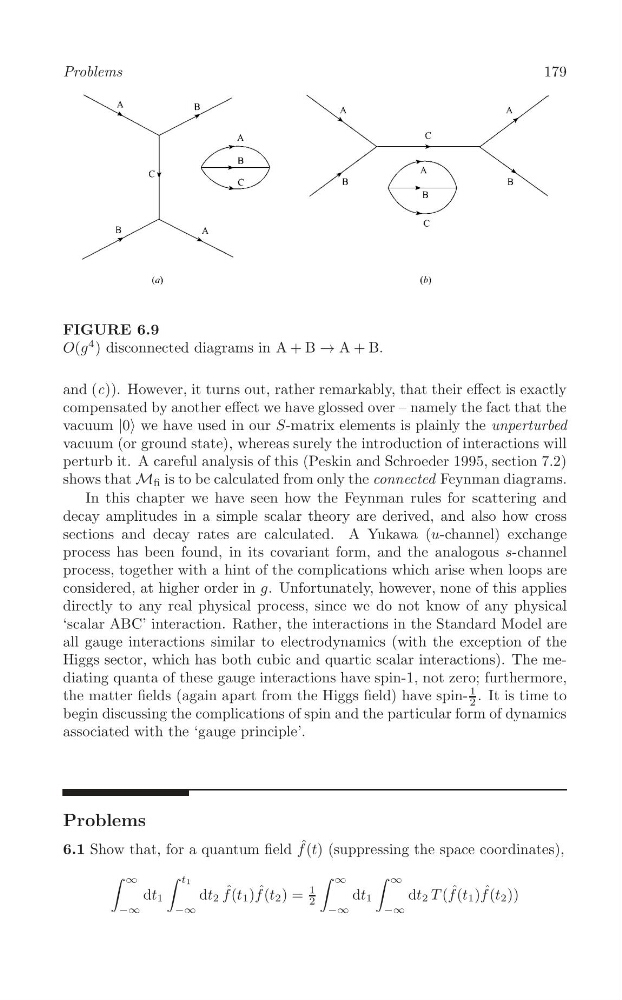
FIGURE 6.9
O(g
4 ) disconnected diagrams in A + B → A + B.
and (c)). However, it turns out, rather remarkably, that their effect is exactly
compensated by another effect we have glossed over – namely the fact that the
vacuum |0> we have used in our S-matrix elements is plainly the unperturbed
vacuum (or ground state), whereas surely the introduction of interactions will
perturb it. A careful analysis of this (Peskin and Schroeder 1995, section 7.2)
shows that M fi is to be calculated from only the connected Feynman diagrams.
In this chapter we have seen how the Feynman rules for scattering and
decay amplitudes in a simple scalar theory are derived, and also how cross
sections and decay rates are calculated. A Yukawa (u-channel) exchange
process has been found, in its covariant form, and the analogous s-channel
process, together with a hint of the complications which arise when loops are
considered, at higher order in g. Unfortunately, however, none of this applies
directly to any real physical process, since we do not know of any physical
‘scalar ABC’ interaction. Rather, the interactions in the Standard Model are
all gauge interactions similar to electrodynamics (with the exception of the
Higgs sector, which has both cubic and quartic scalar interactions). The mediating quanta of these gauge interactions have spin-1, not zero; furthermore,
the matter fields (again apart from the Higgs field) have spin1 . It is time to
2
begin discussing the complications of spin and the particular form of dynamics
associated with the ‘gauge principle’.
Problems
6.1 Show that, for a quantum field f ˆ (t) (suppressing the space coordinates),
∫
∫
∫
∫
∞
t1
∞
∞
dt 1
dt 2 f ˆ (t 1 )f ˆ (t 2 ) =
1
dt 1
dt 2 T (f ˆ (t 1 )f ˆ (t 2 ))
2
−∞
−∞
−∞
−∞
179
FIGURE 6.9
O(g
4 ) disconnected diagrams in A + B → A + B.
and (c)). However, it turns out, rather remarkably, that their effect is exactly
compensated by another effect we have glossed over – namely the fact that the
vacuum |0> we have used in our S-matrix elements is plainly the unperturbed
vacuum (or ground state), whereas surely the introduction of interactions will
perturb it. A careful analysis of this (Peskin and Schroeder 1995, section 7.2)
shows that M fi is to be calculated from only the connected Feynman diagrams.
In this chapter we have seen how the Feynman rules for scattering and
decay amplitudes in a simple scalar theory are derived, and also how cross
sections and decay rates are calculated. A Yukawa (u-channel) exchange
process has been found, in its covariant form, and the analogous s-channel
process, together with a hint of the complications which arise when loops are
considered, at higher order in g. Unfortunately, however, none of this applies
directly to any real physical process, since we do not know of any physical
‘scalar ABC’ interaction. Rather, the interactions in the Standard Model are
all gauge interactions similar to electrodynamics (with the exception of the
Higgs sector, which has both cubic and quartic scalar interactions). The mediating quanta of these gauge interactions have spin-1, not zero; furthermore,
the matter fields (again apart from the Higgs field) have spin1 . It is time to
2
begin discussing the complications of spin and the particular form of dynamics
associated with the ‘gauge principle’.
Problems
6.1 Show that, for a quantum field f ˆ (t) (suppressing the space coordinates),
∫
∫
∫
∫
∞
t1
∞
∞
dt 1
dt 2 f ˆ (t 1 )f ˆ (t 2 ) =
1
dt 1
dt 2 T (f ˆ (t 1 )f ˆ (t 2 ))
2
−∞
−∞
−∞
−∞