

175
6.3. Applications to the ‘ABC’ theory
The number of target particles per unit volume is 2E B (= 2m B for B at rest,
of course).
We must also include the ‘density of final states’ factors, as in (6.59).
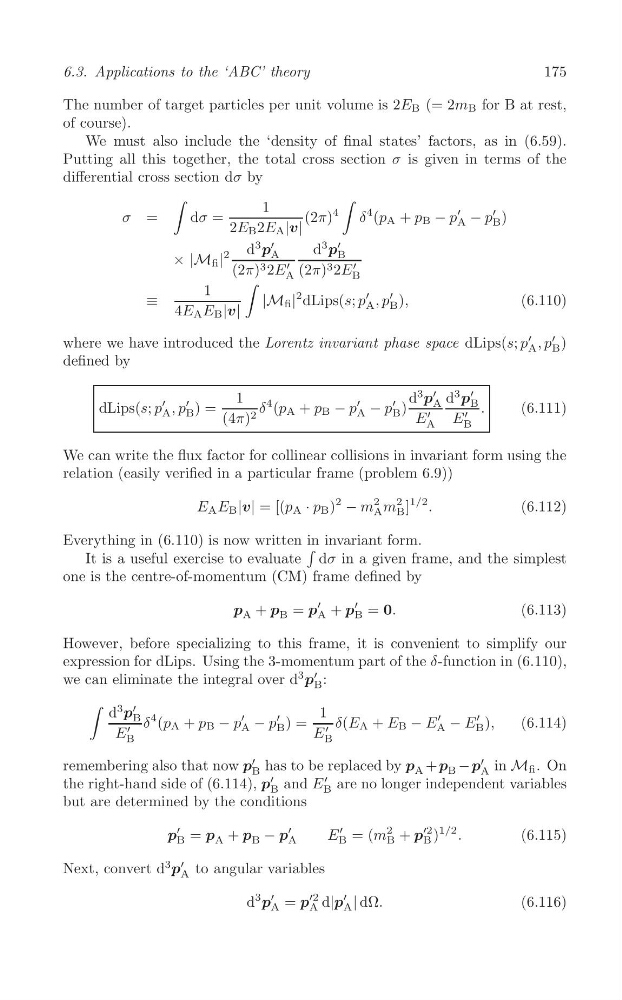
Putting all this together, the total cross section σ is given in terms of the
differential cross section dσ by
σ =
∫
dσ =
1
2E B 2E A |v|
(2π)
4
∫
δ
4 (p A + p B − p
′
A − p
′
B )
× |M fi |
2
d
3
p
′
A
(2π) 3 2E ′
A
d
3
p
′
B
(2π) 3 2E ′
B
∫
≡
1
4E A E B |v|
|M fi |
2 dLips(s; p
′
A , p
′
B ),
(6.110)
′
′
where we have introduced the Lorentz invariant phase space dLips(s; p A , p )
B
defined by
d
3 ′ d
3 ′
1
p
p
′
′
′
′
A
B
dLips(s; p A , p B ) =
δ
4 (p A + p B − p A − p B )
.
(6.111)
′
′
(4π) 2
E A E B
We can write the flux factor for collinear collisions in invariant form using the
relation (easily verified in a particular frame (problem 6.9))
2
2
E A E B |v| = [(p A · p B )
2
− m A m B ]
1/2 .
(6.112)
Everything in (6.110) is now written in invariant form.
∫
It is a useful exercise to evaluate dσ in a given frame, and the simplest
one is the centre-of-momentum (CM) frame defined by
′
′
p A + p B = p A + p = 0.
(6.113)
B
However, before specializing to this frame, it is convenient to simplify our
expression for dLips. Using the 3-momentum part of the δ-function in (6.110),
′
we can eliminate the integral over d
3
p B :
∫
′
B
′
′
′
′
d
3
p δ
4 (p A + p B − p A − p B ) =
1 δ(E A + E B − E A − E B ),
(6.114)
′
′
E
E
B
B
′
′
remembering also that now p has to be replaced by p A + p B − p in M fi . On
B
A
′
′
the right-hand side of (6.114), p and E B are no longer independent variables
B
but are determined by the conditions
′
′
′
2
′2
p = p A + p B − p
E B = (m B + p B )
1/2 .
(6.115)
B
A
′
Next, convert d
3
p to angular variables
A
d
3 ′
′2
′
p = p A d|p A | dΩ.
(6.116)
A
6.3. Applications to the ‘ABC’ theory
The number of target particles per unit volume is 2E B (= 2m B for B at rest,
of course).
We must also include the ‘density of final states’ factors, as in (6.59).
Putting all this together, the total cross section σ is given in terms of the
differential cross section dσ by
σ =
∫
dσ =
1
2E B 2E A |v|
(2π)
4
∫
δ
4 (p A + p B − p
′
A − p
′
B )
× |M fi |
2
d
3
p
′
A
(2π) 3 2E ′
A
d
3
p
′
B
(2π) 3 2E ′
B
∫
≡
1
4E A E B |v|
|M fi |
2 dLips(s; p
′
A , p
′
B ),
(6.110)
′
′
where we have introduced the Lorentz invariant phase space dLips(s; p A , p )
B
defined by
d
3 ′ d
3 ′
1
p
p
′
′
′
′
A
B
dLips(s; p A , p B ) =
δ
4 (p A + p B − p A − p B )
.
(6.111)
′
′
(4π) 2
E A E B
We can write the flux factor for collinear collisions in invariant form using the
relation (easily verified in a particular frame (problem 6.9))
2
2
E A E B |v| = [(p A · p B )
2
− m A m B ]
1/2 .
(6.112)
Everything in (6.110) is now written in invariant form.
∫
It is a useful exercise to evaluate dσ in a given frame, and the simplest
one is the centre-of-momentum (CM) frame defined by
′
′
p A + p B = p A + p = 0.
(6.113)
B
However, before specializing to this frame, it is convenient to simplify our
expression for dLips. Using the 3-momentum part of the δ-function in (6.110),
′
we can eliminate the integral over d
3
p B :
∫
′
B
′
′
′
′
d
3
p δ
4 (p A + p B − p A − p B ) =
1 δ(E A + E B − E A − E B ),
(6.114)
′
′
E
E
B
B
′
′
remembering also that now p has to be replaced by p A + p B − p in M fi . On
B
A
′
′
the right-hand side of (6.114), p and E B are no longer independent variables
B
but are determined by the conditions
′
′
′
2
′2
p = p A + p B − p
E B = (m B + p B )
1/2 .
(6.115)
B
A
′
Next, convert d
3
p to angular variables
A
d
3 ′
′2
′
p = p A d|p A | dΩ.
(6.116)
A