

169
6.3. Applications to the ‘ABC’ theory
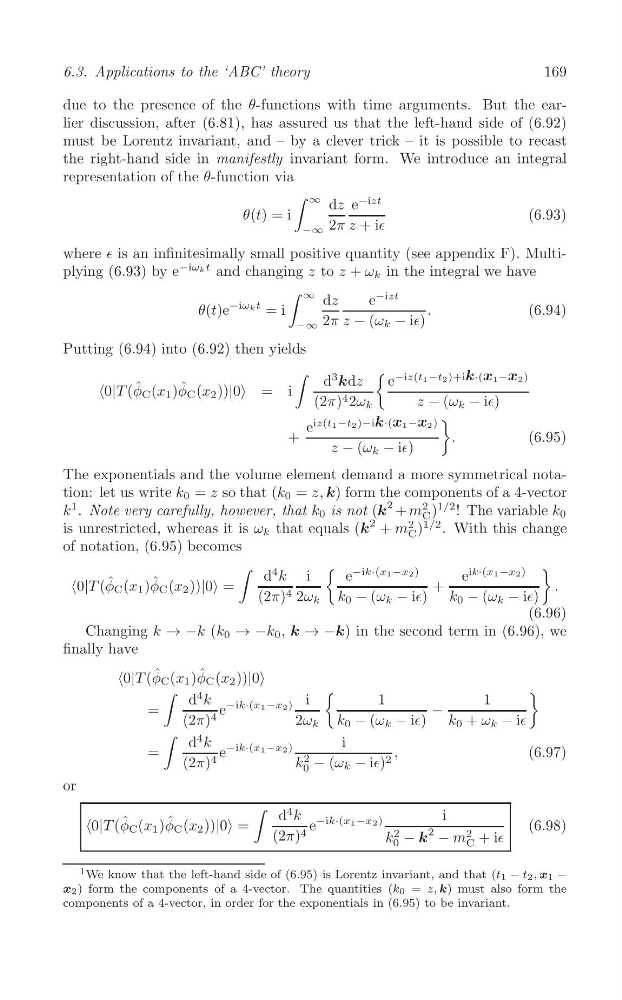
due to the presence of the θ-functions with time arguments. But the earlier discussion, after (6.81), has assured us that the left-hand side of (6.92)
must be Lorentz invariant, and – by a clever trick – it is possible to recast
the right-hand side in manifestly invariant form. We introduce an integral
representation of the θ-function via
∫ ∞
−izt
dz e
θ(t) = i
(6.93)
2π z + i∈
−∞
where ∈ is an infinitesimally small positive quantity (see appendix F). Multiplying (6.93) by e
−iω k t and changing z to z + ω k in the integral we have
∫ ∞
−izt
θ(t)e
−iω k t = i
dz
e
.
(6.94)
2π z − (ω k − i∈)
−∞
Putting (6.94) into (6.92) then yields
(
∫
−iz(t1−t2)+ik·(x1−x2)
d
3
kdz
e
<0|T (φ ˆ C (x 1 )φ ˆ C (x 2 ))|0> = i (2π) 4 2ω k
z − (ω k − i∈)
)
iz(t1−t2 )−ik·(x1 −x2 )
e
+
.
(6.95)
z − (ω k − i∈)
The exponentials and the volume element demand a more symmetrical notation: let us write k 0 = z so that (k 0 = z, k) form the components of a 4-vector
2
k
1 . Note very carefully, however, that k 0 is not (k
2 + m )
1/2 ! The variable k 0
C
2
is unrestricted, whereas it is ω k that equals (k
2 + m )
1/2 . With this change
C
of notation, (6.95) becomes
(
)
∫
−ik·(x1−x2)
ik·(x1−x2)
d
4 k i
e
e
<0|T (φ ˆ C (x 1 )φ ˆ C (x 2 ))|0> =
+
.
(2π) 4 2ω k k 0 − (ω k − i∈) k 0 − (ω k − i∈)
(6.96)
Changing k → −k (k 0 → −k 0 , k → −k) in the second term in (6.96), we
finally have
<0|T (φ ˆ C (x 1 )φ ˆ C (x 2 ))|0>
(
)
∫ d
4 k
i
1
1
−ik·(x1−x2)
=
e
−
(2π) 4
2ω k k 0 − (ω k − i∈) k 0 + ω k − i∈
∫ d
4 k
i
−ik·(x1−x2)
=
e
,
(6.97)
(2π) 4
k 2 − (ω k − i∈) 2
0
or
∫ d
4 k
i
−ik·(x1−x2)
<0|T (φ ˆ C (x 1 )φ ˆ C (x 2 ))|0> =
e
(6.98)
2
(2π) 4
k 2 − k
2
− m + i∈
0
C
1 We know that the left-hand side of (6.95) is Lorentz invariant, and that (t 1 − t 2 , x 1 −
x 2 ) form the components of a 4-vector. The quantities (k 0 = z, k) must also form the
components of a 4-vector, in order for the exponentials in (6.95) to be invariant.
6.3. Applications to the ‘ABC’ theory
due to the presence of the θ-functions with time arguments. But the earlier discussion, after (6.81), has assured us that the left-hand side of (6.92)
must be Lorentz invariant, and – by a clever trick – it is possible to recast
the right-hand side in manifestly invariant form. We introduce an integral
representation of the θ-function via
∫ ∞
−izt
dz e
θ(t) = i
(6.93)
2π z + i∈
−∞
where ∈ is an infinitesimally small positive quantity (see appendix F). Multiplying (6.93) by e
−iω k t and changing z to z + ω k in the integral we have
∫ ∞
−izt
θ(t)e
−iω k t = i
dz
e
.
(6.94)
2π z − (ω k − i∈)
−∞
Putting (6.94) into (6.92) then yields
(
∫
−iz(t1−t2)+ik·(x1−x2)
d
3
kdz
e
<0|T (φ ˆ C (x 1 )φ ˆ C (x 2 ))|0> = i (2π) 4 2ω k
z − (ω k − i∈)
)
iz(t1−t2 )−ik·(x1 −x2 )
e
+
.
(6.95)
z − (ω k − i∈)
The exponentials and the volume element demand a more symmetrical notation: let us write k 0 = z so that (k 0 = z, k) form the components of a 4-vector
2
k
1 . Note very carefully, however, that k 0 is not (k
2 + m )
1/2 ! The variable k 0
C
2
is unrestricted, whereas it is ω k that equals (k
2 + m )
1/2 . With this change
C
of notation, (6.95) becomes
(
)
∫
−ik·(x1−x2)
ik·(x1−x2)
d
4 k i
e
e
<0|T (φ ˆ C (x 1 )φ ˆ C (x 2 ))|0> =
+
.
(2π) 4 2ω k k 0 − (ω k − i∈) k 0 − (ω k − i∈)
(6.96)
Changing k → −k (k 0 → −k 0 , k → −k) in the second term in (6.96), we
finally have
<0|T (φ ˆ C (x 1 )φ ˆ C (x 2 ))|0>
(
)
∫ d
4 k
i
1
1
−ik·(x1−x2)
=
e
−
(2π) 4
2ω k k 0 − (ω k − i∈) k 0 + ω k − i∈
∫ d
4 k
i
−ik·(x1−x2)
=
e
,
(6.97)
(2π) 4
k 2 − (ω k − i∈) 2
0
or
∫ d
4 k
i
−ik·(x1−x2)
<0|T (φ ˆ C (x 1 )φ ˆ C (x 2 ))|0> =
e
(6.98)
2
(2π) 4
k 2 − k
2
− m + i∈
0
C
1 We know that the left-hand side of (6.95) is Lorentz invariant, and that (t 1 − t 2 , x 1 −
x 2 ) form the components of a 4-vector. The quantities (k 0 = z, k) must also form the
components of a 4-vector, in order for the exponentials in (6.95) to be invariant.