

119
5.1. The quantum field: (i) descriptive
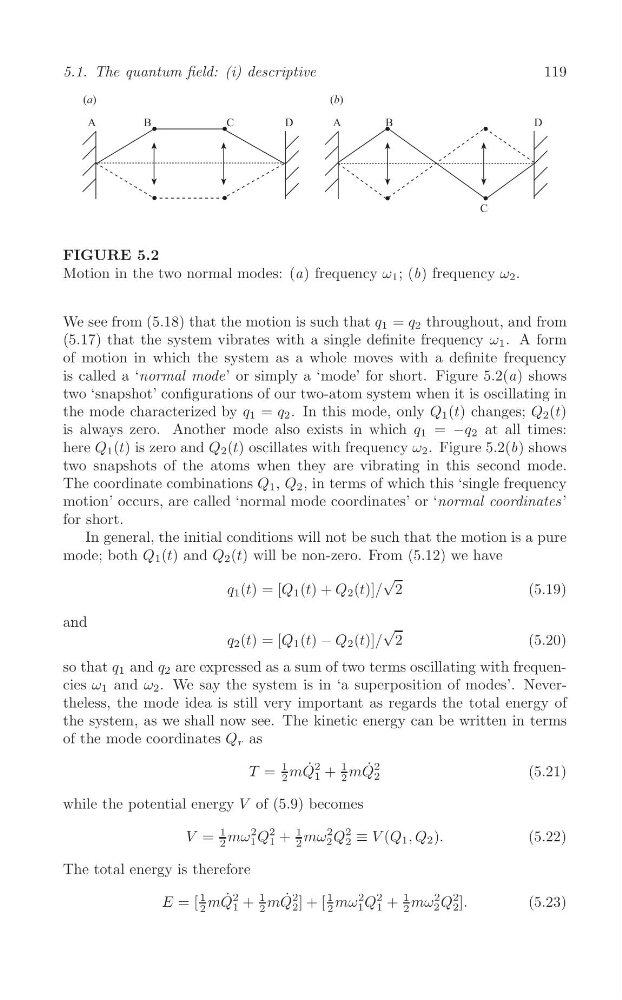
FIGURE 5.2
Motion in the two normal modes: (a) frequency ω 1 ; (b) frequency ω 2 .
We see from (5.18) that the motion is such that q 1 = q 2 throughout, and from
(5.17) that the system vibrates with a single definite frequency ω 1 . A form
of motion in which the system as a whole moves with a definite frequency
is called a ‘normal mode’ or simply a ‘mode’ for short. Figure 5.2(a) shows
two ‘snapshot’ configurations of our two-atom system when it is oscillating in
the mode characterized by q 1 = q 2 . In this mode, only Q 1 (t) changes; Q 2 (t)
is always zero. Another mode also exists in which q 1 = −q 2 at all times:
here Q 1 (t) is zero and Q 2 (t) oscillates with frequency ω 2 . Figure 5.2(b) shows
two snapshots of the atoms when they are vibrating in this second mode.
The coordinate combinations Q 1 , Q 2 , in terms of which this ‘single frequency
motion’ occurs, are called ‘normal mode coordinates’ or ‘normal coordinates’
for short.
In general, the initial conditions will not be such that the motion is a pure
mode; both Q 1 (t) and Q 2 (t) will be non-zero. From (5.12) we have
√
q 1 (t) = [Q 1 (t) + Q 2 (t)]/ 2
(5.19)
and
√
q 2 (t) = [Q 1 (t) − Q 2 (t)]/ 2
(5.20)
so that q 1 and q 2 are expressed as a sum of two terms oscillating with frequencies ω 1 and ω 2 . We say the system is in ‘a superposition of modes’. Nevertheless, the mode idea is still very important as regards the total energy of
the system, as we shall now see. The kinetic energy can be written in terms
of the mode coordinates Q r as
1 Q ˙ 2 1 Q ˙ 2
T =
m
(5.21)
2 m 1 + 2
2
while the potential energy V of (5.9) becomes
1
1
V = mω 1
2 Q
2
1 + mω 2
2 Q
2
2 ≡ V (Q 1 , Q 2 ).
(5.22)
2
2
The total energy is therefore
˙
1
˙
1
E = [
1 mQ
2
1 + mQ 2
2 ] + [
1 mω 1
2 Q
2
1 + mω 2
2 Q
2
2 ].
(5.23)
2
2
2
2
5.1. The quantum field: (i) descriptive
FIGURE 5.2
Motion in the two normal modes: (a) frequency ω 1 ; (b) frequency ω 2 .
We see from (5.18) that the motion is such that q 1 = q 2 throughout, and from
(5.17) that the system vibrates with a single definite frequency ω 1 . A form
of motion in which the system as a whole moves with a definite frequency
is called a ‘normal mode’ or simply a ‘mode’ for short. Figure 5.2(a) shows
two ‘snapshot’ configurations of our two-atom system when it is oscillating in
the mode characterized by q 1 = q 2 . In this mode, only Q 1 (t) changes; Q 2 (t)
is always zero. Another mode also exists in which q 1 = −q 2 at all times:
here Q 1 (t) is zero and Q 2 (t) oscillates with frequency ω 2 . Figure 5.2(b) shows
two snapshots of the atoms when they are vibrating in this second mode.
The coordinate combinations Q 1 , Q 2 , in terms of which this ‘single frequency
motion’ occurs, are called ‘normal mode coordinates’ or ‘normal coordinates’
for short.
In general, the initial conditions will not be such that the motion is a pure
mode; both Q 1 (t) and Q 2 (t) will be non-zero. From (5.12) we have
√
q 1 (t) = [Q 1 (t) + Q 2 (t)]/ 2
(5.19)
and
√
q 2 (t) = [Q 1 (t) − Q 2 (t)]/ 2
(5.20)
so that q 1 and q 2 are expressed as a sum of two terms oscillating with frequencies ω 1 and ω 2 . We say the system is in ‘a superposition of modes’. Nevertheless, the mode idea is still very important as regards the total energy of
the system, as we shall now see. The kinetic energy can be written in terms
of the mode coordinates Q r as
1 Q ˙ 2 1 Q ˙ 2
T =
m
(5.21)
2 m 1 + 2
2
while the potential energy V of (5.9) becomes
1
1
V = mω 1
2 Q
2
1 + mω 2
2 Q
2
2 ≡ V (Q 1 , Q 2 ).
(5.22)
2
2
The total energy is therefore
˙
1
˙
1
E = [
1 mQ
2
1 + mQ 2
2 ] + [
1 mω 1
2 Q
2
1 + mω 2
2 Q
2
2 ].
(5.23)
2
2
2
2