

116
5. Quantum Field Theory I: The Free Scalar Field
F
F
F
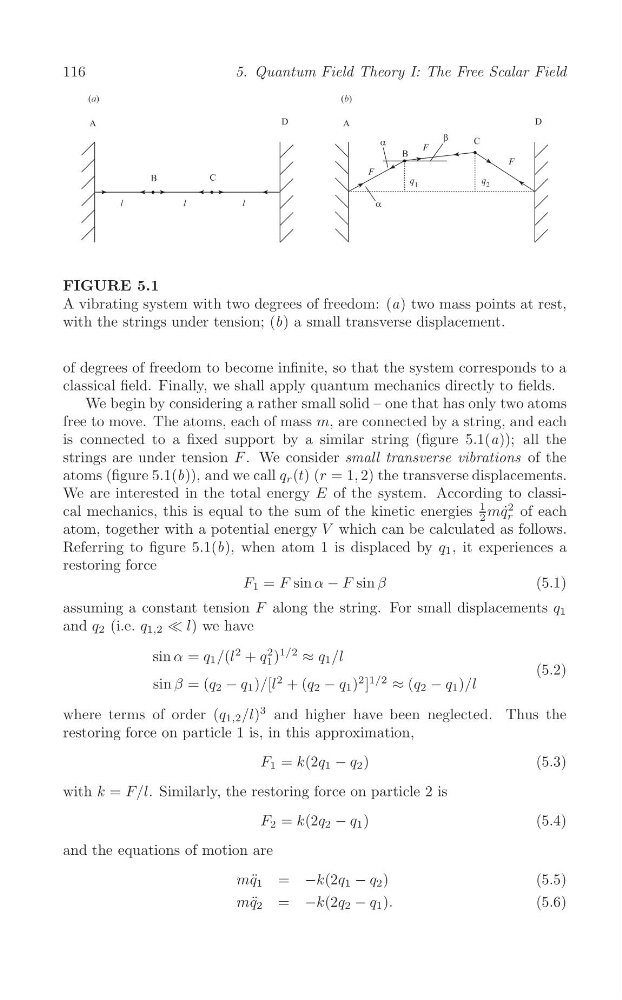
FIGURE 5.1
A vibrating system with two degrees of freedom: (a) two mass points at rest,
with the strings under tension; (b) a small transverse displacement.
of degrees of freedom to become infinite, so that the system corresponds to a
classical field. Finally, we shall apply quantum mechanics directly to fields.
We begin by considering a rather small solid – one that has only two atoms
free to move. The atoms, each of mass m, are connected by a string, and each
is connected to a fixed support by a similar string (figure 5.1(a)); all the
strings are under tension F . We consider small transverse vibrations of the
atoms (figure 5.1(b)), and we call q r (t) (r = 1, 2) the transverse displacements.
We are interested in the total energy E of the system. According to classi2
cal mechanics, this is equal to the sum of the kinetic energies
1 mq˙ of each
2
r
atom, together with a potential energy V which can be calculated as follows.
Referring to figure 5.1(b), when atom 1 is displaced by q 1 , it experiences a
restoring force
F 1 = F sin α − F sin β
(5.1)
assuming a constant tension F along the string. For small displacements q 1
and q 2 (i.e. q 1,2 ≪ l) we have
2
sin α = q 1 /(l
2 + q 1 )
1/2
≈ q 1 /l
(5.2)
sin β = (q 2 − q 1 )/[l
2 + (q 2 − q 1 )
2 ]
1/2
≈ (q 2 − q 1 )/l
where terms of order (q 1,2 /l)
3 and higher have been neglected. Thus the
restoring force on particle 1 is, in this approximation,
F 1 = k(2q 1 − q 2 )
(5.3)
with k = F/l. Similarly, the restoring force on particle 2 is
F 2 = k(2q 2 − q 1 )
(5.4)
and the equations of motion are
mq ¨ 1 = −k(2q 1 − q 2 )
(5.5)
mq ¨ 2 = −k(2q 2 − q 1 ).
(5.6)
5. Quantum Field Theory I: The Free Scalar Field
F
F
F
FIGURE 5.1
A vibrating system with two degrees of freedom: (a) two mass points at rest,
with the strings under tension; (b) a small transverse displacement.
of degrees of freedom to become infinite, so that the system corresponds to a
classical field. Finally, we shall apply quantum mechanics directly to fields.
We begin by considering a rather small solid – one that has only two atoms
free to move. The atoms, each of mass m, are connected by a string, and each
is connected to a fixed support by a similar string (figure 5.1(a)); all the
strings are under tension F . We consider small transverse vibrations of the
atoms (figure 5.1(b)), and we call q r (t) (r = 1, 2) the transverse displacements.
We are interested in the total energy E of the system. According to classi2
cal mechanics, this is equal to the sum of the kinetic energies
1 mq˙ of each
2
r
atom, together with a potential energy V which can be calculated as follows.
Referring to figure 5.1(b), when atom 1 is displaced by q 1 , it experiences a
restoring force
F 1 = F sin α − F sin β
(5.1)
assuming a constant tension F along the string. For small displacements q 1
and q 2 (i.e. q 1,2 ≪ l) we have
2
sin α = q 1 /(l
2 + q 1 )
1/2
≈ q 1 /l
(5.2)
sin β = (q 2 − q 1 )/[l
2 + (q 2 − q 1 )
2 ]
1/2
≈ (q 2 − q 1 )/l
where terms of order (q 1,2 /l)
3 and higher have been neglected. Thus the
restoring force on particle 1 is, in this approximation,
F 1 = k(2q 1 − q 2 )
(5.3)
with k = F/l. Similarly, the restoring force on particle 2 is
F 2 = k(2q 2 − q 1 )
(5.4)
and the equations of motion are
mq ¨ 1 = −k(2q 1 − q 2 )
(5.5)
mq ¨ 2 = −k(2q 2 − q 1 ).
(5.6)