

107
4.2. Discrete transformations: P, C and T
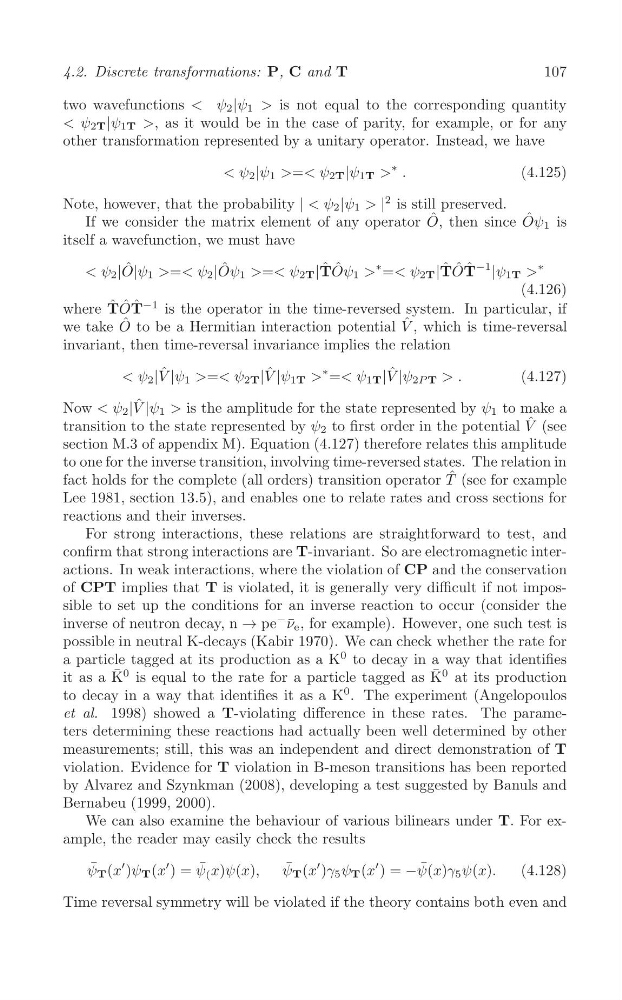
two wavefunctions < ψ 2 |ψ 1 > is not equal to the corresponding quantity
< ψ 2T |ψ 1T >, as it would be in the case of parity, for example, or for any
other transformation represented by a unitary operator. Instead, we have
∗
< ψ 2 |ψ 1 >=< ψ 2T |ψ 1T > .
(4.125)
Note, however, that the probability | < ψ 2 |ψ 1 > |
2 is still preserved.
If we consider the matrix element of any operator O ˆ , then since ˆ 1 is
Oψ
itself a wavefunction, we must have
∗
∗
O|ψ
2 | ˆ
T ˆ
2T | ˆ O ˆ
1T >
< ψ 2 | ˆ 1 >=< ψ Oψ 1 >=< ψ 2T | ˆ Oψ 1 > =< ψ T ˆ T
−1
|ψ
(4.126)
where T ˆ O ˆ T ˆ −1 is the operator in the time-reversed system. In particular, if
we take O ˆ to be a Hermitian interaction potential V ˆ , which is time-reversal
invariant, then time-reversal invariance implies the relation
∗
< ψ 2 |V ˆ |ψ 1 >=< ψ 2T |V ˆ |ψ 1T > =< ψ 1T |V ˆ |ψ 2P T > .
(4.127)
Now < ψ 2 |V ˆ |ψ 1 > is the amplitude for the state represented by ψ 1 to make a
transition to the state represented by ψ 2 to first order in the potential V ˆ (see
section M.3 of appendix M). Equation (4.127) therefore relates this amplitude
to one for the inverse transition, involving time-reversed states. The relation in
fact holds for the complete (all orders) transition operator T ˆ (see for example
Lee 1981, section 13.5), and enables one to relate rates and cross sections for
reactions and their inverses.
For strong interactions, these relations are straightforward to test, and
confirm that strong interactions are T-invariant. So are electromagnetic interactions. In weak interactions, where the violation of CP and the conservation
of CPT implies that T is violated, it is generally very difficult if not impossible to set up the conditions for an inverse reaction to occur (consider the
inverse of neutron decay, n → pe
− ν ¯ e , for example). However, one such test is
possible in neutral K-decays (Kabir 1970). We can check whether the rate for
a particle tagged at its production as a K
0 to decay in a way that identifies
it as a K ¯ 0 is equal to the rate for a particle tagged as K ¯ 0 at its production
to decay in a way that identifies it as a K
0 . The experiment (Angelopoulos
et al. 1998) showed a T-violating difference in these rates. The parameters determining these reactions had actually been well determined by other
measurements; still, this was an independent and direct demonstration of T
violation. Evidence for T violation in B-meson transitions has been reported
by Alvarez and Szynkman (2008), developing a test suggested by Banuls and
Bernabeu (1999, 2000).
We can also examine the behaviour of various bilinears under T. For example, the reader may easily check the results
¯
¯
¯
ψ T (x
′ )ψ T (x
′ ) = ψ ¯ ( x)ψ(x),
ψ T (x
′ )γ 5 ψ T (x
′ ) = −ψ(x)γ 5 ψ(x).
(4.128)
Time reversal symmetry will be violated if the theory contains both even and
4.2. Discrete transformations: P, C and T
two wavefunctions < ψ 2 |ψ 1 > is not equal to the corresponding quantity
< ψ 2T |ψ 1T >, as it would be in the case of parity, for example, or for any
other transformation represented by a unitary operator. Instead, we have
∗
< ψ 2 |ψ 1 >=< ψ 2T |ψ 1T > .
(4.125)
Note, however, that the probability | < ψ 2 |ψ 1 > |
2 is still preserved.
If we consider the matrix element of any operator O ˆ , then since ˆ 1 is
Oψ
itself a wavefunction, we must have
∗
∗
O|ψ
2 | ˆ
T ˆ
2T | ˆ O ˆ
1T >
< ψ 2 | ˆ 1 >=< ψ Oψ 1 >=< ψ 2T | ˆ Oψ 1 > =< ψ T ˆ T
−1
|ψ
(4.126)
where T ˆ O ˆ T ˆ −1 is the operator in the time-reversed system. In particular, if
we take O ˆ to be a Hermitian interaction potential V ˆ , which is time-reversal
invariant, then time-reversal invariance implies the relation
∗
< ψ 2 |V ˆ |ψ 1 >=< ψ 2T |V ˆ |ψ 1T > =< ψ 1T |V ˆ |ψ 2P T > .
(4.127)
Now < ψ 2 |V ˆ |ψ 1 > is the amplitude for the state represented by ψ 1 to make a
transition to the state represented by ψ 2 to first order in the potential V ˆ (see
section M.3 of appendix M). Equation (4.127) therefore relates this amplitude
to one for the inverse transition, involving time-reversed states. The relation in
fact holds for the complete (all orders) transition operator T ˆ (see for example
Lee 1981, section 13.5), and enables one to relate rates and cross sections for
reactions and their inverses.
For strong interactions, these relations are straightforward to test, and
confirm that strong interactions are T-invariant. So are electromagnetic interactions. In weak interactions, where the violation of CP and the conservation
of CPT implies that T is violated, it is generally very difficult if not impossible to set up the conditions for an inverse reaction to occur (consider the
inverse of neutron decay, n → pe
− ν ¯ e , for example). However, one such test is
possible in neutral K-decays (Kabir 1970). We can check whether the rate for
a particle tagged at its production as a K
0 to decay in a way that identifies
it as a K ¯ 0 is equal to the rate for a particle tagged as K ¯ 0 at its production
to decay in a way that identifies it as a K
0 . The experiment (Angelopoulos
et al. 1998) showed a T-violating difference in these rates. The parameters determining these reactions had actually been well determined by other
measurements; still, this was an independent and direct demonstration of T
violation. Evidence for T violation in B-meson transitions has been reported
by Alvarez and Szynkman (2008), developing a test suggested by Banuls and
Bernabeu (1999, 2000).
We can also examine the behaviour of various bilinears under T. For example, the reader may easily check the results
¯
¯
¯
ψ T (x
′ )ψ T (x
′ ) = ψ ¯ ( x)ψ(x),
ψ T (x
′ )γ 5 ψ T (x
′ ) = −ψ(x)γ 5 ψ(x).
(4.128)
Time reversal symmetry will be violated if the theory contains both even and