

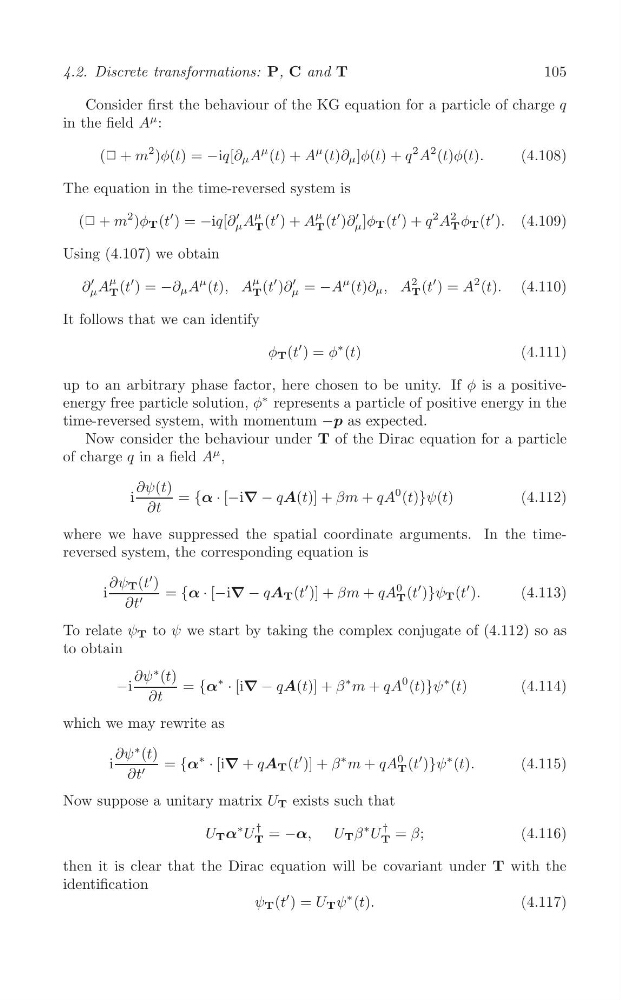
105
4.2. Discrete transformations: P, C and T
Consider first the behaviour of the KG equation for a particle of charge q
in the field A
μ :
(❗ + m
2 )φ(t) = −iq[∂ μ A
μ (t) + A
μ (t)∂ μ ]φ(t) + q
2 A
2 (t)φ(t).
(4.108)
The equation in the time-reversed system is
μ
μ
2 A
2
(❗ + m
2 )φ T (t
′ ) = −iq[∂ μ
′ A (t
′ ) + A (t
′ )∂ μ
′ ]φ T (t
′ ) + q T φ T (t
′ ). (4.109)
T
T
Using (4.107) we obtain
μ
μ
∂ μ
′ A (t
′ ) = −∂ μ A
μ (t), A (t
′ )∂
′ = −A
μ (t)∂ μ , A
2 ′ ) = A
2 (t).
T (t
(4.110)
T
T
μ
It follows that we can identify
φ T (t
′ ) = φ
∗ (t)
(4.111)
up to an arbitrary phase factor, here chosen to be unity. If φ is a positiveenergy free particle solution, φ
∗ represents a particle of positive energy in the
time-reversed system, with momentum −p as expected.
Now consider the behaviour under T of the Dirac equation for a particle
of charge q in a field A
μ ,
∂ψ(t)
i
= {α · [−i∇ − qA(t)] + βm + qA
0 (t)}ψ(t)
(4.112)
∂t
where we have suppressed the spatial coordinate arguments. In the timereversed system, the corresponding equation is
∂ψ T (t
′ )
i
=
[−i∇ − qA T (t
′ )] + βm + qA
0
′ ).
{α ·
T (t
′ )}ψ T (t
(4.113)
∂t ′
To relate ψ T to ψ we start by taking the complex conjugate of (4.112) so as
to obtain
∂ψ
∗ (t)
−i
= {α
∗
· [i∇ − qA(t)] + β
∗ m + qA
0 (t)}ψ
∗ (t)
(4.114)
∂t
which we may rewrite as
∂ψ
∗ (t)
i
= {α
∗
· [i∇ + qA T (t
′ )] + β
∗ m + qA T
0 (t
′ )}ψ
∗ (t).
(4.115)
∂t ′
Now suppose a unitary matrix U T exists such that
†
†
U T α
∗ U = −α, U T β
∗ U = β;
(4.116)
T
T
then it is clear that the Dirac equation will be covariant under T with the
identification
ψ T (t
′ ) = U T ψ
∗ (t).
(4.117)
4.2. Discrete transformations: P, C and T
Consider first the behaviour of the KG equation for a particle of charge q
in the field A
μ :
(❗ + m
2 )φ(t) = −iq[∂ μ A
μ (t) + A
μ (t)∂ μ ]φ(t) + q
2 A
2 (t)φ(t).
(4.108)
The equation in the time-reversed system is
μ
μ
2 A
2
(❗ + m
2 )φ T (t
′ ) = −iq[∂ μ
′ A (t
′ ) + A (t
′ )∂ μ
′ ]φ T (t
′ ) + q T φ T (t
′ ). (4.109)
T
T
Using (4.107) we obtain
μ
μ
∂ μ
′ A (t
′ ) = −∂ μ A
μ (t), A (t
′ )∂
′ = −A
μ (t)∂ μ , A
2 ′ ) = A
2 (t).
T (t
(4.110)
T
T
μ
It follows that we can identify
φ T (t
′ ) = φ
∗ (t)
(4.111)
up to an arbitrary phase factor, here chosen to be unity. If φ is a positiveenergy free particle solution, φ
∗ represents a particle of positive energy in the
time-reversed system, with momentum −p as expected.
Now consider the behaviour under T of the Dirac equation for a particle
of charge q in a field A
μ ,
∂ψ(t)
i
= {α · [−i∇ − qA(t)] + βm + qA
0 (t)}ψ(t)
(4.112)
∂t
where we have suppressed the spatial coordinate arguments. In the timereversed system, the corresponding equation is
∂ψ T (t
′ )
i
=
[−i∇ − qA T (t
′ )] + βm + qA
0
′ ).
{α ·
T (t
′ )}ψ T (t
(4.113)
∂t ′
To relate ψ T to ψ we start by taking the complex conjugate of (4.112) so as
to obtain
∂ψ
∗ (t)
−i
= {α
∗
· [i∇ − qA(t)] + β
∗ m + qA
0 (t)}ψ
∗ (t)
(4.114)
∂t
which we may rewrite as
∂ψ
∗ (t)
i
= {α
∗
· [i∇ + qA T (t
′ )] + β
∗ m + qA T
0 (t
′ )}ψ
∗ (t).
(4.115)
∂t ′
Now suppose a unitary matrix U T exists such that
†
†
U T α
∗ U = −α, U T β
∗ U = β;
(4.116)
T
T
then it is clear that the Dirac equation will be covariant under T with the
identification
ψ T (t
′ ) = U T ψ
∗ (t).
(4.117)