

141
The search for areas of chlorophyll (a) concentration, which is the first link in the food chain,
makes it possible to identify schools of fish that are prey to bluefin tuna such as: mackerel,
herring, sardines, anchovies and krill. Moreover, (FURNESTIN, 1963; Marie-louise,
1957)explained that the third link in the food chain, that of the Chaetognaths: Sagitta
serratodentata and Sagitta elegans, are indicators of mackerel and herring respectively.
Moreover, sardines and anchovies use two feeding behaviours: by filtration (they consume
phytoplankton), or by predation (planktonic prey) ((Chouvelon et al., 2014b); (Ganias, 2014b)
; (Palomera et al., 2007b);(Plounevez and Champalbert, 2000b)). Chlorophyll (a)
concentrations in fishing areas were found to vary from 0.06 to 6.59 mg.m-3 Table 1.
Average chlorophyll (a) concentrations in areas of bluefin tuna overabundance are low, ranging
from 0.11 to 0.14 mg.m-3 in spring seasons and 0.15 to 0.23 mg.m-3 in summer seasons fig.14,
According to (Teo et al., 2007d), tagged adult BFT were located in areas with relatively low
surface chlorophyll concentrations (0.10 to 0.16 mg.m-3).figs.12 , 9 PCA showed that nitrate
(NO3) levels in the fishing area are strongly related to the total length of bluefin tuna (r = 0.717,
p < 0.0001). The limits of nitrate concentrations recorded in the biotope of this species vary
between 0.005 and 8.15 mmol.m-3 Table 1. The nutrient element such as nitrate is important in
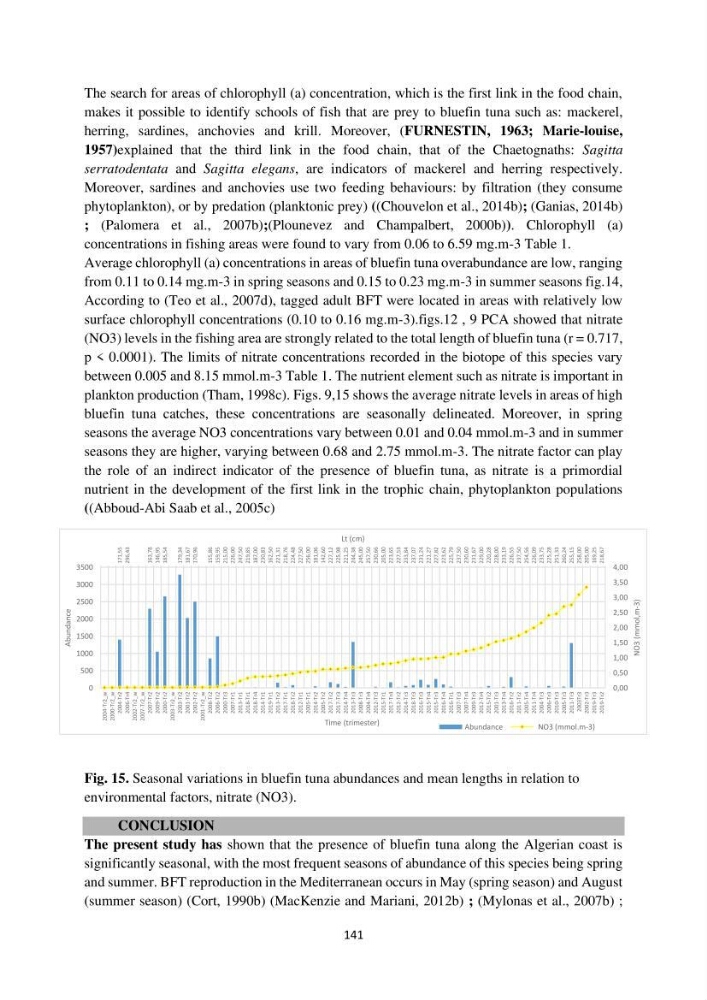
plankton production (Tham, 1998c). Figs. 9,15 shows the average nitrate levels in areas of high
bluefin tuna catches, these concentrations are seasonally delineated. Moreover, in spring
seasons the average NO3 concentrations vary between 0.01 and 0.04 mmol.m-3 and in summer
seasons they are higher, varying between 0.68 and 2.75 mmol.m-3. The nitrate factor can play
the role of an indirect indicator of the presence of bluefin tuna, as nitrate is a primordial
nutrient in the development of the first link in the trophic chain, phytoplankton populations
((Abboud-Abi Saab et al., 2005c)
Fig. 15. Seasonal variations in bluefin tuna abundances and mean lengths in relation to
environmental factors, nitrate (NO3).
CONCLUSION
The present study has shown that the presence of bluefin tuna along the Algerian coast is
significantly seasonal, with the most frequent seasons of abundance of this species being spring
and summer. BFT reproduction in the Mediterranean occurs in May (spring season) and August
(summer season) (Cort, 1990b) (MacKenzie and Mariani, 2012b) ; (Mylonas et al., 2007b) ;
171,55 296,43
163,78 146,95 185,54
179,34 181,67 170,96
155,86 159,95 215,00 226,00 247,50 219,85 187,00 230,83 162,50 221,31 218,76 224,48 227,50 256,00
181,06 142,60 227,12 225,98 221,25 244,38 245,00 257,50 230,66 205,00 223,65 227,53 233,84 237,07 231,24 221,27 227,82 223,62 225,79 237,50 230,60 231,67 229,00
220,28 228,00 233,19 226,55 237,50 254,56 226,09 233,75 225,28 251,33 260,24 255,15 258,00 205,00 169,25 218,67
0,00
0,50
1,00
1,50
2,00
2,50
3,00
3,50
4,00
0
500
1000
1500
2000
2500
3000
3500
2004-Tr2_w 2000-Tr2_w
2004-Tr2 2006-Tr4 2002-Tr2_w
2007-Tr2_w
2007-Tr2 2009-Tr2 2000-Tr2 2003-Tr2_w
2003-Tr2 2001-Tr2 2002-Tr2 2001-Tr2_w
2008-Tr2 2006-Tr2 2000-Tr3 2007-Tr1 2013-Tr1 2018-Tr1 2018-Tr4 2014-Tr1 2019-Tr1 2013-Tr2 2017-Tr1 2018-Tr2 2012-Tr1 2005-Tr1
2014-Tr2 2005-Tr2 2017-Tr2 2017-Tr3 2014-Tr4 2013-Tr3 2008-Tr3 2004-Tr4 2012-Tr3 2015-Tr1 2017-Tr4 2012-Tr2 2014-Tr3 2018-Tr3 2016-Tr3 2015-Tr4 2015-Tr3 2016-Tr4 2016-Tr1 2007-Tr3 2007-Tr4 2009-Tr3 2012-Tr4
2015-Tr2 2001-Tr3 2013-Tr4 2016-Tr2 2011-Tr2 2005-Tr4 2011-Tr4 2004-Tr3 2006-Tr3 2010-Tr3 2005-Tr3 2011-Tr3
2003Tr3 2002-Tr3 2019-Tr3 2019-Tr2
Lt (cm)
NO3
(mmol,m-3)
Abundance
Time (trimester)
Abundance
NO3 (mmol.m-3)
The search for areas of chlorophyll (a) concentration, which is the first link in the food chain,
makes it possible to identify schools of fish that are prey to bluefin tuna such as: mackerel,
herring, sardines, anchovies and krill. Moreover, (FURNESTIN, 1963; Marie-louise,
1957)explained that the third link in the food chain, that of the Chaetognaths: Sagitta
serratodentata and Sagitta elegans, are indicators of mackerel and herring respectively.
Moreover, sardines and anchovies use two feeding behaviours: by filtration (they consume
phytoplankton), or by predation (planktonic prey) ((Chouvelon et al., 2014b); (Ganias, 2014b)
; (Palomera et al., 2007b);(Plounevez and Champalbert, 2000b)). Chlorophyll (a)
concentrations in fishing areas were found to vary from 0.06 to 6.59 mg.m-3 Table 1.
Average chlorophyll (a) concentrations in areas of bluefin tuna overabundance are low, ranging
from 0.11 to 0.14 mg.m-3 in spring seasons and 0.15 to 0.23 mg.m-3 in summer seasons fig.14,
According to (Teo et al., 2007d), tagged adult BFT were located in areas with relatively low
surface chlorophyll concentrations (0.10 to 0.16 mg.m-3).figs.12 , 9 PCA showed that nitrate
(NO3) levels in the fishing area are strongly related to the total length of bluefin tuna (r = 0.717,
p < 0.0001). The limits of nitrate concentrations recorded in the biotope of this species vary
between 0.005 and 8.15 mmol.m-3 Table 1. The nutrient element such as nitrate is important in
plankton production (Tham, 1998c). Figs. 9,15 shows the average nitrate levels in areas of high
bluefin tuna catches, these concentrations are seasonally delineated. Moreover, in spring
seasons the average NO3 concentrations vary between 0.01 and 0.04 mmol.m-3 and in summer
seasons they are higher, varying between 0.68 and 2.75 mmol.m-3. The nitrate factor can play
the role of an indirect indicator of the presence of bluefin tuna, as nitrate is a primordial
nutrient in the development of the first link in the trophic chain, phytoplankton populations
((Abboud-Abi Saab et al., 2005c)
Fig. 15. Seasonal variations in bluefin tuna abundances and mean lengths in relation to
environmental factors, nitrate (NO3).
CONCLUSION
The present study has shown that the presence of bluefin tuna along the Algerian coast is
significantly seasonal, with the most frequent seasons of abundance of this species being spring
and summer. BFT reproduction in the Mediterranean occurs in May (spring season) and August
(summer season) (Cort, 1990b) (MacKenzie and Mariani, 2012b) ; (Mylonas et al., 2007b) ;
171,55 296,43
163,78 146,95 185,54
179,34 181,67 170,96
155,86 159,95 215,00 226,00 247,50 219,85 187,00 230,83 162,50 221,31 218,76 224,48 227,50 256,00
181,06 142,60 227,12 225,98 221,25 244,38 245,00 257,50 230,66 205,00 223,65 227,53 233,84 237,07 231,24 221,27 227,82 223,62 225,79 237,50 230,60 231,67 229,00
220,28 228,00 233,19 226,55 237,50 254,56 226,09 233,75 225,28 251,33 260,24 255,15 258,00 205,00 169,25 218,67
0,00
0,50
1,00
1,50
2,00
2,50
3,00
3,50
4,00
0
500
1000
1500
2000
2500
3000
3500
2004-Tr2_w 2000-Tr2_w
2004-Tr2 2006-Tr4 2002-Tr2_w
2007-Tr2_w
2007-Tr2 2009-Tr2 2000-Tr2 2003-Tr2_w
2003-Tr2 2001-Tr2 2002-Tr2 2001-Tr2_w
2008-Tr2 2006-Tr2 2000-Tr3 2007-Tr1 2013-Tr1 2018-Tr1 2018-Tr4 2014-Tr1 2019-Tr1 2013-Tr2 2017-Tr1 2018-Tr2 2012-Tr1 2005-Tr1
2014-Tr2 2005-Tr2 2017-Tr2 2017-Tr3 2014-Tr4 2013-Tr3 2008-Tr3 2004-Tr4 2012-Tr3 2015-Tr1 2017-Tr4 2012-Tr2 2014-Tr3 2018-Tr3 2016-Tr3 2015-Tr4 2015-Tr3 2016-Tr4 2016-Tr1 2007-Tr3 2007-Tr4 2009-Tr3 2012-Tr4
2015-Tr2 2001-Tr3 2013-Tr4 2016-Tr2 2011-Tr2 2005-Tr4 2011-Tr4 2004-Tr3 2006-Tr3 2010-Tr3 2005-Tr3 2011-Tr3
2003Tr3 2002-Tr3 2019-Tr3 2019-Tr2
Lt (cm)
NO3
(mmol,m-3)
Abundance
Time (trimester)
Abundance
NO3 (mmol.m-3)