

5.5 Research Agenda for Strengthening the Footprint–boundary …
83
5.5.3 Harmonization of the Footprint Metric
and the Boundary Metric
In concretizing the F–B ESA framework presented in the chapter, maintaining the
harmonization between the footprint and boundary metrics deserves priority. We
elaborate on this in two aspects: the harmonization of coverage and the harmonization
of methodologies.
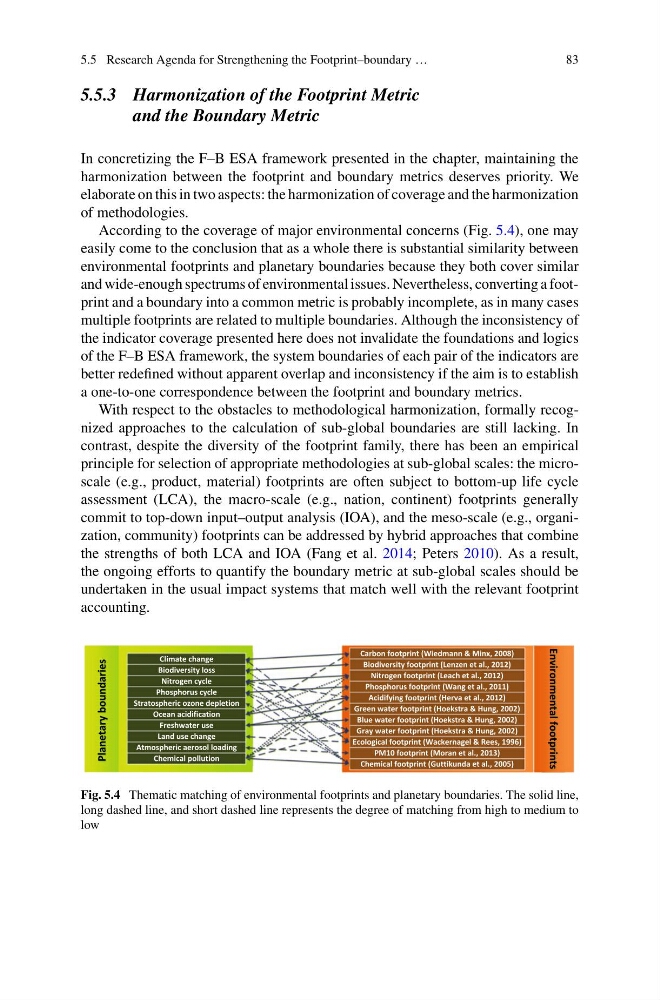
According to the coverage of major environmental concerns (Fig. 5.4), one may
easily come to the conclusion that as a whole there is substantial similarity between
environmental footprints and planetary boundaries because they both cover similar
and wide-enough spectrums of environmental issues. Nevertheless, converting a footprint and a boundary into a common metric is probably incomplete, as in many cases
multiple footprints are related to multiple boundaries. Although the inconsistency of
the indicator coverage presented here does not invalidate the foundations and logics
of the F–B ESA framework, the system boundaries of each pair of the indicators are
better redefined without apparent overlap and inconsistency if the aim is to establish
a one-to-one correspondence between the footprint and boundary metrics.
With respect to the obstacles to methodological harmonization, formally recognized approaches to the calculation of sub-global boundaries are still lacking. In
contrast, despite the diversity of the footprint family, there has been an empirical
principle for selection of appropriate methodologies at sub-global scales: the microscale (e.g., product, material) footprints are often subject to bottom-up life cycle
assessment (LCA), the macro-scale (e.g., nation, continent) footprints generally
commit to top-down input–output analysis (IOA), and the meso-scale (e.g., organization, community) footprints can be addressed by hybrid approaches that combine
the strengths of both LCA and IOA (Fang et al. 2014; Peters 2010). As a result,
the ongoing efforts to quantify the boundary metric at sub-global scales should be
undertaken in the usual impact systems that match well with the relevant footprint
accounting.
Fig. 5.4 Thematic matching of environmental footprints and planetary boundaries. The solid line,
long dashed line, and short dashed line represents the degree of matching from high to medium to
low
83
5.5.3 Harmonization of the Footprint Metric
and the Boundary Metric
In concretizing the F–B ESA framework presented in the chapter, maintaining the
harmonization between the footprint and boundary metrics deserves priority. We
elaborate on this in two aspects: the harmonization of coverage and the harmonization
of methodologies.
According to the coverage of major environmental concerns (Fig. 5.4), one may
easily come to the conclusion that as a whole there is substantial similarity between
environmental footprints and planetary boundaries because they both cover similar
and wide-enough spectrums of environmental issues. Nevertheless, converting a footprint and a boundary into a common metric is probably incomplete, as in many cases
multiple footprints are related to multiple boundaries. Although the inconsistency of
the indicator coverage presented here does not invalidate the foundations and logics
of the F–B ESA framework, the system boundaries of each pair of the indicators are
better redefined without apparent overlap and inconsistency if the aim is to establish
a one-to-one correspondence between the footprint and boundary metrics.
With respect to the obstacles to methodological harmonization, formally recognized approaches to the calculation of sub-global boundaries are still lacking. In
contrast, despite the diversity of the footprint family, there has been an empirical
principle for selection of appropriate methodologies at sub-global scales: the microscale (e.g., product, material) footprints are often subject to bottom-up life cycle
assessment (LCA), the macro-scale (e.g., nation, continent) footprints generally
commit to top-down input–output analysis (IOA), and the meso-scale (e.g., organization, community) footprints can be addressed by hybrid approaches that combine
the strengths of both LCA and IOA (Fang et al. 2014; Peters 2010). As a result,
the ongoing efforts to quantify the boundary metric at sub-global scales should be
undertaken in the usual impact systems that match well with the relevant footprint
accounting.
Fig. 5.4 Thematic matching of environmental footprints and planetary boundaries. The solid line,
long dashed line, and short dashed line represents the degree of matching from high to medium to
low