

82
5 Understanding the Complementarities of Environmental …
does not verify that all entities should take an equal responsibility for emission reduction—a politically salient issue that tends to trigger international instability. To start
downscaling systemic boundaries for the allocation of responsibility, establishing
internationally agreed criteria is a preparatory step towards a politically acceptable
way, just like the distribution of CO 2 emission quotas (Germain and Van Steenberghe
2003).
Any environmental agreement on the partitioning of systemic planetary boundaries requires negotiation and compromise among different levels of stakeholders
such as governments, non-governmental organizations, corporations, and individual
citizens. In the absence of reliable databases for local conditions, the partitioning
of the “cake” can be first implemented nation by nation. Admittedly, there is more
than one way to operationalize such a top-down process, such as on a population size
base, a Gross Domestic Product (GDP) base, a territorial area base, or on other bases.
Extending the national-scale boundary to sub-national scales will only be realized by
a large number of dedicated personnel with sufficient technical and financial support.
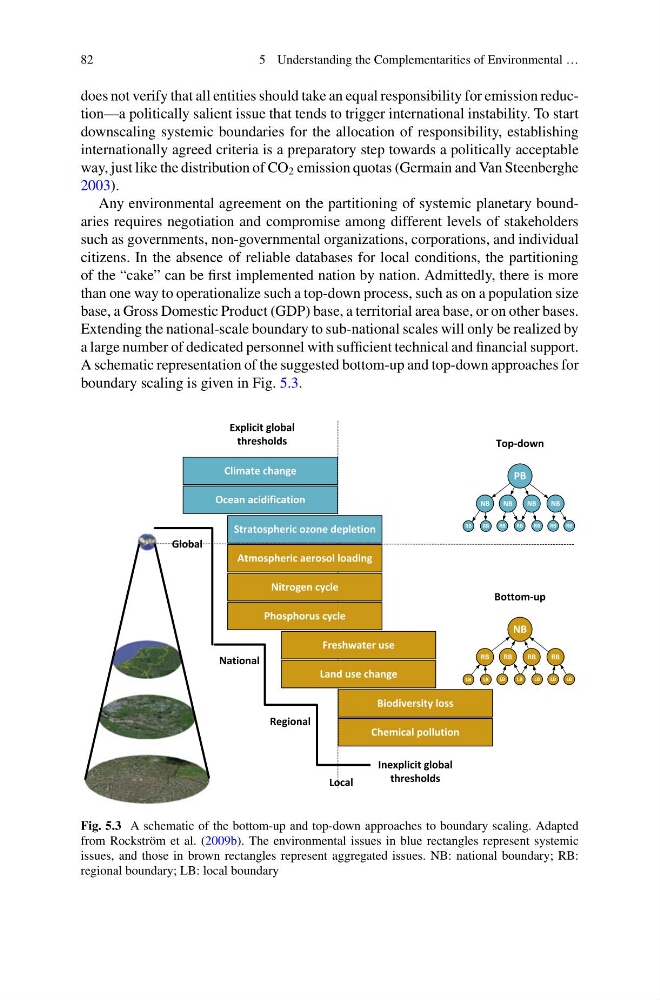
A schematic representation of the suggested bottom-up and top-down approaches for
boundary scaling is given in Fig. 5.3.
Fig. 5.3 A schematic of the bottom-up and top-down approaches to boundary scaling. Adapted
from Rockström et al. (2009b). The environmental issues in blue rectangles represent systemic
issues, and those in brown rectangles represent aggregated issues. NB: national boundary; RB:
regional boundary; LB: local boundary
5 Understanding the Complementarities of Environmental …
does not verify that all entities should take an equal responsibility for emission reduction—a politically salient issue that tends to trigger international instability. To start
downscaling systemic boundaries for the allocation of responsibility, establishing
internationally agreed criteria is a preparatory step towards a politically acceptable
way, just like the distribution of CO 2 emission quotas (Germain and Van Steenberghe
2003).
Any environmental agreement on the partitioning of systemic planetary boundaries requires negotiation and compromise among different levels of stakeholders
such as governments, non-governmental organizations, corporations, and individual
citizens. In the absence of reliable databases for local conditions, the partitioning
of the “cake” can be first implemented nation by nation. Admittedly, there is more
than one way to operationalize such a top-down process, such as on a population size
base, a Gross Domestic Product (GDP) base, a territorial area base, or on other bases.
Extending the national-scale boundary to sub-national scales will only be realized by
a large number of dedicated personnel with sufficient technical and financial support.
A schematic representation of the suggested bottom-up and top-down approaches for
boundary scaling is given in Fig. 5.3.
Fig. 5.3 A schematic of the bottom-up and top-down approaches to boundary scaling. Adapted
from Rockström et al. (2009b). The environmental issues in blue rectangles represent systemic
issues, and those in brown rectangles represent aggregated issues. NB: national boundary; RB:
regional boundary; LB: local boundary