

100
6 Benchmarking the Carbon, Water and Land Footprints …
6.2.5.2 Environmental Sustainability Ratio (ESR)
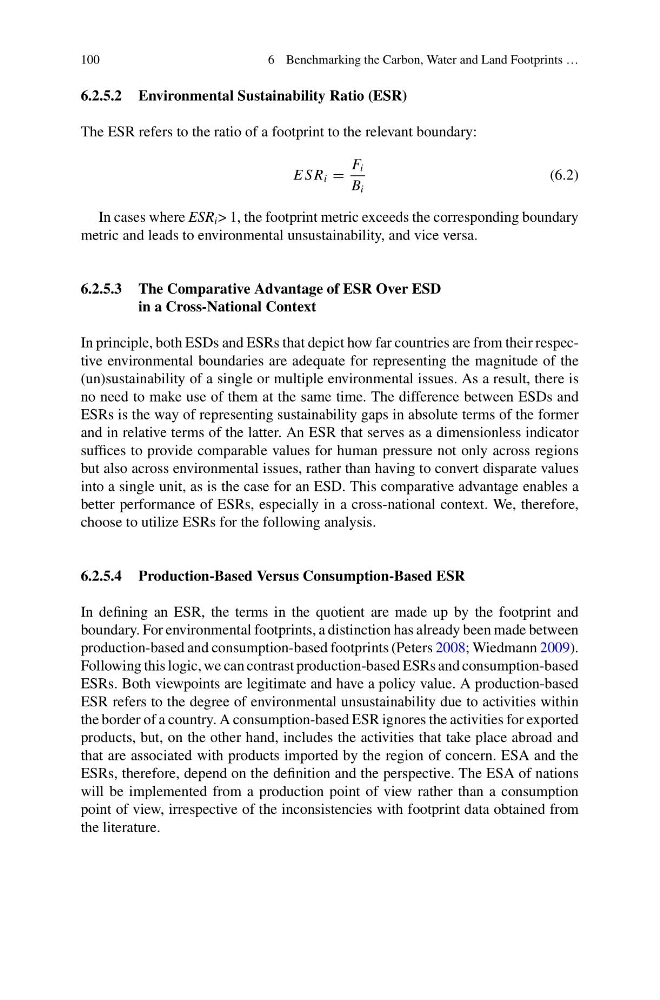
The ESR refers to the ratio of a footprint to the relevant boundary:
E S R i =
F i
B i
(6.2)
In cases where ESR i > 1, the footprint metric exceeds the corresponding boundary
metric and leads to environmental unsustainability, and vice versa.
6.2.5.3 The Comparative Advantage of ESR Over ESD
in a Cross-National Context
In principle, both ESDs and ESRs that depict how far countries are from their respective environmental boundaries are adequate for representing the magnitude of the
(un)sustainability of a single or multiple environmental issues. As a result, there is
no need to make use of them at the same time. The difference between ESDs and
ESRs is the way of representing sustainability gaps in absolute terms of the former
and in relative terms of the latter. An ESR that serves as a dimensionless indicator
suffices to provide comparable values for human pressure not only across regions
but also across environmental issues, rather than having to convert disparate values
into a single unit, as is the case for an ESD. This comparative advantage enables a
better performance of ESRs, especially in a cross-national context. We, therefore,
choose to utilize ESRs for the following analysis.
6.2.5.4 Production-Based Versus Consumption-Based ESR
In defining an ESR, the terms in the quotient are made up by the footprint and
boundary. For environmental footprints, a distinction has already been made between
production-based and consumption-based footprints (Peters 2008; Wiedmann 2009).
Following this logic, we can contrast production-based ESRs and consumption-based
ESRs. Both viewpoints are legitimate and have a policy value. A production-based
ESR refers to the degree of environmental unsustainability due to activities within
the border of a country. A consumption-based ESR ignores the activities for exported
products, but, on the other hand, includes the activities that take place abroad and
that are associated with products imported by the region of concern. ESA and the
ESRs, therefore, depend on the definition and the perspective. The ESA of nations
will be implemented from a production point of view rather than a consumption
point of view, irrespective of the inconsistencies with footprint data obtained from
the literature.
6 Benchmarking the Carbon, Water and Land Footprints …
6.2.5.2 Environmental Sustainability Ratio (ESR)
The ESR refers to the ratio of a footprint to the relevant boundary:
E S R i =
F i
B i
(6.2)
In cases where ESR i > 1, the footprint metric exceeds the corresponding boundary
metric and leads to environmental unsustainability, and vice versa.
6.2.5.3 The Comparative Advantage of ESR Over ESD
in a Cross-National Context
In principle, both ESDs and ESRs that depict how far countries are from their respective environmental boundaries are adequate for representing the magnitude of the
(un)sustainability of a single or multiple environmental issues. As a result, there is
no need to make use of them at the same time. The difference between ESDs and
ESRs is the way of representing sustainability gaps in absolute terms of the former
and in relative terms of the latter. An ESR that serves as a dimensionless indicator
suffices to provide comparable values for human pressure not only across regions
but also across environmental issues, rather than having to convert disparate values
into a single unit, as is the case for an ESD. This comparative advantage enables a
better performance of ESRs, especially in a cross-national context. We, therefore,
choose to utilize ESRs for the following analysis.
6.2.5.4 Production-Based Versus Consumption-Based ESR
In defining an ESR, the terms in the quotient are made up by the footprint and
boundary. For environmental footprints, a distinction has already been made between
production-based and consumption-based footprints (Peters 2008; Wiedmann 2009).
Following this logic, we can contrast production-based ESRs and consumption-based
ESRs. Both viewpoints are legitimate and have a policy value. A production-based
ESR refers to the degree of environmental unsustainability due to activities within
the border of a country. A consumption-based ESR ignores the activities for exported
products, but, on the other hand, includes the activities that take place abroad and
that are associated with products imported by the region of concern. ESA and the
ESRs, therefore, depend on the definition and the perspective. The ESA of nations
will be implemented from a production point of view rather than a consumption
point of view, irrespective of the inconsistencies with footprint data obtained from
the literature.