

80
M. Rz˛ etała
Kozłowa Góra Reservoir within the Przemsza River basin was also adapted for water
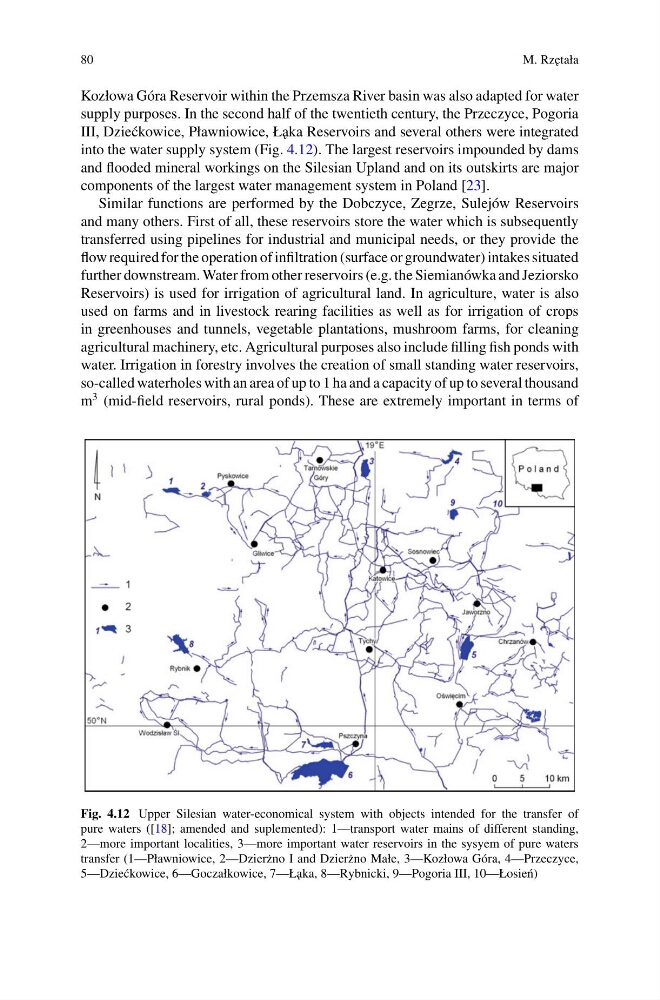
supply purposes. In the second half of the twentieth century, the Przeczyce, Pogoria
III, Dzie´ ckowice, Pławniowice, Ł˛ aka Reservoirs and several others were integrated
into the water supply system (Fig. 4.12). The largest reservoirs impounded by dams
and flooded mineral workings on the Silesian Upland and on its outskirts are major
components of the largest water management system in Poland [23].
Similar functions are performed by the Dobczyce, Zegrze, Sulejów Reservoirs
and many others. First of all, these reservoirs store the water which is subsequently
transferred using pipelines for industrial and municipal needs, or they provide the
flow required for the operation of infiltration (surface or groundwater) intakes situated
further downstream. Water from other reservoirs (e.g. the Siemianówka and Jeziorsko
Reservoirs) is used for irrigation of agricultural land. In agriculture, water is also
used on farms and in livestock rearing facilities as well as for irrigation of crops
in greenhouses and tunnels, vegetable plantations, mushroom farms, for cleaning
agricultural machinery, etc. Agricultural purposes also include filling fish ponds with
water. Irrigation in forestry involves the creation of small standing water reservoirs,
so-called waterholes with an area of up to 1 ha and a capacity of up to several thousand
m
3 (mid-field reservoirs, rural ponds). These are extremely important in terms of
Fig. 4.12 Upper Silesian water-economical system with objects intended for the transfer of
pure waters ([18]; amended and suplemented): 1—transport water mains of different standing,
2—more important localities, 3—more important water reservoirs in the sysyem of pure waters
transfer (1—Pławniowice, 2—Dzier˙ zno I and Dzier˙ zno Małe, 3—Kozłowa Góra, 4—Przeczyce,
5—Dzie´ ckowice, 6—Goczałkowice, 7—Ł˛ aka, 8—Rybnicki, 9—Pogoria III, 10—Łosie´ n)
M. Rz˛ etała
Kozłowa Góra Reservoir within the Przemsza River basin was also adapted for water
supply purposes. In the second half of the twentieth century, the Przeczyce, Pogoria
III, Dzie´ ckowice, Pławniowice, Ł˛ aka Reservoirs and several others were integrated
into the water supply system (Fig. 4.12). The largest reservoirs impounded by dams
and flooded mineral workings on the Silesian Upland and on its outskirts are major
components of the largest water management system in Poland [23].
Similar functions are performed by the Dobczyce, Zegrze, Sulejów Reservoirs
and many others. First of all, these reservoirs store the water which is subsequently
transferred using pipelines for industrial and municipal needs, or they provide the
flow required for the operation of infiltration (surface or groundwater) intakes situated
further downstream. Water from other reservoirs (e.g. the Siemianówka and Jeziorsko
Reservoirs) is used for irrigation of agricultural land. In agriculture, water is also
used on farms and in livestock rearing facilities as well as for irrigation of crops
in greenhouses and tunnels, vegetable plantations, mushroom farms, for cleaning
agricultural machinery, etc. Agricultural purposes also include filling fish ponds with
water. Irrigation in forestry involves the creation of small standing water reservoirs,
so-called waterholes with an area of up to 1 ha and a capacity of up to several thousand
m
3 (mid-field reservoirs, rural ponds). These are extremely important in terms of
Fig. 4.12 Upper Silesian water-economical system with objects intended for the transfer of
pure waters ([18]; amended and suplemented): 1—transport water mains of different standing,
2—more important localities, 3—more important water reservoirs in the sysyem of pure waters
transfer (1—Pławniowice, 2—Dzier˙ zno I and Dzier˙ zno Małe, 3—Kozłowa Góra, 4—Przeczyce,
5—Dzie´ ckowice, 6—Goczałkowice, 7—Ł˛ aka, 8—Rybnicki, 9—Pogoria III, 10—Łosie´ n)