

4 Anthropogenic Water Reservoirs in Poland
79
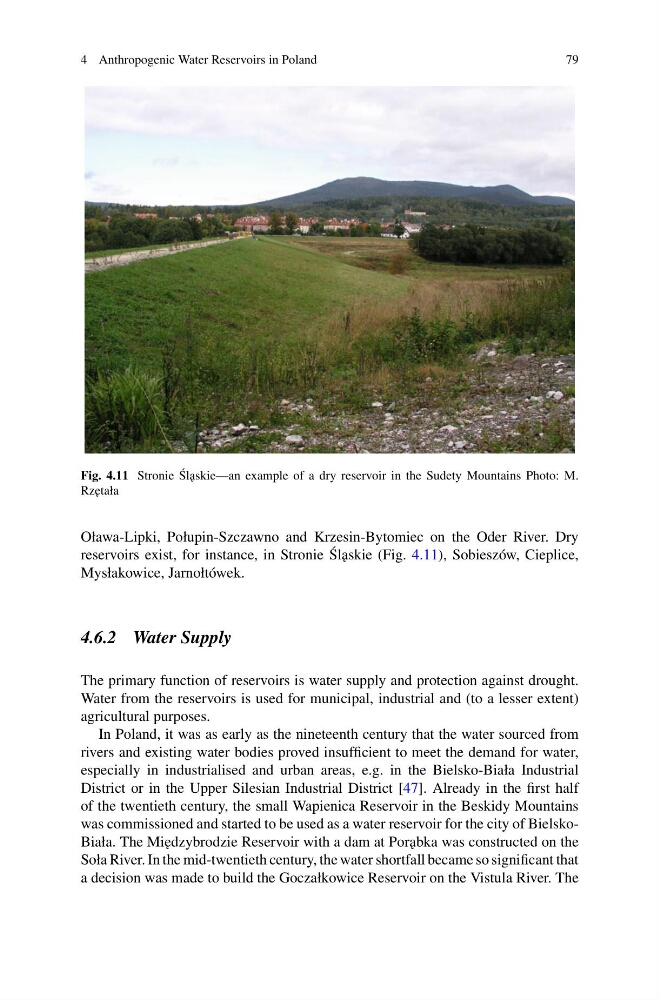
Fig. 4.11 Stronie ´
Sl˛ askie—an example of a dry reservoir in the Sudety Mountains Photo: M.
Rz˛ etała
Oława-Lipki, Połupin-Szczawno and Krzesin-Bytomiec on the Oder River. Dry
reservoirs exist, for instance, in Stronie ´
Sl˛ askie (Fig. 4.11), Sobieszów, Cieplice,
Mysłakowice, Jarnołtówek.
4.6.2 Water Supply
The primary function of reservoirs is water supply and protection against drought.
Water from the reservoirs is used for municipal, industrial and (to a lesser extent)
agricultural purposes.
In Poland, it was as early as the nineteenth century that the water sourced from
rivers and existing water bodies proved insufficient to meet the demand for water,
especially in industrialised and urban areas, e.g. in the Bielsko-Biała Industrial
District or in the Upper Silesian Industrial District [47]. Already in the first half
of the twentieth century, the small Wapienica Reservoir in the Beskidy Mountains
was commissioned and started to be used as a water reservoir for the city of BielskoBiała. The Mi˛ edzybrodzie Reservoir with a dam at Por˛ abka was constructed on the
Soła River. In the mid-twentieth century, the water shortfall became so significant that
a decision was made to build the Goczałkowice Reservoir on the Vistula River. The
79
Fig. 4.11 Stronie ´
Sl˛ askie—an example of a dry reservoir in the Sudety Mountains Photo: M.
Rz˛ etała
Oława-Lipki, Połupin-Szczawno and Krzesin-Bytomiec on the Oder River. Dry
reservoirs exist, for instance, in Stronie ´
Sl˛ askie (Fig. 4.11), Sobieszów, Cieplice,
Mysłakowice, Jarnołtówek.
4.6.2 Water Supply
The primary function of reservoirs is water supply and protection against drought.
Water from the reservoirs is used for municipal, industrial and (to a lesser extent)
agricultural purposes.
In Poland, it was as early as the nineteenth century that the water sourced from
rivers and existing water bodies proved insufficient to meet the demand for water,
especially in industrialised and urban areas, e.g. in the Bielsko-Biała Industrial
District or in the Upper Silesian Industrial District [47]. Already in the first half
of the twentieth century, the small Wapienica Reservoir in the Beskidy Mountains
was commissioned and started to be used as a water reservoir for the city of BielskoBiała. The Mi˛ edzybrodzie Reservoir with a dam at Por˛ abka was constructed on the
Soła River. In the mid-twentieth century, the water shortfall became so significant that
a decision was made to build the Goczałkowice Reservoir on the Vistula River. The