

4 Anthropogenic Water Reservoirs in Poland
61
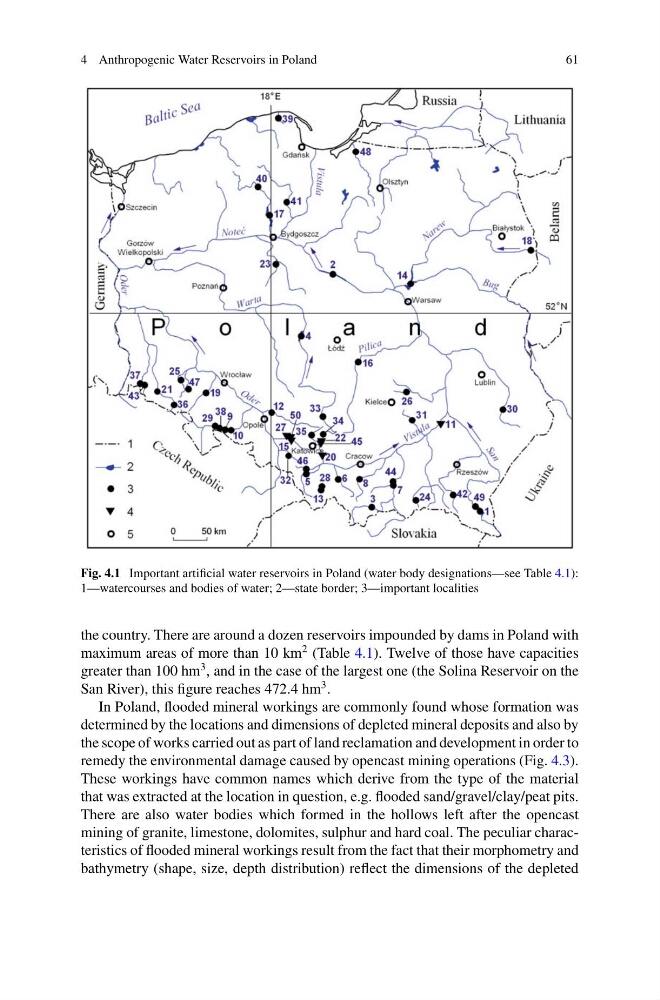
Fig. 4.1 Important artificial water reservoirs in Poland (water body designations—see Table 4.1):
1—watercourses and bodies of water; 2—state border; 3—important localities
the country. There are around a dozen reservoirs impounded by dams in Poland with
maximum areas of more than 10 km
2 (Table 4.1). Twelve of those have capacities
greater than 100 hm
3 , and in the case of the largest one (the Solina Reservoir on the
San River), this figure reaches 472.4 hm
3 .
In Poland, flooded mineral workings are commonly found whose formation was
determined by the locations and dimensions of depleted mineral deposits and also by
the scope of works carried out as part of land reclamation and development in order to
remedy the environmental damage caused by opencast mining operations (Fig. 4.3).
These workings have common names which derive from the type of the material
that was extracted at the location in question, e.g. flooded sand/gravel/clay/peat pits.
There are also water bodies which formed in the hollows left after the opencast
mining of granite, limestone, dolomites, sulphur and hard coal. The peculiar characteristics of flooded mineral workings result from the fact that their morphometry and
bathymetry (shape, size, depth distribution) reflect the dimensions of the depleted
61
Fig. 4.1 Important artificial water reservoirs in Poland (water body designations—see Table 4.1):
1—watercourses and bodies of water; 2—state border; 3—important localities
the country. There are around a dozen reservoirs impounded by dams in Poland with
maximum areas of more than 10 km
2 (Table 4.1). Twelve of those have capacities
greater than 100 hm
3 , and in the case of the largest one (the Solina Reservoir on the
San River), this figure reaches 472.4 hm
3 .
In Poland, flooded mineral workings are commonly found whose formation was
determined by the locations and dimensions of depleted mineral deposits and also by
the scope of works carried out as part of land reclamation and development in order to
remedy the environmental damage caused by opencast mining operations (Fig. 4.3).
These workings have common names which derive from the type of the material
that was extracted at the location in question, e.g. flooded sand/gravel/clay/peat pits.
There are also water bodies which formed in the hollows left after the opencast
mining of granite, limestone, dolomites, sulphur and hard coal. The peculiar characteristics of flooded mineral workings result from the fact that their morphometry and
bathymetry (shape, size, depth distribution) reflect the dimensions of the depleted