

402
T. Ciupa and R. Suligowski
0
10
20
30
40
50
60
Warsaw
Białystok
Łódź
Lublin
Poznań
Zielona Góra
Wrocław
Cracow
Toruń
Katowice
Olsztyn
Bydgoszcz
Gdańsk
Kielce
Gorzów W.
Opole
Rzeszów
Szczecin
%
mean - 42,1
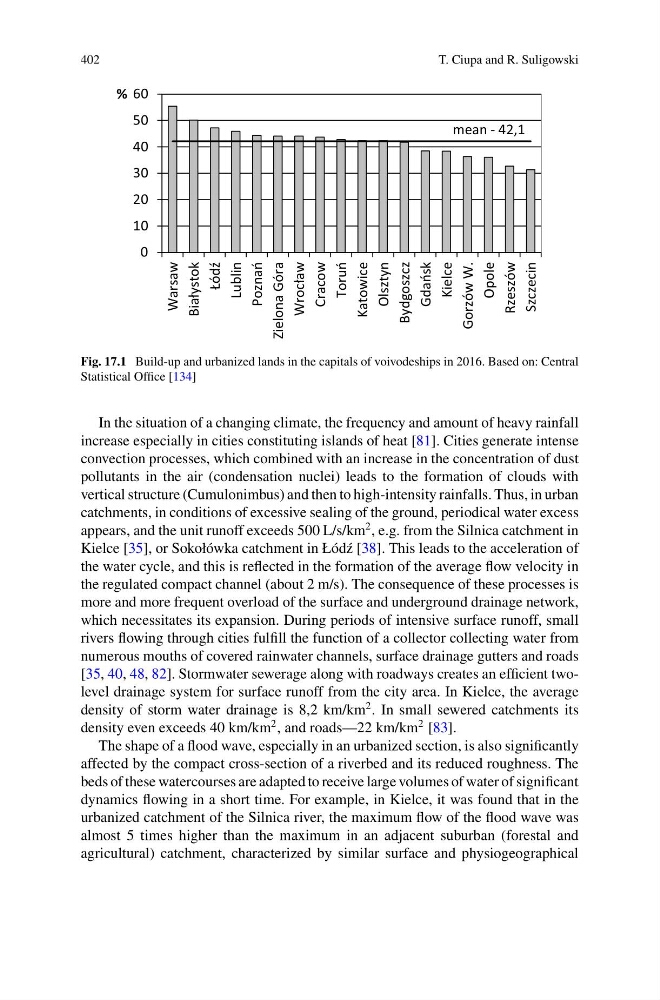
Fig. 17.1 Build-up and urbanized lands in the capitals of voivodeships in 2016. Based on: Central
Statistical Office [134]
In the situation of a changing climate, the frequency and amount of heavy rainfall
increase especially in cities constituting islands of heat [81]. Cities generate intense
convection processes, which combined with an increase in the concentration of dust
pollutants in the air (condensation nuclei) leads to the formation of clouds with
vertical structure (Cumulonimbus) and then to high-intensity rainfalls. Thus, in urban
catchments, in conditions of excessive sealing of the ground, periodical water excess
appears, and the unit runoff exceeds 500 L/s/km
2 , e.g. from the Silnica catchment in
Kielce [35], or Sokołówka catchment in Łód´ z [38]. This leads to the acceleration of
the water cycle, and this is reflected in the formation of the average flow velocity in
the regulated compact channel (about 2 m/s). The consequence of these processes is
more and more frequent overload of the surface and underground drainage network,
which necessitates its expansion. During periods of intensive surface runoff, small
rivers flowing through cities fulfill the function of a collector collecting water from
numerous mouths of covered rainwater channels, surface drainage gutters and roads
[35, 40, 48, 82]. Stormwater sewerage along with roadways creates an efficient twolevel drainage system for surface runoff from the city area. In Kielce, the average
density of storm water drainage is 8,2 km/km
2 . In small sewered catchments its
density even exceeds 40 km/km
2 , and roads—22 km/km
2 [83].
The shape of a flood wave, especially in an urbanized section, is also significantly
affected by the compact cross-section of a riverbed and its reduced roughness. The
beds of these watercourses are adapted to receive large volumes of water of significant
dynamics flowing in a short time. For example, in Kielce, it was found that in the
urbanized catchment of the Silnica river, the maximum flow of the flood wave was
almost 5 times higher than the maximum in an adjacent suburban (forestal and
agricultural) catchment, characterized by similar surface and physiogeographical
T. Ciupa and R. Suligowski
0
10
20
30
40
50
60
Warsaw
Białystok
Łódź
Lublin
Poznań
Zielona Góra
Wrocław
Cracow
Toruń
Katowice
Olsztyn
Bydgoszcz
Gdańsk
Kielce
Gorzów W.
Opole
Rzeszów
Szczecin
%
mean - 42,1
Fig. 17.1 Build-up and urbanized lands in the capitals of voivodeships in 2016. Based on: Central
Statistical Office [134]
In the situation of a changing climate, the frequency and amount of heavy rainfall
increase especially in cities constituting islands of heat [81]. Cities generate intense
convection processes, which combined with an increase in the concentration of dust
pollutants in the air (condensation nuclei) leads to the formation of clouds with
vertical structure (Cumulonimbus) and then to high-intensity rainfalls. Thus, in urban
catchments, in conditions of excessive sealing of the ground, periodical water excess
appears, and the unit runoff exceeds 500 L/s/km
2 , e.g. from the Silnica catchment in
Kielce [35], or Sokołówka catchment in Łód´ z [38]. This leads to the acceleration of
the water cycle, and this is reflected in the formation of the average flow velocity in
the regulated compact channel (about 2 m/s). The consequence of these processes is
more and more frequent overload of the surface and underground drainage network,
which necessitates its expansion. During periods of intensive surface runoff, small
rivers flowing through cities fulfill the function of a collector collecting water from
numerous mouths of covered rainwater channels, surface drainage gutters and roads
[35, 40, 48, 82]. Stormwater sewerage along with roadways creates an efficient twolevel drainage system for surface runoff from the city area. In Kielce, the average
density of storm water drainage is 8,2 km/km
2 . In small sewered catchments its
density even exceeds 40 km/km
2 , and roads—22 km/km
2 [83].
The shape of a flood wave, especially in an urbanized section, is also significantly
affected by the compact cross-section of a riverbed and its reduced roughness. The
beds of these watercourses are adapted to receive large volumes of water of significant
dynamics flowing in a short time. For example, in Kielce, it was found that in the
urbanized catchment of the Silnica river, the maximum flow of the flood wave was
almost 5 times higher than the maximum in an adjacent suburban (forestal and
agricultural) catchment, characterized by similar surface and physiogeographical