

338
E. Neverova-Dziopak
by the Author of the chapter, which fully meets the requirements set for modern
environmental indicators [12, 54]. The elaboration of this index was based on the
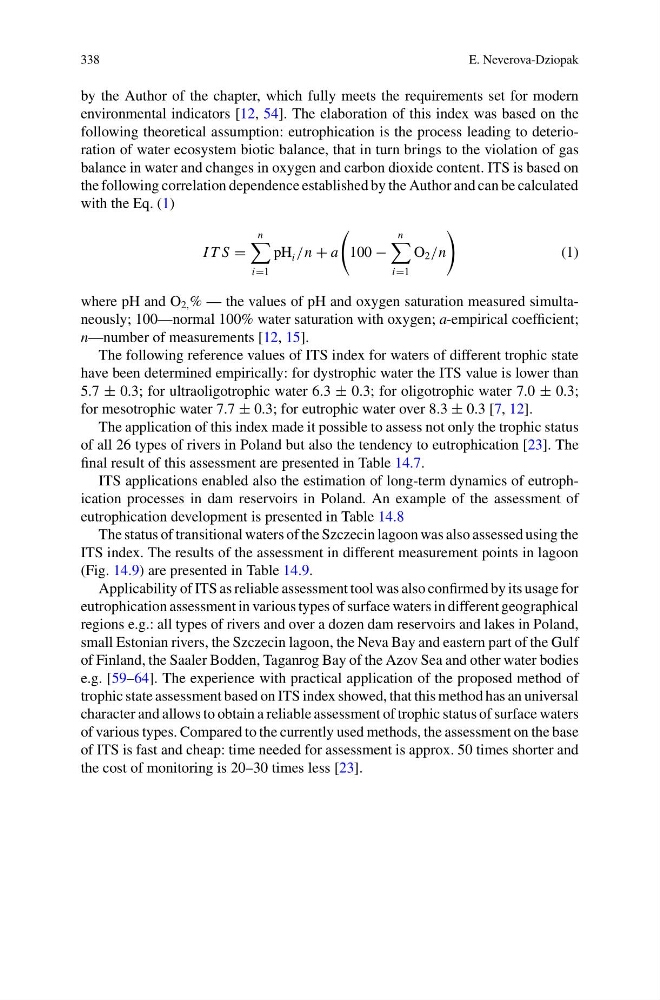
following theoretical assumption: eutrophication is the process leading to deterioration of water ecosystem biotic balance, that in turn brings to the violation of gas
balance in water and changes in oxygen and carbon dioxide content. ITS is based on
the following correlation dependence established by the Author and can be calculated
with the Eq. (1)
I T S =
n
i=1
pH i /n + a
100 −
n
i=1
O 2 /n
(1)
where pH and O 2, % — the values of pH and oxygen saturation measured simultaneously; 100—normal 100% water saturation with oxygen; a-empirical coefficient;
n—number of measurements [12, 15].
The following reference values of ITS index for waters of different trophic state
have been determined empirically: for dystrophic water the ITS value is lower than
5.7 ± 0.3; for ultraoligotrophic water 6.3 ± 0.3; for oligotrophic water 7.0 ± 0.3;
for mesotrophic water 7.7 ± 0.3; for eutrophic water over 8.3 ± 0.3 [7, 12].
The application of this index made it possible to assess not only the trophic status
of all 26 types of rivers in Poland but also the tendency to eutrophication [23]. The
final result of this assessment are presented in Table 14.7.
ITS applications enabled also the estimation of long-term dynamics of eutrophication processes in dam reservoirs in Poland. An example of the assessment of
eutrophication development is presented in Table 14.8
The status of transitional waters of the Szczecin lagoon was also assessed using the
ITS index. The results of the assessment in different measurement points in lagoon
(Fig. 14.9) are presented in Table 14.9.
Applicability of ITS as reliable assessment tool was also confirmed by its usage for
eutrophication assessment in various types of surface waters in different geographical
regions e.g.: all types of rivers and over a dozen dam reservoirs and lakes in Poland,
small Estonian rivers, the Szczecin lagoon, the Neva Bay and eastern part of the Gulf
of Finland, the Saaler Bodden, Taganrog Bay of the Azov Sea and other water bodies
e.g. [59–64]. The experience with practical application of the proposed method of
trophic state assessment based on ITS index showed, that this method has an universal
character and allows to obtain a reliable assessment of trophic status of surface waters
of various types. Compared to the currently used methods, the assessment on the base
of ITS is fast and cheap: time needed for assessment is approx. 50 times shorter and
the cost of monitoring is 20–30 times less [23].
E. Neverova-Dziopak
by the Author of the chapter, which fully meets the requirements set for modern
environmental indicators [12, 54]. The elaboration of this index was based on the
following theoretical assumption: eutrophication is the process leading to deterioration of water ecosystem biotic balance, that in turn brings to the violation of gas
balance in water and changes in oxygen and carbon dioxide content. ITS is based on
the following correlation dependence established by the Author and can be calculated
with the Eq. (1)
I T S =
n
i=1
pH i /n + a
100 −
n
i=1
O 2 /n
(1)
where pH and O 2, % — the values of pH and oxygen saturation measured simultaneously; 100—normal 100% water saturation with oxygen; a-empirical coefficient;
n—number of measurements [12, 15].
The following reference values of ITS index for waters of different trophic state
have been determined empirically: for dystrophic water the ITS value is lower than
5.7 ± 0.3; for ultraoligotrophic water 6.3 ± 0.3; for oligotrophic water 7.0 ± 0.3;
for mesotrophic water 7.7 ± 0.3; for eutrophic water over 8.3 ± 0.3 [7, 12].
The application of this index made it possible to assess not only the trophic status
of all 26 types of rivers in Poland but also the tendency to eutrophication [23]. The
final result of this assessment are presented in Table 14.7.
ITS applications enabled also the estimation of long-term dynamics of eutrophication processes in dam reservoirs in Poland. An example of the assessment of
eutrophication development is presented in Table 14.8
The status of transitional waters of the Szczecin lagoon was also assessed using the
ITS index. The results of the assessment in different measurement points in lagoon
(Fig. 14.9) are presented in Table 14.9.
Applicability of ITS as reliable assessment tool was also confirmed by its usage for
eutrophication assessment in various types of surface waters in different geographical
regions e.g.: all types of rivers and over a dozen dam reservoirs and lakes in Poland,
small Estonian rivers, the Szczecin lagoon, the Neva Bay and eastern part of the Gulf
of Finland, the Saaler Bodden, Taganrog Bay of the Azov Sea and other water bodies
e.g. [59–64]. The experience with practical application of the proposed method of
trophic state assessment based on ITS index showed, that this method has an universal
character and allows to obtain a reliable assessment of trophic status of surface waters
of various types. Compared to the currently used methods, the assessment on the base
of ITS is fast and cheap: time needed for assessment is approx. 50 times shorter and
the cost of monitoring is 20–30 times less [23].