

328
E. Neverova-Dziopak
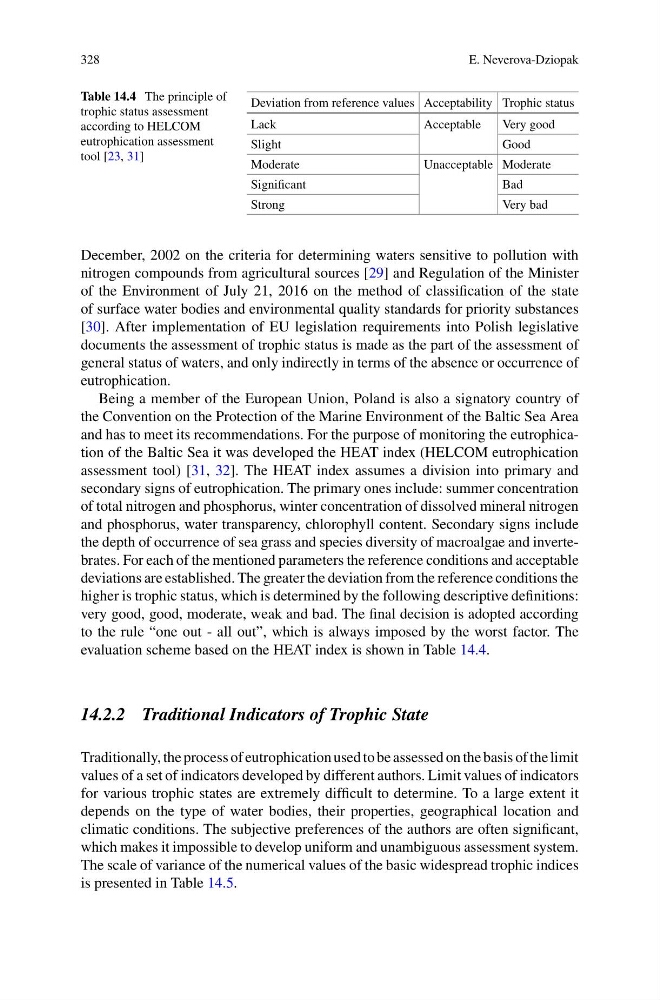
Table 14.4 The principle of
trophic status assessment
according to HELCOM
eutrophication assessment
tool [23, 31]
Deviation from reference values Acceptability Trophic status
Lack
Acceptable
Very good
Slight
Good
Moderate
Unacceptable Moderate
Significant
Bad
Strong
Very bad
December, 2002 on the criteria for determining waters sensitive to pollution with
nitrogen compounds from agricultural sources [29] and Regulation of the Minister
of the Environment of July 21, 2016 on the method of classification of the state
of surface water bodies and environmental quality standards for priority substances
[30]. After implementation of EU legislation requirements into Polish legislative
documents the assessment of trophic status is made as the part of the assessment of
general status of waters, and only indirectly in terms of the absence or occurrence of
eutrophication.
Being a member of the European Union, Poland is also a signatory country of
the Convention on the Protection of the Marine Environment of the Baltic Sea Area
and has to meet its recommendations. For the purpose of monitoring the eutrophication of the Baltic Sea it was developed the HEAT index (HELCOM eutrophication
assessment tool) [31, 32]. The HEAT index assumes a division into primary and
secondary signs of eutrophication. The primary ones include: summer concentration
of total nitrogen and phosphorus, winter concentration of dissolved mineral nitrogen
and phosphorus, water transparency, chlorophyll content. Secondary signs include
the depth of occurrence of sea grass and species diversity of macroalgae and invertebrates. For each of the mentioned parameters the reference conditions and acceptable
deviations are established. The greater the deviation from the reference conditions the
higher is trophic status, which is determined by the following descriptive definitions:
very good, good, moderate, weak and bad. The final decision is adopted according
to the rule “one out - all out”, which is always imposed by the worst factor. The
evaluation scheme based on the HEAT index is shown in Table 14.4.
14.2.2 Traditional Indicators of Trophic State
Traditionally, the process of eutrophication used to be assessed on the basis of the limit
values of a set of indicators developed by different authors. Limit values of indicators
for various trophic states are extremely difficult to determine. To a large extent it
depends on the type of water bodies, their properties, geographical location and
climatic conditions. The subjective preferences of the authors are often significant,
which makes it impossible to develop uniform and unambiguous assessment system.
The scale of variance of the numerical values of the basic widespread trophic indices
is presented in Table 14.5.
E. Neverova-Dziopak
Table 14.4 The principle of
trophic status assessment
according to HELCOM
eutrophication assessment
tool [23, 31]
Deviation from reference values Acceptability Trophic status
Lack
Acceptable
Very good
Slight
Good
Moderate
Unacceptable Moderate
Significant
Bad
Strong
Very bad
December, 2002 on the criteria for determining waters sensitive to pollution with
nitrogen compounds from agricultural sources [29] and Regulation of the Minister
of the Environment of July 21, 2016 on the method of classification of the state
of surface water bodies and environmental quality standards for priority substances
[30]. After implementation of EU legislation requirements into Polish legislative
documents the assessment of trophic status is made as the part of the assessment of
general status of waters, and only indirectly in terms of the absence or occurrence of
eutrophication.
Being a member of the European Union, Poland is also a signatory country of
the Convention on the Protection of the Marine Environment of the Baltic Sea Area
and has to meet its recommendations. For the purpose of monitoring the eutrophication of the Baltic Sea it was developed the HEAT index (HELCOM eutrophication
assessment tool) [31, 32]. The HEAT index assumes a division into primary and
secondary signs of eutrophication. The primary ones include: summer concentration
of total nitrogen and phosphorus, winter concentration of dissolved mineral nitrogen
and phosphorus, water transparency, chlorophyll content. Secondary signs include
the depth of occurrence of sea grass and species diversity of macroalgae and invertebrates. For each of the mentioned parameters the reference conditions and acceptable
deviations are established. The greater the deviation from the reference conditions the
higher is trophic status, which is determined by the following descriptive definitions:
very good, good, moderate, weak and bad. The final decision is adopted according
to the rule “one out - all out”, which is always imposed by the worst factor. The
evaluation scheme based on the HEAT index is shown in Table 14.4.
14.2.2 Traditional Indicators of Trophic State
Traditionally, the process of eutrophication used to be assessed on the basis of the limit
values of a set of indicators developed by different authors. Limit values of indicators
for various trophic states are extremely difficult to determine. To a large extent it
depends on the type of water bodies, their properties, geographical location and
climatic conditions. The subjective preferences of the authors are often significant,
which makes it impossible to develop uniform and unambiguous assessment system.
The scale of variance of the numerical values of the basic widespread trophic indices
is presented in Table 14.5.