

306
J. P. Siwek
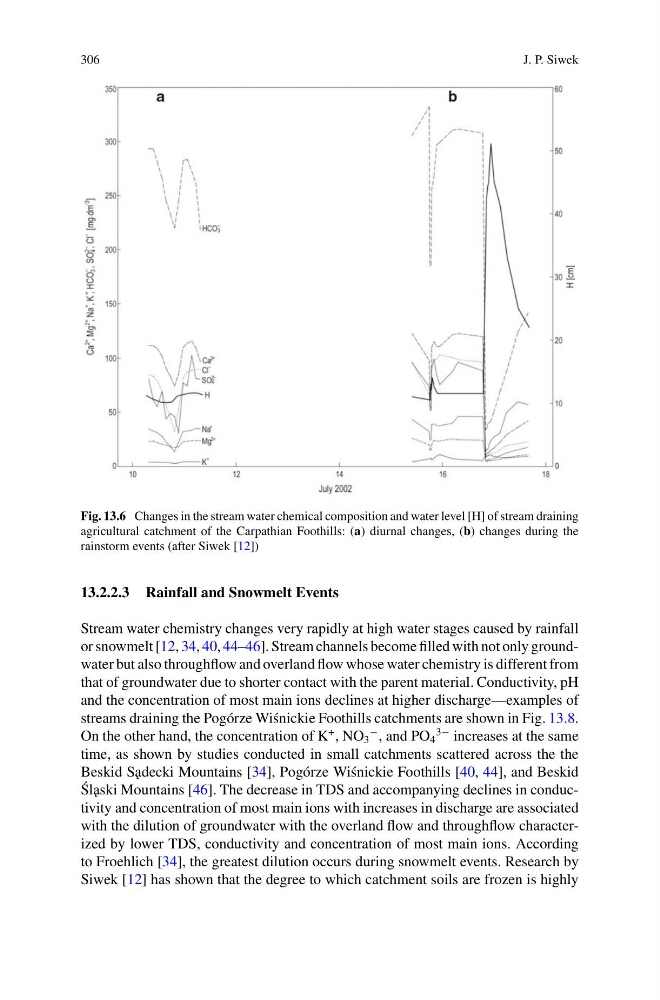
Fig. 13.6 Changes in the stream water chemical composition and water level [H] of stream draining
agricultural catchment of the Carpathian Foothills: (a) diurnal changes, (b) changes during the
rainstorm events (after Siwek [12])
13.2.2.3 Rainfall and Snowmelt Events
Stream water chemistry changes very rapidly at high water stages caused by rainfall
or snowmelt [12, 34, 40, 44–46]. Stream channels become filled with not only groundwater but also throughflow and overland flow whose water chemistry is different from
that of groundwater due to shorter contact with the parent material. Conductivity, pH
and the concentration of most main ions declines at higher discharge—examples of
streams draining the Pogórze Wi´ snickie Foothills catchments are shown in Fig. 13.8.
On the other hand, the concentration of K
+ , NO 3
− , and PO 4
3− increases at the same
time, as shown by studies conducted in small catchments scattered across the the
Beskid S˛ adecki Mountains [34], Pogórze Wi´ snickie Foothills [40, 44], and Beskid
´
Sl˛ aski Mountains [46]. The decrease in TDS and accompanying declines in conductivity and concentration of most main ions with increases in discharge are associated
with the dilution of groundwater with the overland flow and throughflow characterized by lower TDS, conductivity and concentration of most main ions. According
to Froehlich [34], the greatest dilution occurs during snowmelt events. Research by
Siwek [12] has shown that the degree to which catchment soils are frozen is highly
J. P. Siwek
Fig. 13.6 Changes in the stream water chemical composition and water level [H] of stream draining
agricultural catchment of the Carpathian Foothills: (a) diurnal changes, (b) changes during the
rainstorm events (after Siwek [12])
13.2.2.3 Rainfall and Snowmelt Events
Stream water chemistry changes very rapidly at high water stages caused by rainfall
or snowmelt [12, 34, 40, 44–46]. Stream channels become filled with not only groundwater but also throughflow and overland flow whose water chemistry is different from
that of groundwater due to shorter contact with the parent material. Conductivity, pH
and the concentration of most main ions declines at higher discharge—examples of
streams draining the Pogórze Wi´ snickie Foothills catchments are shown in Fig. 13.8.
On the other hand, the concentration of K
+ , NO 3
− , and PO 4
3− increases at the same
time, as shown by studies conducted in small catchments scattered across the the
Beskid S˛ adecki Mountains [34], Pogórze Wi´ snickie Foothills [40, 44], and Beskid
´
Sl˛ aski Mountains [46]. The decrease in TDS and accompanying declines in conductivity and concentration of most main ions with increases in discharge are associated
with the dilution of groundwater with the overland flow and throughflow characterized by lower TDS, conductivity and concentration of most main ions. According
to Froehlich [34], the greatest dilution occurs during snowmelt events. Research by
Siwek [12] has shown that the degree to which catchment soils are frozen is highly