

13 Environmental and Anthropogenic Determinants of Water Chemistry …
305
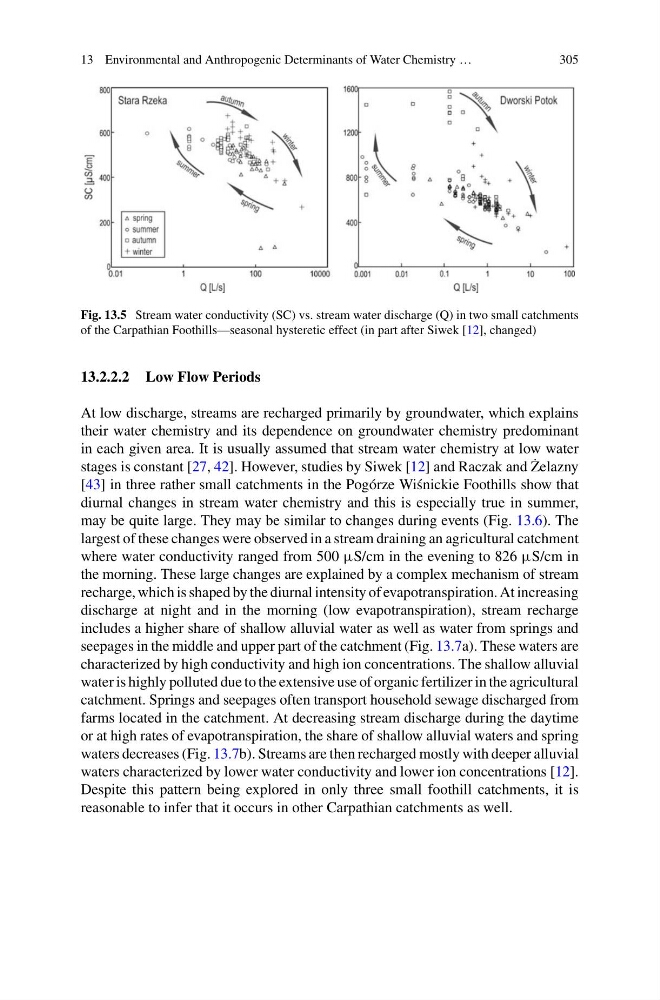
Fig. 13.5 Stream water conductivity (SC) vs. stream water discharge (Q) in two small catchments
of the Carpathian Foothills—seasonal hysteretic effect (in part after Siwek [12], changed)
13.2.2.2 Low Flow Periods
At low discharge, streams are recharged primarily by groundwater, which explains
their water chemistry and its dependence on groundwater chemistry predominant
in each given area. It is usually assumed that stream water chemistry at low water
stages is constant [27, 42]. However, studies by Siwek [12] and Raczak and ˙
Zelazny
[43] in three rather small catchments in the Pogórze Wi´ snickie Foothills show that
diurnal changes in stream water chemistry and this is especially true in summer,
may be quite large. They may be similar to changes during events (Fig. 13.6). The
largest of these changes were observed in a stream draining an agricultural catchment
where water conductivity ranged from 500 µS/cm in the evening to 826 µS/cm in
the morning. These large changes are explained by a complex mechanism of stream
recharge, which is shaped by the diurnal intensity of evapotranspiration. At increasing
discharge at night and in the morning (low evapotranspiration), stream recharge
includes a higher share of shallow alluvial water as well as water from springs and
seepages in the middle and upper part of the catchment (Fig. 13.7a). These waters are
characterized by high conductivity and high ion concentrations. The shallow alluvial
water is highly polluted due to the extensive use of organic fertilizer in the agricultural
catchment. Springs and seepages often transport household sewage discharged from
farms located in the catchment. At decreasing stream discharge during the daytime
or at high rates of evapotranspiration, the share of shallow alluvial waters and spring
waters decreases (Fig. 13.7b). Streams are then recharged mostly with deeper alluvial
waters characterized by lower water conductivity and lower ion concentrations [12].
Despite this pattern being explored in only three small foothill catchments, it is
reasonable to infer that it occurs in other Carpathian catchments as well.
305
Fig. 13.5 Stream water conductivity (SC) vs. stream water discharge (Q) in two small catchments
of the Carpathian Foothills—seasonal hysteretic effect (in part after Siwek [12], changed)
13.2.2.2 Low Flow Periods
At low discharge, streams are recharged primarily by groundwater, which explains
their water chemistry and its dependence on groundwater chemistry predominant
in each given area. It is usually assumed that stream water chemistry at low water
stages is constant [27, 42]. However, studies by Siwek [12] and Raczak and ˙
Zelazny
[43] in three rather small catchments in the Pogórze Wi´ snickie Foothills show that
diurnal changes in stream water chemistry and this is especially true in summer,
may be quite large. They may be similar to changes during events (Fig. 13.6). The
largest of these changes were observed in a stream draining an agricultural catchment
where water conductivity ranged from 500 µS/cm in the evening to 826 µS/cm in
the morning. These large changes are explained by a complex mechanism of stream
recharge, which is shaped by the diurnal intensity of evapotranspiration. At increasing
discharge at night and in the morning (low evapotranspiration), stream recharge
includes a higher share of shallow alluvial water as well as water from springs and
seepages in the middle and upper part of the catchment (Fig. 13.7a). These waters are
characterized by high conductivity and high ion concentrations. The shallow alluvial
water is highly polluted due to the extensive use of organic fertilizer in the agricultural
catchment. Springs and seepages often transport household sewage discharged from
farms located in the catchment. At decreasing stream discharge during the daytime
or at high rates of evapotranspiration, the share of shallow alluvial waters and spring
waters decreases (Fig. 13.7b). Streams are then recharged mostly with deeper alluvial
waters characterized by lower water conductivity and lower ion concentrations [12].
Despite this pattern being explored in only three small foothill catchments, it is
reasonable to infer that it occurs in other Carpathian catchments as well.