

13 Environmental and Anthropogenic Determinants of Water Chemistry …
299
13.2.1.1 The Tatra Mountains
Large differences in geologic structure across the Polish Tatra Mountains leads to
large differences in stream water and groundwater chemistry in the region. The
southern part of the Tatra Mountains is formed of poorly soluble crystalline rocks
known as the crystalline core [14, 15], where total dissolved solids (TDS) and conductivity of spring and stream water are very low (extremely fresh water) [16]. According
to ˙
Zelazny [9], mean TDS and water conductivity in 489 springs located across the
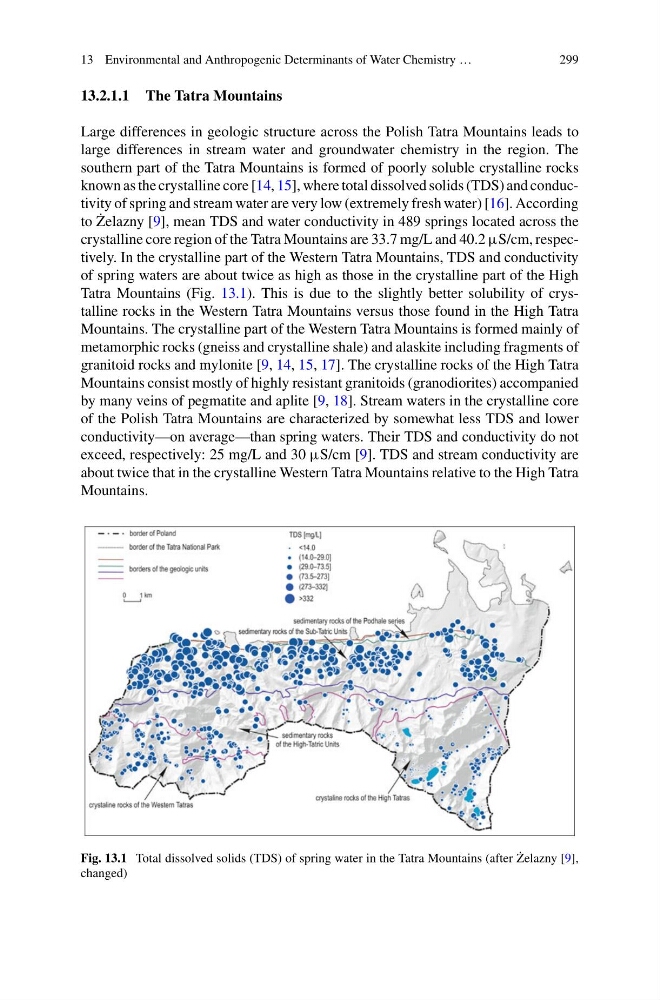
crystalline core region of the Tatra Mountains are 33.7 mg/L and 40.2 µS/cm, respectively. In the crystalline part of the Western Tatra Mountains, TDS and conductivity
of spring waters are about twice as high as those in the crystalline part of the High
Tatra Mountains (Fig. 13.1). This is due to the slightly better solubility of crystalline rocks in the Western Tatra Mountains versus those found in the High Tatra
Mountains. The crystalline part of the Western Tatra Mountains is formed mainly of
metamorphic rocks (gneiss and crystalline shale) and alaskite including fragments of
granitoid rocks and mylonite [9, 14, 15, 17]. The crystalline rocks of the High Tatra
Mountains consist mostly of highly resistant granitoids (granodiorites) accompanied
by many veins of pegmatite and aplite [9, 18]. Stream waters in the crystalline core
of the Polish Tatra Mountains are characterized by somewhat less TDS and lower
conductivity—on average—than spring waters. Their TDS and conductivity do not
exceed, respectively: 25 mg/L and 30 µS/cm [9]. TDS and stream conductivity are
about twice that in the crystalline Western Tatra Mountains relative to the High Tatra
Mountains.
Fig. 13.1 Total dissolved solids (TDS) of spring water in the Tatra Mountains (after ˙
Zelazny [9],
changed)
299
13.2.1.1 The Tatra Mountains
Large differences in geologic structure across the Polish Tatra Mountains leads to
large differences in stream water and groundwater chemistry in the region. The
southern part of the Tatra Mountains is formed of poorly soluble crystalline rocks
known as the crystalline core [14, 15], where total dissolved solids (TDS) and conductivity of spring and stream water are very low (extremely fresh water) [16]. According
to ˙
Zelazny [9], mean TDS and water conductivity in 489 springs located across the
crystalline core region of the Tatra Mountains are 33.7 mg/L and 40.2 µS/cm, respectively. In the crystalline part of the Western Tatra Mountains, TDS and conductivity
of spring waters are about twice as high as those in the crystalline part of the High
Tatra Mountains (Fig. 13.1). This is due to the slightly better solubility of crystalline rocks in the Western Tatra Mountains versus those found in the High Tatra
Mountains. The crystalline part of the Western Tatra Mountains is formed mainly of
metamorphic rocks (gneiss and crystalline shale) and alaskite including fragments of
granitoid rocks and mylonite [9, 14, 15, 17]. The crystalline rocks of the High Tatra
Mountains consist mostly of highly resistant granitoids (granodiorites) accompanied
by many veins of pegmatite and aplite [9, 18]. Stream waters in the crystalline core
of the Polish Tatra Mountains are characterized by somewhat less TDS and lower
conductivity—on average—than spring waters. Their TDS and conductivity do not
exceed, respectively: 25 mg/L and 30 µS/cm [9]. TDS and stream conductivity are
about twice that in the crystalline Western Tatra Mountains relative to the High Tatra
Mountains.
Fig. 13.1 Total dissolved solids (TDS) of spring water in the Tatra Mountains (after ˙
Zelazny [9],
changed)