

282
M. Habel et al.
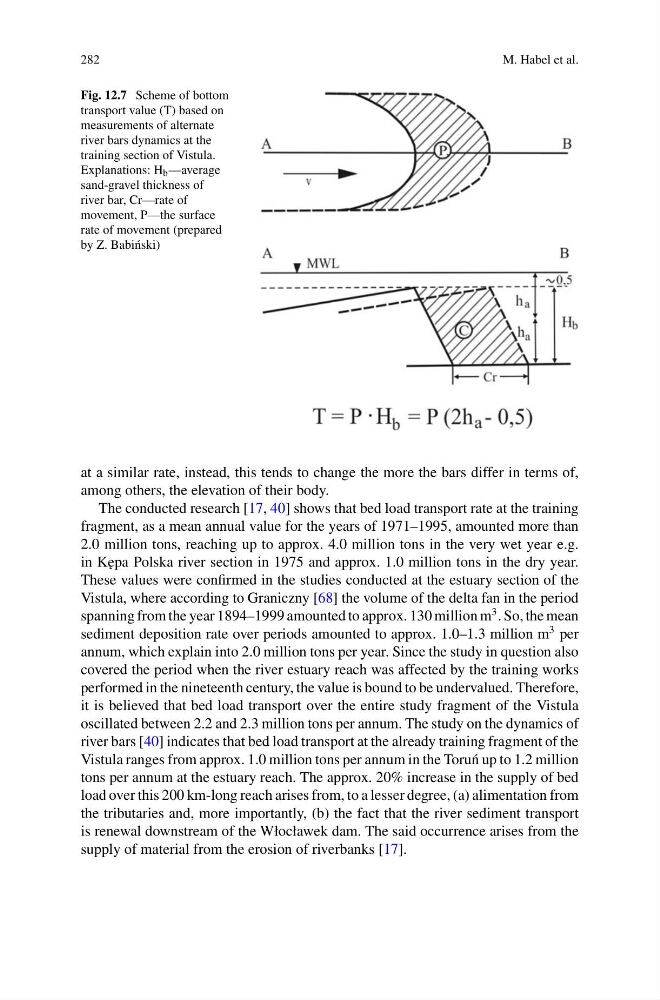
Fig. 12.7 Scheme of bottom
transport value (T) based on
measurements of alternate
river bars dynamics at the
training section of Vistula.
Explanations: H b —average
sand-gravel thickness of
river bar, Cr—rate of
movement, P—the surface
rate of movement (prepared
by Z. Babi´ nski)
at a similar rate, instead, this tends to change the more the bars differ in terms of,
among others, the elevation of their body.
The conducted research [17, 40] shows that bed load transport rate at the training
fragment, as a mean annual value for the years of 1971–1995, amounted more than
2.0 million tons, reaching up to approx. 4.0 million tons in the very wet year e.g.
in K˛ epa Polska river section in 1975 and approx. 1.0 million tons in the dry year.
These values were confirmed in the studies conducted at the estuary section of the
Vistula, where according to Graniczny [68] the volume of the delta fan in the period
spanning from the year 1894–1999 amounted to approx. 130 million m
3 . So, the mean
sediment deposition rate over periods amounted to approx. 1.0–1.3 million m
3 per
annum, which explain into 2.0 million tons per year. Since the study in question also
covered the period when the river estuary reach was affected by the training works
performed in the nineteenth century, the value is bound to be undervalued. Therefore,
it is believed that bed load transport over the entire study fragment of the Vistula
oscillated between 2.2 and 2.3 million tons per annum. The study on the dynamics of
river bars [40] indicates that bed load transport at the already training fragment of the
Vistula ranges from approx. 1.0 million tons per annum in the Toru´ n up to 1.2 million
tons per annum at the estuary reach. The approx. 20% increase in the supply of bed
load over this 200 km-long reach arises from, to a lesser degree, (a) alimentation from
the tributaries and, more importantly, (b) the fact that the river sediment transport
is renewal downstream of the Włocławek dam. The said occurrence arises from the
supply of material from the erosion of riverbanks [17].
M. Habel et al.
Fig. 12.7 Scheme of bottom
transport value (T) based on
measurements of alternate
river bars dynamics at the
training section of Vistula.
Explanations: H b —average
sand-gravel thickness of
river bar, Cr—rate of
movement, P—the surface
rate of movement (prepared
by Z. Babi´ nski)
at a similar rate, instead, this tends to change the more the bars differ in terms of,
among others, the elevation of their body.
The conducted research [17, 40] shows that bed load transport rate at the training
fragment, as a mean annual value for the years of 1971–1995, amounted more than
2.0 million tons, reaching up to approx. 4.0 million tons in the very wet year e.g.
in K˛ epa Polska river section in 1975 and approx. 1.0 million tons in the dry year.
These values were confirmed in the studies conducted at the estuary section of the
Vistula, where according to Graniczny [68] the volume of the delta fan in the period
spanning from the year 1894–1999 amounted to approx. 130 million m
3 . So, the mean
sediment deposition rate over periods amounted to approx. 1.0–1.3 million m
3 per
annum, which explain into 2.0 million tons per year. Since the study in question also
covered the period when the river estuary reach was affected by the training works
performed in the nineteenth century, the value is bound to be undervalued. Therefore,
it is believed that bed load transport over the entire study fragment of the Vistula
oscillated between 2.2 and 2.3 million tons per annum. The study on the dynamics of
river bars [40] indicates that bed load transport at the already training fragment of the
Vistula ranges from approx. 1.0 million tons per annum in the Toru´ n up to 1.2 million
tons per annum at the estuary reach. The approx. 20% increase in the supply of bed
load over this 200 km-long reach arises from, to a lesser degree, (a) alimentation from
the tributaries and, more importantly, (b) the fact that the river sediment transport
is renewal downstream of the Włocławek dam. The said occurrence arises from the
supply of material from the erosion of riverbanks [17].