

258
I. Jamorska
292.8
275.72
273.28
266
254
17.7
18.4
20.1
18.3
18
39.1
42.25
40.94
41.3
40
0.73
0.78
0.42
0.77
0.8
0
0.73
0
0.56
0.63
2013
2014
2015
2016
2017
I/173/1 J
ClNa+
Fe
SO42245.22
236.68
250.1
262
243
1.77
2.76
2.69
1.52
2.46
2.81
3.05
2.61
2.6
2.5
0.37
0.34
0.37
0.42
0.41
6.73
8.23
7.54
7.15
8.8
2013
2014
2015
2016
2017
I/470/3 J
ClNa+
Fe
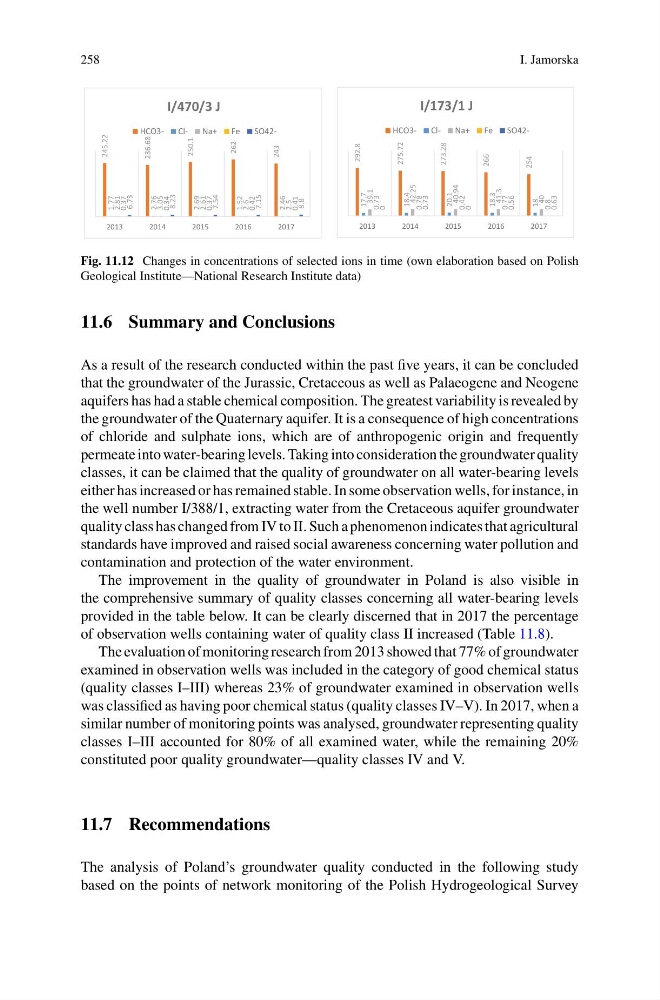
SO42Fig. 11.12 Changes in concentrations of selected ions in time (own elaboration based on Polish
Geological Institute—National Research Institute data)
11.6 Summary and Conclusions
As a result of the research conducted within the past five years, it can be concluded
that the groundwater of the Jurassic, Cretaceous as well as Palaeogene and Neogene
aquifers has had a stable chemical composition. The greatest variability is revealed by
the groundwater of the Quaternary aquifer. It is a consequence of high concentrations
of chloride and sulphate ions, which are of anthropogenic origin and frequently
permeate into water-bearing levels. Taking into consideration the groundwater quality
classes, it can be claimed that the quality of groundwater on all water-bearing levels
either has increased or has remained stable. In some observation wells, for instance, in
the well number I/388/1, extracting water from the Cretaceous aquifer groundwater
quality class has changed from IV to II. Such a phenomenon indicates that agricultural
standards have improved and raised social awareness concerning water pollution and
contamination and protection of the water environment.
The improvement in the quality of groundwater in Poland is also visible in
the comprehensive summary of quality classes concerning all water-bearing levels
provided in the table below. It can be clearly discerned that in 2017 the percentage
of observation wells containing water of quality class II increased (Table 11.8).
The evaluation of monitoring research from 2013 showed that 77% of groundwater
examined in observation wells was included in the category of good chemical status
(quality classes I–III) whereas 23% of groundwater examined in observation wells
was classified as having poor chemical status (quality classes IV–V). In 2017, when a
similar number of monitoring points was analysed, groundwater representing quality
classes I–III accounted for 80% of all examined water, while the remaining 20%
constituted poor quality groundwater—quality classes IV and V.
11.7 Recommendations
The analysis of Poland’s groundwater quality conducted in the following study
based on the points of network monitoring of the Polish Hydrogeological Survey
I. Jamorska
292.8
275.72
273.28
266
254
17.7
18.4
20.1
18.3
18
39.1
42.25
40.94
41.3
40
0.73
0.78
0.42
0.77
0.8
0
0.73
0
0.56
0.63
2013
2014
2015
2016
2017
I/173/1 J
ClNa+
Fe
SO42245.22
236.68
250.1
262
243
1.77
2.76
2.69
1.52
2.46
2.81
3.05
2.61
2.6
2.5
0.37
0.34
0.37
0.42
0.41
6.73
8.23
7.54
7.15
8.8
2013
2014
2015
2016
2017
I/470/3 J
ClNa+
Fe
SO42Fig. 11.12 Changes in concentrations of selected ions in time (own elaboration based on Polish
Geological Institute—National Research Institute data)
11.6 Summary and Conclusions
As a result of the research conducted within the past five years, it can be concluded
that the groundwater of the Jurassic, Cretaceous as well as Palaeogene and Neogene
aquifers has had a stable chemical composition. The greatest variability is revealed by
the groundwater of the Quaternary aquifer. It is a consequence of high concentrations
of chloride and sulphate ions, which are of anthropogenic origin and frequently
permeate into water-bearing levels. Taking into consideration the groundwater quality
classes, it can be claimed that the quality of groundwater on all water-bearing levels
either has increased or has remained stable. In some observation wells, for instance, in
the well number I/388/1, extracting water from the Cretaceous aquifer groundwater
quality class has changed from IV to II. Such a phenomenon indicates that agricultural
standards have improved and raised social awareness concerning water pollution and
contamination and protection of the water environment.
The improvement in the quality of groundwater in Poland is also visible in
the comprehensive summary of quality classes concerning all water-bearing levels
provided in the table below. It can be clearly discerned that in 2017 the percentage
of observation wells containing water of quality class II increased (Table 11.8).
The evaluation of monitoring research from 2013 showed that 77% of groundwater
examined in observation wells was included in the category of good chemical status
(quality classes I–III) whereas 23% of groundwater examined in observation wells
was classified as having poor chemical status (quality classes IV–V). In 2017, when a
similar number of monitoring points was analysed, groundwater representing quality
classes I–III accounted for 80% of all examined water, while the remaining 20%
constituted poor quality groundwater—quality classes IV and V.
11.7 Recommendations
The analysis of Poland’s groundwater quality conducted in the following study
based on the points of network monitoring of the Polish Hydrogeological Survey