

248
I. Jamorska
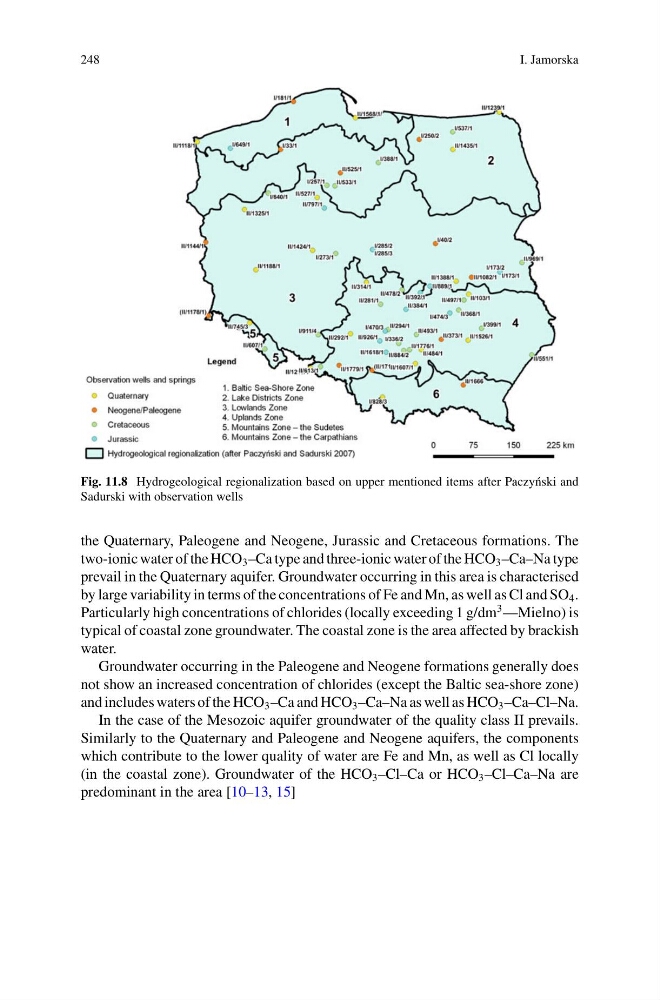
Fig. 11.8 Hydrogeological regionalization based on upper mentioned items after Paczy´ nski and
Sadurski with observation wells
the Quaternary, Paleogene and Neogene, Jurassic and Cretaceous formations. The
two-ionic water of the HCO 3 –Ca type and three-ionic water of the HCO 3 –Ca–Na type
prevail in the Quaternary aquifer. Groundwater occurring in this area is characterised
by large variability in terms of the concentrations of Fe and Mn, as well as Cl and SO 4 .
Particularly high concentrations of chlorides (locally exceeding 1 g/dm
3 —Mielno) is
typical of coastal zone groundwater. The coastal zone is the area affected by brackish
water.
Groundwater occurring in the Paleogene and Neogene formations generally does
not show an increased concentration of chlorides (except the Baltic sea-shore zone)
and includes waters of the HCO 3 –Ca and HCO 3 –Ca–Na as well as HCO 3 –Ca–Cl–Na.
In the case of the Mesozoic aquifer groundwater of the quality class II prevails.
Similarly to the Quaternary and Paleogene and Neogene aquifers, the components
which contribute to the lower quality of water are Fe and Mn, as well as Cl locally
(in the coastal zone). Groundwater of the HCO 3 –Cl–Ca or HCO 3 –Cl–Ca–Na are
predominant in the area [10–13, 15]
I. Jamorska
Fig. 11.8 Hydrogeological regionalization based on upper mentioned items after Paczy´ nski and
Sadurski with observation wells
the Quaternary, Paleogene and Neogene, Jurassic and Cretaceous formations. The
two-ionic water of the HCO 3 –Ca type and three-ionic water of the HCO 3 –Ca–Na type
prevail in the Quaternary aquifer. Groundwater occurring in this area is characterised
by large variability in terms of the concentrations of Fe and Mn, as well as Cl and SO 4 .
Particularly high concentrations of chlorides (locally exceeding 1 g/dm
3 —Mielno) is
typical of coastal zone groundwater. The coastal zone is the area affected by brackish
water.
Groundwater occurring in the Paleogene and Neogene formations generally does
not show an increased concentration of chlorides (except the Baltic sea-shore zone)
and includes waters of the HCO 3 –Ca and HCO 3 –Ca–Na as well as HCO 3 –Ca–Cl–Na.
In the case of the Mesozoic aquifer groundwater of the quality class II prevails.
Similarly to the Quaternary and Paleogene and Neogene aquifers, the components
which contribute to the lower quality of water are Fe and Mn, as well as Cl locally
(in the coastal zone). Groundwater of the HCO 3 –Cl–Ca or HCO 3 –Cl–Ca–Na are
predominant in the area [10–13, 15]