

8 Water Quality and Ecosystem Modelling …
185
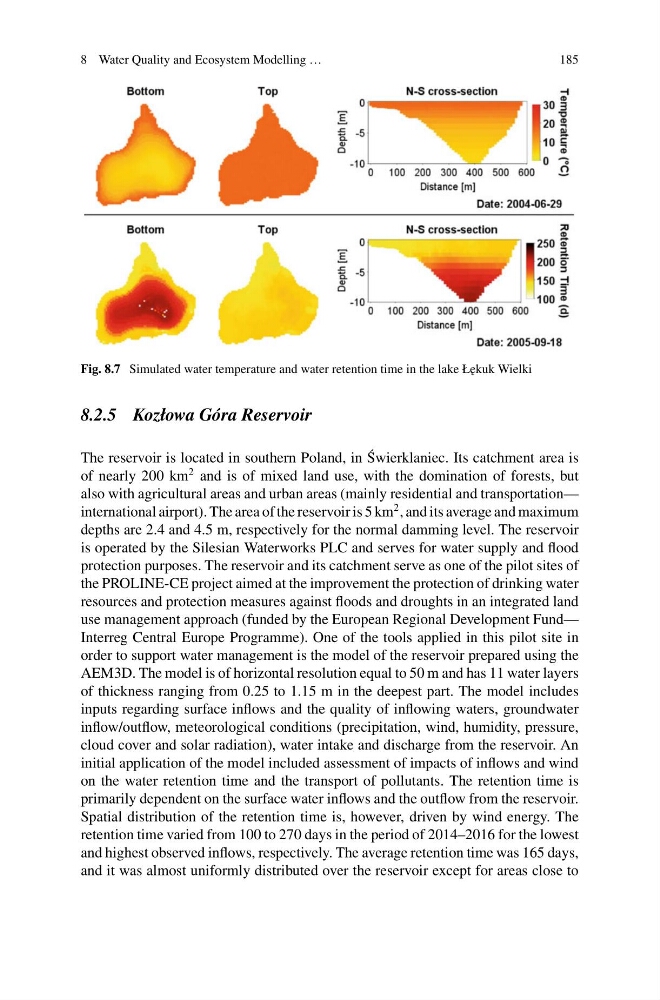
Fig. 8.7 Simulated water temperature and water retention time in the lake Ł˛ ekuk Wielki
8.2.5 Kozłowa Góra Reservoir
The reservoir is located in southern Poland, in ´
Swierklaniec. Its catchment area is
of nearly 200 km
2 and is of mixed land use, with the domination of forests, but
also with agricultural areas and urban areas (mainly residential and transportation—
international airport). The area of the reservoir is 5 km
2 , and its average and maximum
depths are 2.4 and 4.5 m, respectively for the normal damming level. The reservoir
is operated by the Silesian Waterworks PLC and serves for water supply and flood
protection purposes. The reservoir and its catchment serve as one of the pilot sites of
the PROLINE-CE project aimed at the improvement the protection of drinking water
resources and protection measures against floods and droughts in an integrated land
use management approach (funded by the European Regional Development Fund—
Interreg Central Europe Programme). One of the tools applied in this pilot site in
order to support water management is the model of the reservoir prepared using the
AEM3D. The model is of horizontal resolution equal to 50 m and has 11 water layers
of thickness ranging from 0.25 to 1.15 m in the deepest part. The model includes
inputs regarding surface inflows and the quality of inflowing waters, groundwater
inflow/outflow, meteorological conditions (precipitation, wind, humidity, pressure,
cloud cover and solar radiation), water intake and discharge from the reservoir. An
initial application of the model included assessment of impacts of inflows and wind
on the water retention time and the transport of pollutants. The retention time is
primarily dependent on the surface water inflows and the outflow from the reservoir.
Spatial distribution of the retention time is, however, driven by wind energy. The
retention time varied from 100 to 270 days in the period of 2014–2016 for the lowest
and highest observed inflows, respectively. The average retention time was 165 days,
and it was almost uniformly distributed over the reservoir except for areas close to
185
Fig. 8.7 Simulated water temperature and water retention time in the lake Ł˛ ekuk Wielki
8.2.5 Kozłowa Góra Reservoir
The reservoir is located in southern Poland, in ´
Swierklaniec. Its catchment area is
of nearly 200 km
2 and is of mixed land use, with the domination of forests, but
also with agricultural areas and urban areas (mainly residential and transportation—
international airport). The area of the reservoir is 5 km
2 , and its average and maximum
depths are 2.4 and 4.5 m, respectively for the normal damming level. The reservoir
is operated by the Silesian Waterworks PLC and serves for water supply and flood
protection purposes. The reservoir and its catchment serve as one of the pilot sites of
the PROLINE-CE project aimed at the improvement the protection of drinking water
resources and protection measures against floods and droughts in an integrated land
use management approach (funded by the European Regional Development Fund—
Interreg Central Europe Programme). One of the tools applied in this pilot site in
order to support water management is the model of the reservoir prepared using the
AEM3D. The model is of horizontal resolution equal to 50 m and has 11 water layers
of thickness ranging from 0.25 to 1.15 m in the deepest part. The model includes
inputs regarding surface inflows and the quality of inflowing waters, groundwater
inflow/outflow, meteorological conditions (precipitation, wind, humidity, pressure,
cloud cover and solar radiation), water intake and discharge from the reservoir. An
initial application of the model included assessment of impacts of inflows and wind
on the water retention time and the transport of pollutants. The retention time is
primarily dependent on the surface water inflows and the outflow from the reservoir.
Spatial distribution of the retention time is, however, driven by wind energy. The
retention time varied from 100 to 270 days in the period of 2014–2016 for the lowest
and highest observed inflows, respectively. The average retention time was 165 days,
and it was almost uniformly distributed over the reservoir except for areas close to