

182
R. Ula´ nczyk et al.
if the flow exceeds the minimum measured in a dry season. The second scenario
assumed the restoration to a larger extent, including the same as the scenario (1)
and additionally transfer of the ˙
Zwakowski stream back to the lake’s catchment area.
The model simulation allowed to identify locations where the peak concentration of
chlorophyll a exceeded 200 µg/l suggesting algal blooms. According to the model
outputs, the increase in inflow (restoration of the catchment area) should increase
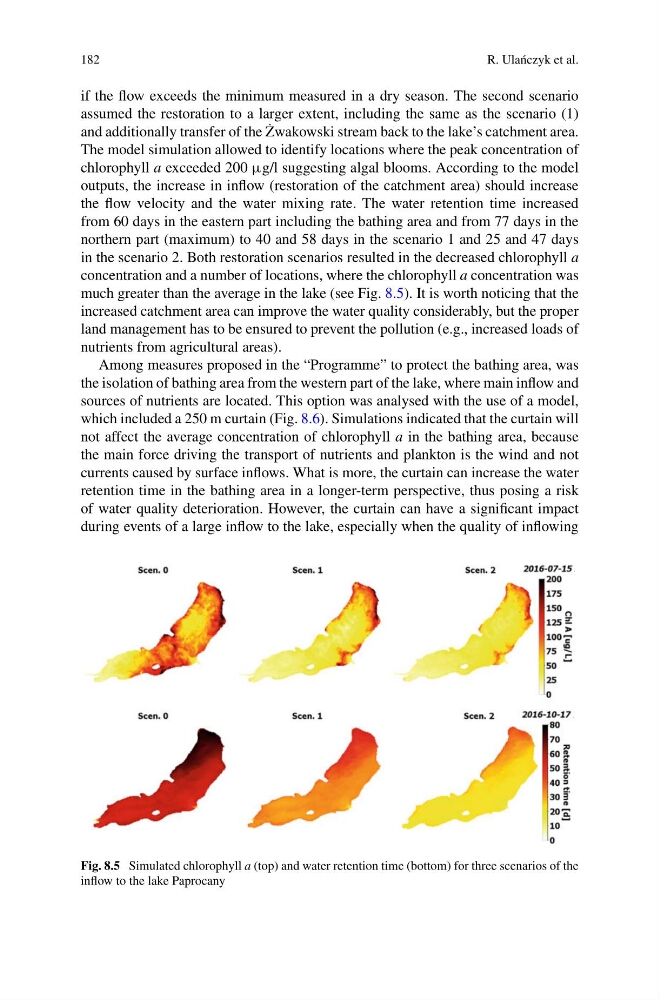
the flow velocity and the water mixing rate. The water retention time increased
from 60 days in the eastern part including the bathing area and from 77 days in the
northern part (maximum) to 40 and 58 days in the scenario 1 and 25 and 47 days
in the scenario 2. Both restoration scenarios resulted in the decreased chlorophyll a
concentration and a number of locations, where the chlorophyll a concentration was
much greater than the average in the lake (see Fig. 8.5). It is worth noticing that the
increased catchment area can improve the water quality considerably, but the proper
land management has to be ensured to prevent the pollution (e.g., increased loads of
nutrients from agricultural areas).
Among measures proposed in the “Programme” to protect the bathing area, was
the isolation of bathing area from the western part of the lake, where main inflow and
sources of nutrients are located. This option was analysed with the use of a model,
which included a 250 m curtain (Fig. 8.6). Simulations indicated that the curtain will
not affect the average concentration of chlorophyll a in the bathing area, because
the main force driving the transport of nutrients and plankton is the wind and not
currents caused by surface inflows. What is more, the curtain can increase the water
retention time in the bathing area in a longer-term perspective, thus posing a risk
of water quality deterioration. However, the curtain can have a significant impact
during events of a large inflow to the lake, especially when the quality of inflowing
Fig. 8.5 Simulated chlorophyll a (top) and water retention time (bottom) for three scenarios of the
inflow to the lake Paprocany
R. Ula´ nczyk et al.
if the flow exceeds the minimum measured in a dry season. The second scenario
assumed the restoration to a larger extent, including the same as the scenario (1)
and additionally transfer of the ˙
Zwakowski stream back to the lake’s catchment area.
The model simulation allowed to identify locations where the peak concentration of
chlorophyll a exceeded 200 µg/l suggesting algal blooms. According to the model
outputs, the increase in inflow (restoration of the catchment area) should increase
the flow velocity and the water mixing rate. The water retention time increased
from 60 days in the eastern part including the bathing area and from 77 days in the
northern part (maximum) to 40 and 58 days in the scenario 1 and 25 and 47 days
in the scenario 2. Both restoration scenarios resulted in the decreased chlorophyll a
concentration and a number of locations, where the chlorophyll a concentration was
much greater than the average in the lake (see Fig. 8.5). It is worth noticing that the
increased catchment area can improve the water quality considerably, but the proper
land management has to be ensured to prevent the pollution (e.g., increased loads of
nutrients from agricultural areas).
Among measures proposed in the “Programme” to protect the bathing area, was
the isolation of bathing area from the western part of the lake, where main inflow and
sources of nutrients are located. This option was analysed with the use of a model,
which included a 250 m curtain (Fig. 8.6). Simulations indicated that the curtain will
not affect the average concentration of chlorophyll a in the bathing area, because
the main force driving the transport of nutrients and plankton is the wind and not
currents caused by surface inflows. What is more, the curtain can increase the water
retention time in the bathing area in a longer-term perspective, thus posing a risk
of water quality deterioration. However, the curtain can have a significant impact
during events of a large inflow to the lake, especially when the quality of inflowing
Fig. 8.5 Simulated chlorophyll a (top) and water retention time (bottom) for three scenarios of the
inflow to the lake Paprocany