

134
A. Solarczyk
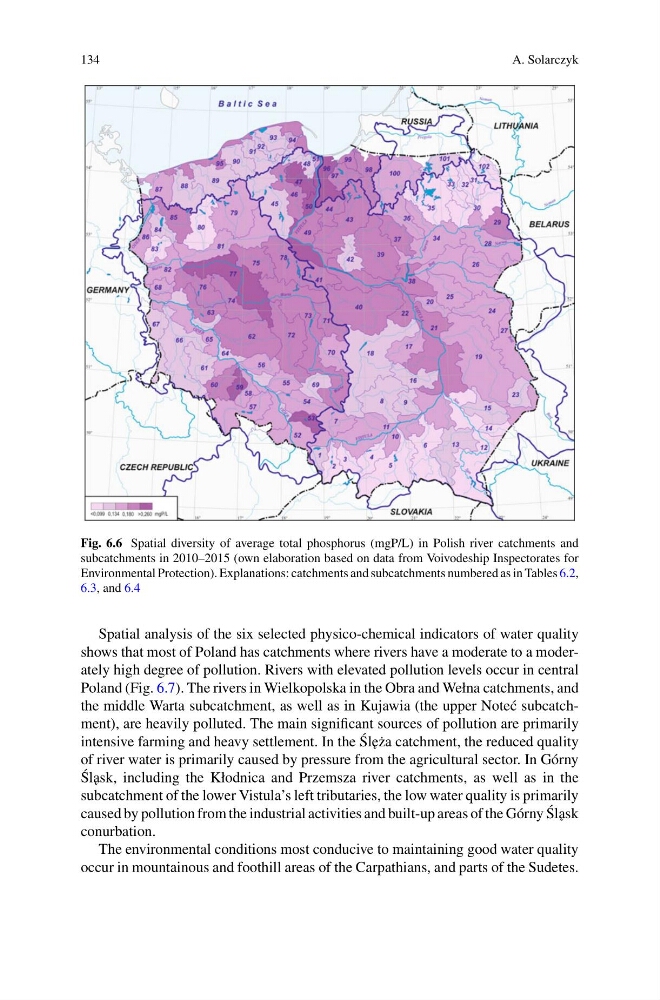
Fig. 6.6 Spatial diversity of average total phosphorus (mgP/L) in Polish river catchments and
subcatchments in 2010–2015 (own elaboration based on data from Voivodeship Inspectorates for
Environmental Protection). Explanations: catchments and subcatchments numbered as in Tables 6.2,
6.3, and 6.4
Spatial analysis of the six selected physico-chemical indicators of water quality
shows that most of Poland has catchments where rivers have a moderate to a moderately high degree of pollution. Rivers with elevated pollution levels occur in central
Poland (Fig. 6.7). The rivers in Wielkopolska in the Obra and Wełna catchments, and
the middle Warta subcatchment, as well as in Kujawia (the upper Note´ c subcatchment), are heavily polluted. The main significant sources of pollution are primarily
intensive farming and heavy settlement. In the ´
Sl˛ e˙ za catchment, the reduced quality
of river water is primarily caused by pressure from the agricultural sector. In Górny
´
Sl˛ ask, including the Kłodnica and Przemsza river catchments, as well as in the
subcatchment of the lower Vistula’s left tributaries, the low water quality is primarily
caused by pollution from the industrial activities and built-up areas of the Górny ´
Sl˛ ask
conurbation.
The environmental conditions most conducive to maintaining good water quality
occur in mountainous and foothill areas of the Carpathians, and parts of the Sudetes.
A. Solarczyk
Fig. 6.6 Spatial diversity of average total phosphorus (mgP/L) in Polish river catchments and
subcatchments in 2010–2015 (own elaboration based on data from Voivodeship Inspectorates for
Environmental Protection). Explanations: catchments and subcatchments numbered as in Tables 6.2,
6.3, and 6.4
Spatial analysis of the six selected physico-chemical indicators of water quality
shows that most of Poland has catchments where rivers have a moderate to a moderately high degree of pollution. Rivers with elevated pollution levels occur in central
Poland (Fig. 6.7). The rivers in Wielkopolska in the Obra and Wełna catchments, and
the middle Warta subcatchment, as well as in Kujawia (the upper Note´ c subcatchment), are heavily polluted. The main significant sources of pollution are primarily
intensive farming and heavy settlement. In the ´
Sl˛ e˙ za catchment, the reduced quality
of river water is primarily caused by pressure from the agricultural sector. In Górny
´
Sl˛ ask, including the Kłodnica and Przemsza river catchments, as well as in the
subcatchment of the lower Vistula’s left tributaries, the low water quality is primarily
caused by pollution from the industrial activities and built-up areas of the Górny ´
Sl˛ ask
conurbation.
The environmental conditions most conducive to maintaining good water quality
occur in mountainous and foothill areas of the Carpathians, and parts of the Sudetes.