

5 Irrigation and Drainage in Polish Agriculture …
99
Table 5.4 Irrigated area in Poland and water withdrawal for irrigation
Year Total
Irrigation method
Subirrigation Sprinkling Microirrigation Flood irrigation Other
Irrigated area, ha
1990 301500
284950
10300
–
2550
3700
2016
73202
64077
8737
155200
168
220
Water withdrawal, hm 3
1990
519
–
–
–
–
–
2016
89.9
83.8
5.4
–
0.03
0.04
Source [7]
with irrigation systems and facilities) is about 422000 ha of which—375000 ha with
gravity systems on grasslands and 47000 ha with pumped systems on arable lands.
It is noticed, that most of the agricultural land is drained without possibility to be
irrigated.
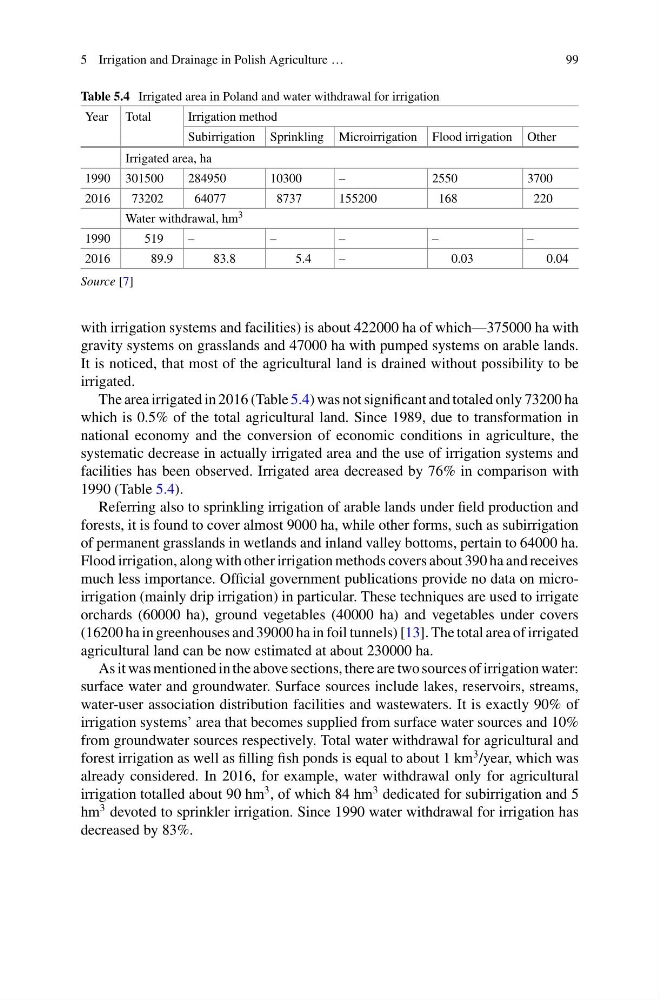
The area irrigated in 2016 (Table 5.4) was not significant and totaled only 73200 ha
which is 0.5% of the total agricultural land. Since 1989, due to transformation in
national economy and the conversion of economic conditions in agriculture, the
systematic decrease in actually irrigated area and the use of irrigation systems and
facilities has been observed. Irrigated area decreased by 76% in comparison with
1990 (Table 5.4).
Referring also to sprinkling irrigation of arable lands under field production and
forests, it is found to cover almost 9000 ha, while other forms, such as subirrigation
of permanent grasslands in wetlands and inland valley bottoms, pertain to 64000 ha.
Flood irrigation, along with other irrigation methods covers about 390 ha and receives
much less importance. Official government publications provide no data on microirrigation (mainly drip irrigation) in particular. These techniques are used to irrigate
orchards (60000 ha), ground vegetables (40000 ha) and vegetables under covers
(16200 ha in greenhouses and 39000 ha in foil tunnels) [13]. The total area of irrigated
agricultural land can be now estimated at about 230000 ha.
As it was mentioned in the above sections, there are two sources of irrigation water:
surface water and groundwater. Surface sources include lakes, reservoirs, streams,
water-user association distribution facilities and wastewaters. It is exactly 90% of
irrigation systems’ area that becomes supplied from surface water sources and 10%
from groundwater sources respectively. Total water withdrawal for agricultural and
forest irrigation as well as filling fish ponds is equal to about 1 km
3 /year, which was
already considered. In 2016, for example, water withdrawal only for agricultural
irrigation totalled about 90 hm
3 , of which 84 hm
3 dedicated for subirrigation and 5
hm
3 devoted to sprinkler irrigation. Since 1990 water withdrawal for irrigation has
decreased by 83%.
99
Table 5.4 Irrigated area in Poland and water withdrawal for irrigation
Year Total
Irrigation method
Subirrigation Sprinkling Microirrigation Flood irrigation Other
Irrigated area, ha
1990 301500
284950
10300
–
2550
3700
2016
73202
64077
8737
155200
168
220
Water withdrawal, hm 3
1990
519
–
–
–
–
–
2016
89.9
83.8
5.4
–
0.03
0.04
Source [7]
with irrigation systems and facilities) is about 422000 ha of which—375000 ha with
gravity systems on grasslands and 47000 ha with pumped systems on arable lands.
It is noticed, that most of the agricultural land is drained without possibility to be
irrigated.
The area irrigated in 2016 (Table 5.4) was not significant and totaled only 73200 ha
which is 0.5% of the total agricultural land. Since 1989, due to transformation in
national economy and the conversion of economic conditions in agriculture, the
systematic decrease in actually irrigated area and the use of irrigation systems and
facilities has been observed. Irrigated area decreased by 76% in comparison with
1990 (Table 5.4).
Referring also to sprinkling irrigation of arable lands under field production and
forests, it is found to cover almost 9000 ha, while other forms, such as subirrigation
of permanent grasslands in wetlands and inland valley bottoms, pertain to 64000 ha.
Flood irrigation, along with other irrigation methods covers about 390 ha and receives
much less importance. Official government publications provide no data on microirrigation (mainly drip irrigation) in particular. These techniques are used to irrigate
orchards (60000 ha), ground vegetables (40000 ha) and vegetables under covers
(16200 ha in greenhouses and 39000 ha in foil tunnels) [13]. The total area of irrigated
agricultural land can be now estimated at about 230000 ha.
As it was mentioned in the above sections, there are two sources of irrigation water:
surface water and groundwater. Surface sources include lakes, reservoirs, streams,
water-user association distribution facilities and wastewaters. It is exactly 90% of
irrigation systems’ area that becomes supplied from surface water sources and 10%
from groundwater sources respectively. Total water withdrawal for agricultural and
forest irrigation as well as filling fish ponds is equal to about 1 km
3 /year, which was
already considered. In 2016, for example, water withdrawal only for agricultural
irrigation totalled about 90 hm
3 , of which 84 hm
3 dedicated for subirrigation and 5
hm
3 devoted to sprinkler irrigation. Since 1990 water withdrawal for irrigation has
decreased by 83%.