

98
L. Łab˛ edzki et al.
On the other hand, taking into account the climatic and geomorphological variability of the Poland’s territory, there occurs local and periodical excess of water
that creates the need for drainage. Areas inundated by excessive rainfall and high
groundwater levels have negative impacts on agricultural production and call for
drainage infrastructure and management to mitigate those effects [12]. As it was
already stressed by the authors, the positive effects of agricultural drainage on the
land resources as well as its impacts on agricultural productivity and farm income are
well known. Drainage also plays a significant role in mitigating the adverse effects
of droughts on crop yields. The role of drainage systems involves lowering of the
groundwater table in the spring, which allows field works to be started earlier and
thus earlier plant growth and root development, triggering the root systems to take up
water from the deeper layers of the soil profile during prevailing drought conditions.
However, an awareness needs to be maintained that if water is drained from the soil,
less water remains in its’ profile and drought could appear earlier.
5.3.2 Irrigated and Drained Area
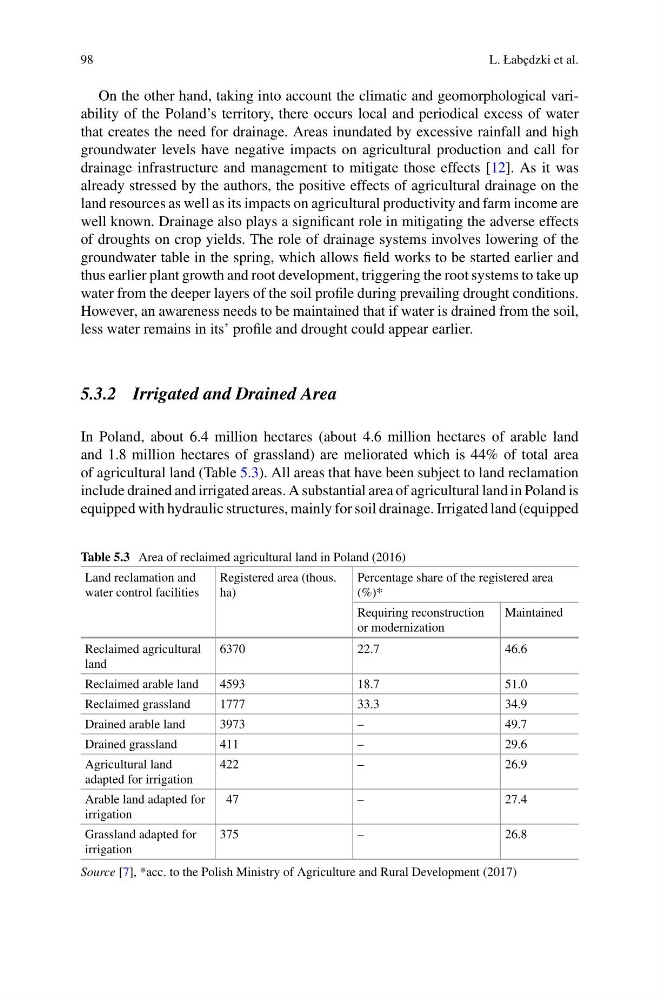
In Poland, about 6.4 million hectares (about 4.6 million hectares of arable land
and 1.8 million hectares of grassland) are meliorated which is 44% of total area
of agricultural land (Table 5.3). All areas that have been subject to land reclamation
include drained and irrigated areas. A substantial area of agricultural land in Poland is
equipped with hydraulic structures, mainly for soil drainage. Irrigated land (equipped
Table 5.3 Area of reclaimed agricultural land in Poland (2016)
Land reclamation and
water control facilities
Registered area (thous.
ha)
Percentage share of the registered area
(%)*
Requiring reconstruction
or modernization
Maintained
Reclaimed agricultural
land
6370
22.7
46.6
Reclaimed arable land
4593
18.7
51.0
Reclaimed grassland
1777
33.3
34.9
Drained arable land
3973
–
49.7
Drained grassland
411
–
29.6
Agricultural land
adapted for irrigation
422
–
26.9
Arable land adapted for
irrigation
47
–
27.4
Grassland adapted for
irrigation
375
–
26.8
Source [7], *acc. to the Polish Ministry of Agriculture and Rural Development (2017)
L. Łab˛ edzki et al.
On the other hand, taking into account the climatic and geomorphological variability of the Poland’s territory, there occurs local and periodical excess of water
that creates the need for drainage. Areas inundated by excessive rainfall and high
groundwater levels have negative impacts on agricultural production and call for
drainage infrastructure and management to mitigate those effects [12]. As it was
already stressed by the authors, the positive effects of agricultural drainage on the
land resources as well as its impacts on agricultural productivity and farm income are
well known. Drainage also plays a significant role in mitigating the adverse effects
of droughts on crop yields. The role of drainage systems involves lowering of the
groundwater table in the spring, which allows field works to be started earlier and
thus earlier plant growth and root development, triggering the root systems to take up
water from the deeper layers of the soil profile during prevailing drought conditions.
However, an awareness needs to be maintained that if water is drained from the soil,
less water remains in its’ profile and drought could appear earlier.
5.3.2 Irrigated and Drained Area
In Poland, about 6.4 million hectares (about 4.6 million hectares of arable land
and 1.8 million hectares of grassland) are meliorated which is 44% of total area
of agricultural land (Table 5.3). All areas that have been subject to land reclamation
include drained and irrigated areas. A substantial area of agricultural land in Poland is
equipped with hydraulic structures, mainly for soil drainage. Irrigated land (equipped
Table 5.3 Area of reclaimed agricultural land in Poland (2016)
Land reclamation and
water control facilities
Registered area (thous.
ha)
Percentage share of the registered area
(%)*
Requiring reconstruction
or modernization
Maintained
Reclaimed agricultural
land
6370
22.7
46.6
Reclaimed arable land
4593
18.7
51.0
Reclaimed grassland
1777
33.3
34.9
Drained arable land
3973
–
49.7
Drained grassland
411
–
29.6
Agricultural land
adapted for irrigation
422
–
26.9
Arable land adapted for
irrigation
47
–
27.4
Grassland adapted for
irrigation
375
–
26.8
Source [7], *acc. to the Polish Ministry of Agriculture and Rural Development (2017)