

resistance in the environment [79, 80]. Moreover, within these biofilms, the presence
of metallic contaminants has been shown to be favourable for the spread of antimicrobial resistance [81, 82].
Within the PIREN-Seine programme, the resistome (genes conferring antibiotic
and/or trace metal resistance) of microbial communities in biofilms has been studied
as an indicator of vulnerability or environmental resilience to chemical or microbiological contaminants. In the Seine River, observations in situ and in the laboratory
have shown that the acquisition of a trace metal tolerance of microbial biofilm
communities depends on several factors. At the cellular level, the increase of
genes encoding resistance to heavy metals, such as silver (silA gene) or cadmium/
zinc/cobalt (czcA gene), suggests a selection of resistant bacteria in response to
chronic exposure to toxic thresholds in Ag
+
, Zn
2+ , Co
2+ or Cd
2+ . At the microbial
community level, the resistance to antibiotics may be related to a change in
microbial diversity, with an increase in the abundance of bacterial genera able to
grow in contaminated environments, such as Burkholderiales, Cytophagales and
Sphingobacteriales [83]. Within these phyla, there are autochthonous bacterial
genera but also bacteria that could be opportunistic pathogens such Burkholderia.
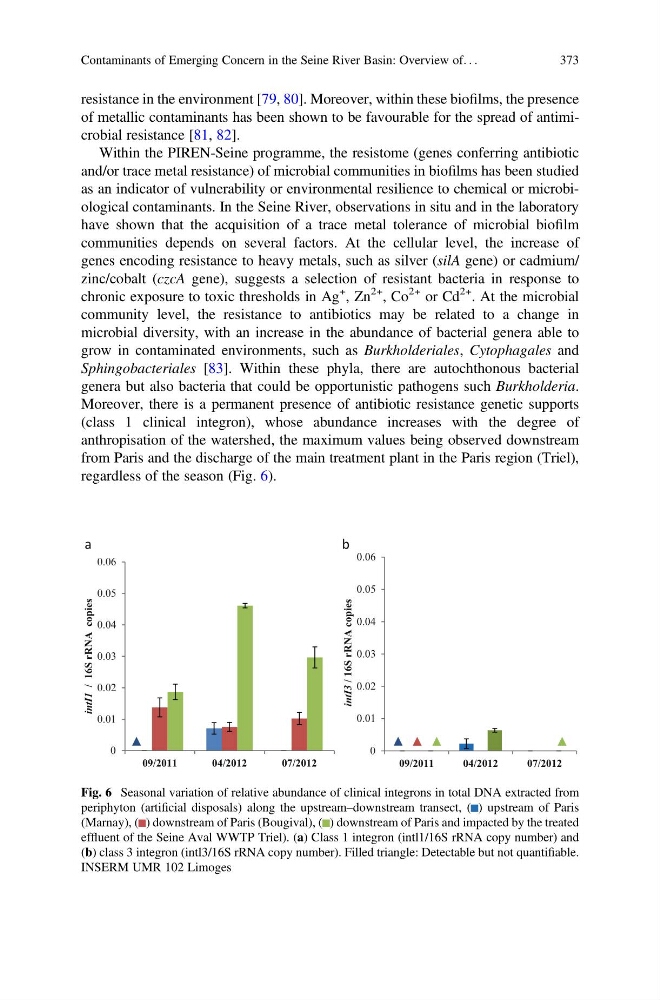
Moreover, there is a permanent presence of antibiotic resistance genetic supports
(class 1 clinical integron), whose abundance increases with the degree of
anthropisation of the watershed, the maximum values being observed downstream
from Paris and the discharge of the main treatment plant in the Paris region (Triel),
regardless of the season (Fig. 6).
0
0.01
0.02
0.03
0.04
0.05
0.06
09/2011
04/2012
07/2012
intI1 / 16S rRNA copies
0
0.01
0.02
0.03
0.04
0.05
0.06
09/2011
04/2012
07/2012
intI3
/ 16S rRNA copies
a
b
Fig. 6 Seasonal variation of relative abundance of clinical integrons in total DNA extracted from
periphyton (artificial disposals) along the upstream–downstream transect, ( ) upstream of Paris
(Marnay), ( ) downstream of Paris (Bougival), ( ) downstream of Paris and impacted by the treated
effluent of the Seine Aval WWTP Triel). (a) Class 1 integron (intl1/16S rRNA copy number) and
(b) class 3 integron (intl3/16S rRNA copy number). Filled triangle: Detectable but not quantifiable.
INSERM UMR 102 Limoges
Contaminants of Emerging Concern in the Seine River Basin: Overview of. . .
373
of metallic contaminants has been shown to be favourable for the spread of antimicrobial resistance [81, 82].
Within the PIREN-Seine programme, the resistome (genes conferring antibiotic
and/or trace metal resistance) of microbial communities in biofilms has been studied
as an indicator of vulnerability or environmental resilience to chemical or microbiological contaminants. In the Seine River, observations in situ and in the laboratory
have shown that the acquisition of a trace metal tolerance of microbial biofilm
communities depends on several factors. At the cellular level, the increase of
genes encoding resistance to heavy metals, such as silver (silA gene) or cadmium/
zinc/cobalt (czcA gene), suggests a selection of resistant bacteria in response to
chronic exposure to toxic thresholds in Ag
+
, Zn
2+ , Co
2+ or Cd
2+ . At the microbial
community level, the resistance to antibiotics may be related to a change in
microbial diversity, with an increase in the abundance of bacterial genera able to
grow in contaminated environments, such as Burkholderiales, Cytophagales and
Sphingobacteriales [83]. Within these phyla, there are autochthonous bacterial
genera but also bacteria that could be opportunistic pathogens such Burkholderia.
Moreover, there is a permanent presence of antibiotic resistance genetic supports
(class 1 clinical integron), whose abundance increases with the degree of
anthropisation of the watershed, the maximum values being observed downstream
from Paris and the discharge of the main treatment plant in the Paris region (Triel),
regardless of the season (Fig. 6).
0
0.01
0.02
0.03
0.04
0.05
0.06
09/2011
04/2012
07/2012
intI1 / 16S rRNA copies
0
0.01
0.02
0.03
0.04
0.05
0.06
09/2011
04/2012
07/2012
intI3
/ 16S rRNA copies
a
b
Fig. 6 Seasonal variation of relative abundance of clinical integrons in total DNA extracted from
periphyton (artificial disposals) along the upstream–downstream transect, ( ) upstream of Paris
(Marnay), ( ) downstream of Paris (Bougival), ( ) downstream of Paris and impacted by the treated
effluent of the Seine Aval WWTP Triel). (a) Class 1 integron (intl1/16S rRNA copy number) and
(b) class 3 integron (intl3/16S rRNA copy number). Filled triangle: Detectable but not quantifiable.
INSERM UMR 102 Limoges
Contaminants of Emerging Concern in the Seine River Basin: Overview of. . .
373