

antibiotic concentrations during high-flow events seems to confirm that the intake is
mainly related to medical uses and the origin of contamination is point sources.
Overall, antibiotic concentrations measured in the Seine River are similar to those
measured in Europe [73].
5.4 The Resistome and Antimicrobial Resistance
The contamination of water with antibiotics, which results from their prescription in
human or veterinary medicine, is accompanied by a contamination of waterbodies by
antibiotic-resistant bacteria. The occurrence of such resistant strains may be
explained by the selection pressure exerted on the gut microbiota of humans and
animals receiving antibiotic therapy. In the Seine River, Servais and Passerat
demonstrated the presence of antibiotic-resistant faecal bacteria, the abundance of
which reflects the level of anthropisation of the watershed [74].
In this context, particular attention is focused on biofilms or periphyton, which
are microenvironments likely to concentrate chemical and microbiological contaminants [75–77]. In the aquatic environment, biofilms are ecological niches, where
microbial communities experience chronic multiexposure to chemical contaminants
(organic or metallic) including antibiotics. To this exposure is added a continuous
supply of antibiotic-resistant bacteria of human or animal origin and therefore of
genetic support involved in the dissemination of antibiotic resistance, such as
clinical integrons [78]. Today, clinical integrons, considered as xenogeneic contaminants, are believed to be bioindicators of the risk of dissemination of antimicrobial
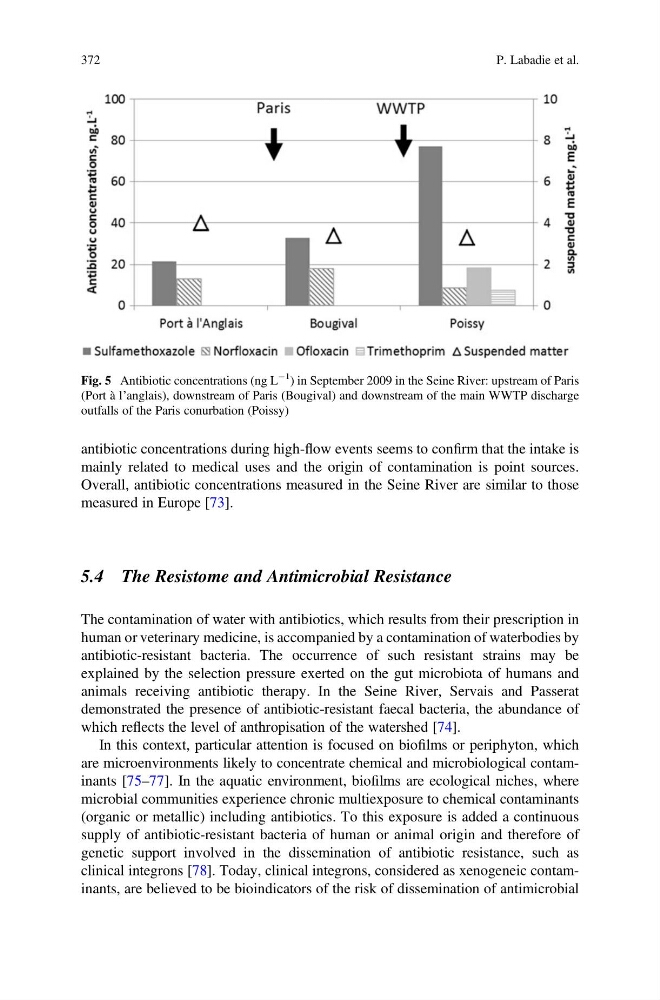
Fig. 5 Antibiotic concentrations (ng L
À1 ) in September 2009 in the Seine River: upstream of Paris
(Port à l’anglais), downstream of Paris (Bougival) and downstream of the main WWTP discharge
outfalls of the Paris conurbation (Poissy)
372
P. Labadie et al.
mainly related to medical uses and the origin of contamination is point sources.
Overall, antibiotic concentrations measured in the Seine River are similar to those
measured in Europe [73].
5.4 The Resistome and Antimicrobial Resistance
The contamination of water with antibiotics, which results from their prescription in
human or veterinary medicine, is accompanied by a contamination of waterbodies by
antibiotic-resistant bacteria. The occurrence of such resistant strains may be
explained by the selection pressure exerted on the gut microbiota of humans and
animals receiving antibiotic therapy. In the Seine River, Servais and Passerat
demonstrated the presence of antibiotic-resistant faecal bacteria, the abundance of
which reflects the level of anthropisation of the watershed [74].
In this context, particular attention is focused on biofilms or periphyton, which
are microenvironments likely to concentrate chemical and microbiological contaminants [75–77]. In the aquatic environment, biofilms are ecological niches, where
microbial communities experience chronic multiexposure to chemical contaminants
(organic or metallic) including antibiotics. To this exposure is added a continuous
supply of antibiotic-resistant bacteria of human or animal origin and therefore of
genetic support involved in the dissemination of antibiotic resistance, such as
clinical integrons [78]. Today, clinical integrons, considered as xenogeneic contaminants, are believed to be bioindicators of the risk of dissemination of antimicrobial
Fig. 5 Antibiotic concentrations (ng L
À1 ) in September 2009 in the Seine River: upstream of Paris
(Port à l’anglais), downstream of Paris (Bougival) and downstream of the main WWTP discharge
outfalls of the Paris conurbation (Poissy)
372
P. Labadie et al.