

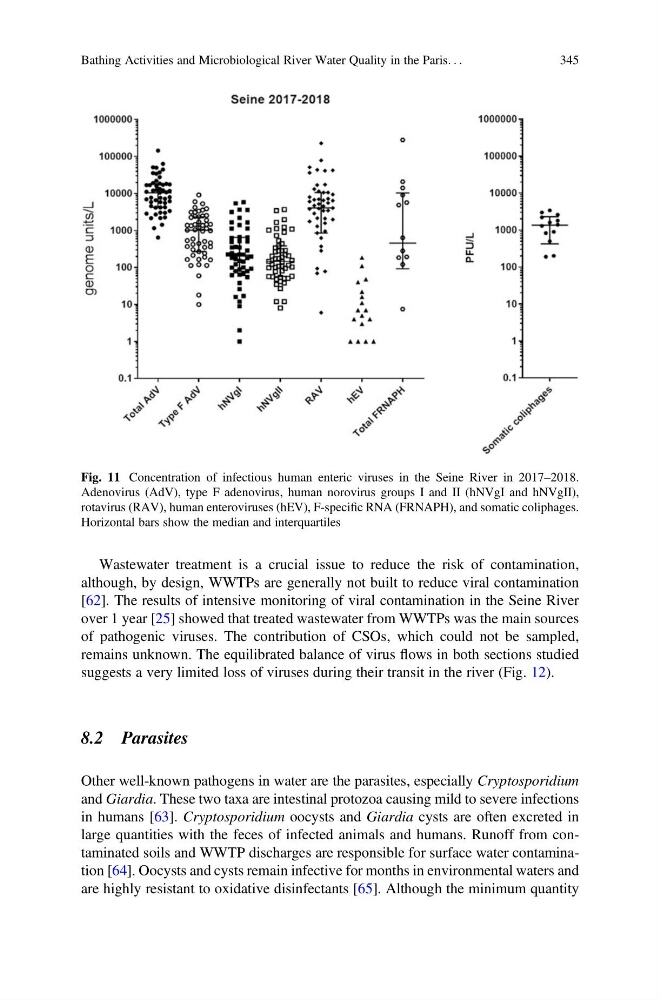
Wastewater treatment is a crucial issue to reduce the risk of contamination,
although, by design, WWTPs are generally not built to reduce viral contamination
[62]. The results of intensive monitoring of viral contamination in the Seine River
over 1 year [25] showed that treated wastewater from WWTPs was the main sources
of pathogenic viruses. The contribution of CSOs, which could not be sampled,
remains unknown. The equilibrated balance of virus flows in both sections studied
suggests a very limited loss of viruses during their transit in the river (Fig. 12).
8.2 Parasites
Other well-known pathogens in water are the parasites, especially Cryptosporidium
and Giardia. These two taxa are intestinal protozoa causing mild to severe infections
in humans [63]. Cryptosporidium oocysts and Giardia cysts are often excreted in
large quantities with the feces of infected animals and humans. Runoff from contaminated soils and WWTP discharges are responsible for surface water contamination [64]. Oocysts and cysts remain infective for months in environmental waters and
are highly resistant to oxidative disinfectants [65]. Although the minimum quantity
Fig. 11 Concentration of infectious human enteric viruses in the Seine River in 2017–2018.
Adenovirus (AdV), type F adenovirus, human norovirus groups I and II (hNVgI and hNVgII),
rotavirus (RAV), human enteroviruses (hEV), F-specific RNA (FRNAPH), and somatic coliphages.
Horizontal bars show the median and interquartiles
Bathing Activities and Microbiological River Water Quality in the Paris. . .
345
although, by design, WWTPs are generally not built to reduce viral contamination
[62]. The results of intensive monitoring of viral contamination in the Seine River
over 1 year [25] showed that treated wastewater from WWTPs was the main sources
of pathogenic viruses. The contribution of CSOs, which could not be sampled,
remains unknown. The equilibrated balance of virus flows in both sections studied
suggests a very limited loss of viruses during their transit in the river (Fig. 12).
8.2 Parasites
Other well-known pathogens in water are the parasites, especially Cryptosporidium
and Giardia. These two taxa are intestinal protozoa causing mild to severe infections
in humans [63]. Cryptosporidium oocysts and Giardia cysts are often excreted in
large quantities with the feces of infected animals and humans. Runoff from contaminated soils and WWTP discharges are responsible for surface water contamination [64]. Oocysts and cysts remain infective for months in environmental waters and
are highly resistant to oxidative disinfectants [65]. Although the minimum quantity
Fig. 11 Concentration of infectious human enteric viruses in the Seine River in 2017–2018.
Adenovirus (AdV), type F adenovirus, human norovirus groups I and II (hNVgI and hNVgII),
rotavirus (RAV), human enteroviruses (hEV), F-specific RNA (FRNAPH), and somatic coliphages.
Horizontal bars show the median and interquartiles
Bathing Activities and Microbiological River Water Quality in the Paris. . .
345