

series at Orly and Joinville, the strong influence of rain events on the highest
concentrations is clearly demonstrated.
8 Presence of Pathogens in the Seine and Marne Rivers
in the Paris Area
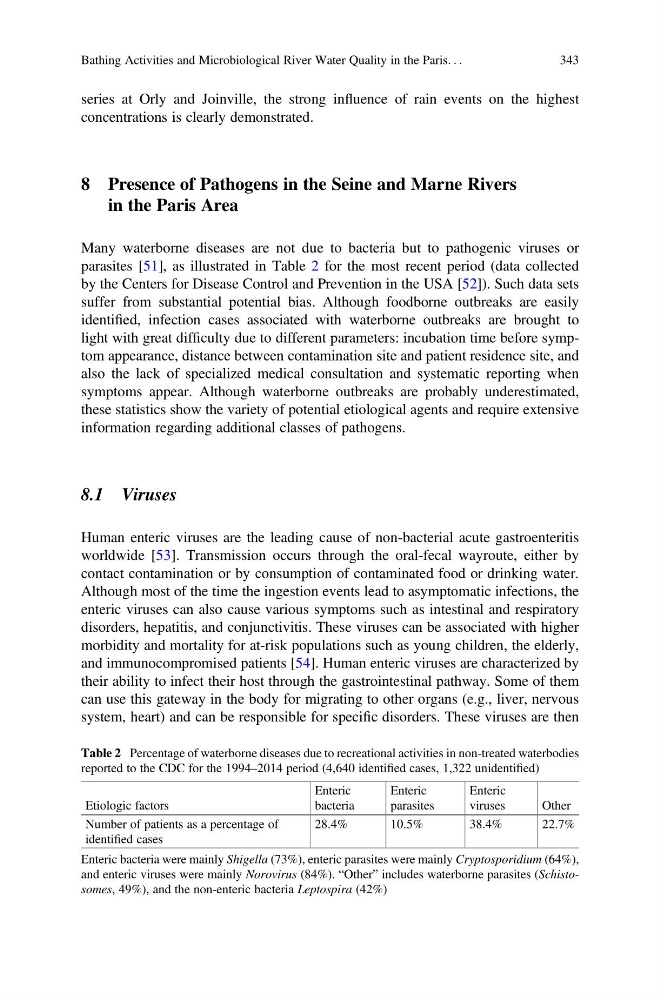
Many waterborne diseases are not due to bacteria but to pathogenic viruses or
parasites [51], as illustrated in Table 2 for the most recent period (data collected
by the Centers for Disease Control and Prevention in the USA [52]). Such data sets
suffer from substantial potential bias. Although foodborne outbreaks are easily
identified, infection cases associated with waterborne outbreaks are brought to
light with great difficulty due to different parameters: incubation time before symptom appearance, distance between contamination site and patient residence site, and
also the lack of specialized medical consultation and systematic reporting when
symptoms appear. Although waterborne outbreaks are probably underestimated,
these statistics show the variety of potential etiological agents and require extensive
information regarding additional classes of pathogens.
8.1 Viruses
Human enteric viruses are the leading cause of non-bacterial acute gastroenteritis
worldwide [53]. Transmission occurs through the oral-fecal wayroute, either by
contact contamination or by consumption of contaminated food or drinking water.
Although most of the time the ingestion events lead to asymptomatic infections, the
enteric viruses can also cause various symptoms such as intestinal and respiratory
disorders, hepatitis, and conjunctivitis. These viruses can be associated with higher
morbidity and mortality for at-risk populations such as young children, the elderly,
and immunocompromised patients [54]. Human enteric viruses are characterized by
their ability to infect their host through the gastrointestinal pathway. Some of them
can use this gateway in the body for migrating to other organs (e.g., liver, nervous
system, heart) and can be responsible for specific disorders. These viruses are then
Table 2 Percentage of waterborne diseases due to recreational activities in non-treated waterbodies
reported to the CDC for the 1994–2014 period (4,640 identified cases, 1,322 unidentified)
Etiologic factors
Enteric
bacteria
Enteric
parasites
Enteric
viruses
Other
Number of patients as a percentage of
identified cases
28.4%
10.5%
38.4%
22.7%
Enteric bacteria were mainly Shigella (73%), enteric parasites were mainly Cryptosporidium (64%),
and enteric viruses were mainly Norovirus (84%). “Other” includes waterborne parasites (Schistosomes, 49%), and the non-enteric bacteria Leptospira (42%)
Bathing Activities and Microbiological River Water Quality in the Paris. . .
343
concentrations is clearly demonstrated.
8 Presence of Pathogens in the Seine and Marne Rivers
in the Paris Area
Many waterborne diseases are not due to bacteria but to pathogenic viruses or
parasites [51], as illustrated in Table 2 for the most recent period (data collected
by the Centers for Disease Control and Prevention in the USA [52]). Such data sets
suffer from substantial potential bias. Although foodborne outbreaks are easily
identified, infection cases associated with waterborne outbreaks are brought to
light with great difficulty due to different parameters: incubation time before symptom appearance, distance between contamination site and patient residence site, and
also the lack of specialized medical consultation and systematic reporting when
symptoms appear. Although waterborne outbreaks are probably underestimated,
these statistics show the variety of potential etiological agents and require extensive
information regarding additional classes of pathogens.
8.1 Viruses
Human enteric viruses are the leading cause of non-bacterial acute gastroenteritis
worldwide [53]. Transmission occurs through the oral-fecal wayroute, either by
contact contamination or by consumption of contaminated food or drinking water.
Although most of the time the ingestion events lead to asymptomatic infections, the
enteric viruses can also cause various symptoms such as intestinal and respiratory
disorders, hepatitis, and conjunctivitis. These viruses can be associated with higher
morbidity and mortality for at-risk populations such as young children, the elderly,
and immunocompromised patients [54]. Human enteric viruses are characterized by
their ability to infect their host through the gastrointestinal pathway. Some of them
can use this gateway in the body for migrating to other organs (e.g., liver, nervous
system, heart) and can be responsible for specific disorders. These viruses are then
Table 2 Percentage of waterborne diseases due to recreational activities in non-treated waterbodies
reported to the CDC for the 1994–2014 period (4,640 identified cases, 1,322 unidentified)
Etiologic factors
Enteric
bacteria
Enteric
parasites
Enteric
viruses
Other
Number of patients as a percentage of
identified cases
28.4%
10.5%
38.4%
22.7%
Enteric bacteria were mainly Shigella (73%), enteric parasites were mainly Cryptosporidium (64%),
and enteric viruses were mainly Norovirus (84%). “Other” includes waterborne parasites (Schistosomes, 49%), and the non-enteric bacteria Leptospira (42%)
Bathing Activities and Microbiological River Water Quality in the Paris. . .
343