

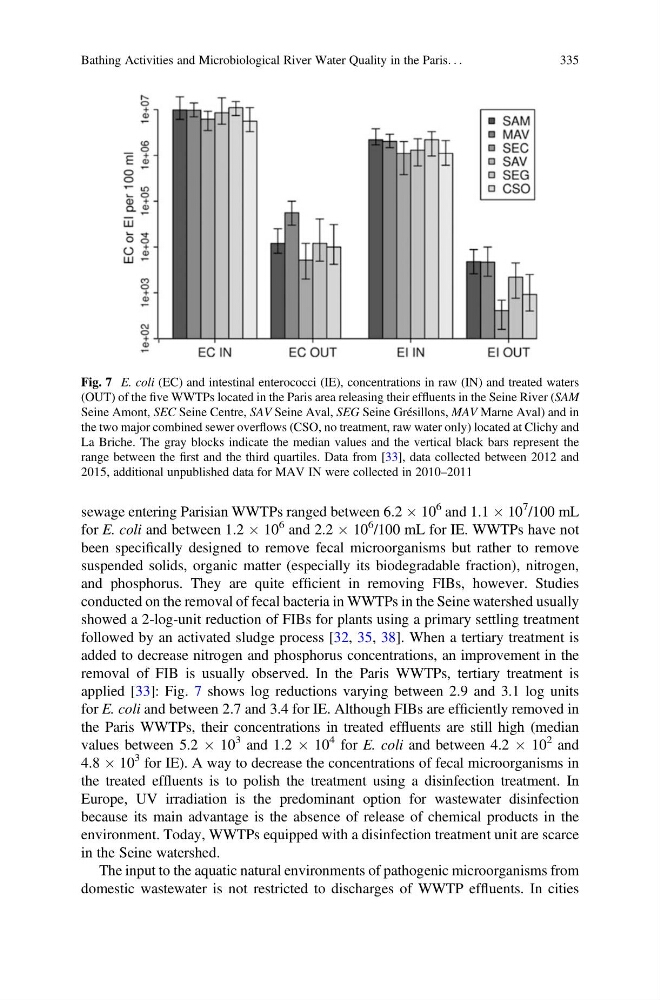
sewage entering Parisian WWTPs ranged between 6.2 Â 10
6 and 1.1 Â 10
7 /100 mL
for E. coli and between 1.2 Â 10
6 and 2.2 Â 10
6 /100 mL for IE. WWTPs have not
been specifically designed to remove fecal microorganisms but rather to remove
suspended solids, organic matter (especially its biodegradable fraction), nitrogen,
and phosphorus. They are quite efficient in removing FIBs, however. Studies
conducted on the removal of fecal bacteria in WWTPs in the Seine watershed usually
showed a 2-log-unit reduction of FIBs for plants using a primary settling treatment
followed by an activated sludge process [32, 35, 38]. When a tertiary treatment is
added to decrease nitrogen and phosphorus concentrations, an improvement in the
removal of FIB is usually observed. In the Paris WWTPs, tertiary treatment is
applied [33]: Fig. 7 shows log reductions varying between 2.9 and 3.1 log units
for E. coli and between 2.7 and 3.4 for IE. Although FIBs are efficiently removed in
the Paris WWTPs, their concentrations in treated effluents are still high (median
values between 5.2 Â 10
3 and 1.2 Â 10
4 for E. coli and between 4.2 Â 10
2 and
4.8 Â 10
3 for IE). A way to decrease the concentrations of fecal microorganisms in
the treated effluents is to polish the treatment using a disinfection treatment. In
Europe, UV irradiation is the predominant option for wastewater disinfection
because its main advantage is the absence of release of chemical products in the
environment. Today, WWTPs equipped with a disinfection treatment unit are scarce
in the Seine watershed.
The input to the aquatic natural environments of pathogenic microorganisms from
domestic wastewater is not restricted to discharges of WWTP effluents. In cities
Fig. 7 E. coli (EC) and intestinal enterococci (IE), concentrations in raw (IN) and treated waters
(OUT) of the five WWTPs located in the Paris area releasing their effluents in the Seine River (SAM
Seine Amont, SEC Seine Centre, SAV Seine Aval, SEG Seine Grésillons, MAV Marne Aval) and in
the two major combined sewer overflows (CSO, no treatment, raw water only) located at Clichy and
La Briche. The gray blocks indicate the median values and the vertical black bars represent the
range between the first and the third quartiles. Data from [33], data collected between 2012 and
2015, additional unpublished data for MAV IN were collected in 2010–2011
Bathing Activities and Microbiological River Water Quality in the Paris. . .
335
6 and 1.1 Â 10
7 /100 mL
for E. coli and between 1.2 Â 10
6 and 2.2 Â 10
6 /100 mL for IE. WWTPs have not
been specifically designed to remove fecal microorganisms but rather to remove
suspended solids, organic matter (especially its biodegradable fraction), nitrogen,
and phosphorus. They are quite efficient in removing FIBs, however. Studies
conducted on the removal of fecal bacteria in WWTPs in the Seine watershed usually
showed a 2-log-unit reduction of FIBs for plants using a primary settling treatment
followed by an activated sludge process [32, 35, 38]. When a tertiary treatment is
added to decrease nitrogen and phosphorus concentrations, an improvement in the
removal of FIB is usually observed. In the Paris WWTPs, tertiary treatment is
applied [33]: Fig. 7 shows log reductions varying between 2.9 and 3.1 log units
for E. coli and between 2.7 and 3.4 for IE. Although FIBs are efficiently removed in
the Paris WWTPs, their concentrations in treated effluents are still high (median
values between 5.2 Â 10
3 and 1.2 Â 10
4 for E. coli and between 4.2 Â 10
2 and
4.8 Â 10
3 for IE). A way to decrease the concentrations of fecal microorganisms in
the treated effluents is to polish the treatment using a disinfection treatment. In
Europe, UV irradiation is the predominant option for wastewater disinfection
because its main advantage is the absence of release of chemical products in the
environment. Today, WWTPs equipped with a disinfection treatment unit are scarce
in the Seine watershed.
The input to the aquatic natural environments of pathogenic microorganisms from
domestic wastewater is not restricted to discharges of WWTP effluents. In cities
Fig. 7 E. coli (EC) and intestinal enterococci (IE), concentrations in raw (IN) and treated waters
(OUT) of the five WWTPs located in the Paris area releasing their effluents in the Seine River (SAM
Seine Amont, SEC Seine Centre, SAV Seine Aval, SEG Seine Grésillons, MAV Marne Aval) and in
the two major combined sewer overflows (CSO, no treatment, raw water only) located at Clichy and
La Briche. The gray blocks indicate the median values and the vertical black bars represent the
range between the first and the third quartiles. Data from [33], data collected between 2012 and
2015, additional unpublished data for MAV IN were collected in 2010–2011
Bathing Activities and Microbiological River Water Quality in the Paris. . .
335