

concentrations of FIB in small streams upstream of any source of domestic contamination were measured, while these small streams were characterized on the basis of
the land use of their watershed: forests and cultivated and grazed areas [34]. These
data show that the concentrations measured depend greatly on the land use of the
watershed [35, 36]. Small streams located in pastured areas presented contamination
levels (median values of FIB concentrations: 250 E. coli/100 mL and 100 IE/
100 mL) around one order of magnitude higher than the streams located in forest
or crop areas (median values of FIB concentrations: 42 E. coli/100 mL and 11 IE/
100 mL). This clearly demonstrates the importance of manure grazing livestock as a
source of fecal contamination of surface waters in rural areas in the Seine River
catchment.
Concentrations of microorganisms of fecal origin are very high in raw domestic
wastewaters [37]. For example, Fig. 7 shows that median concentrations in raw
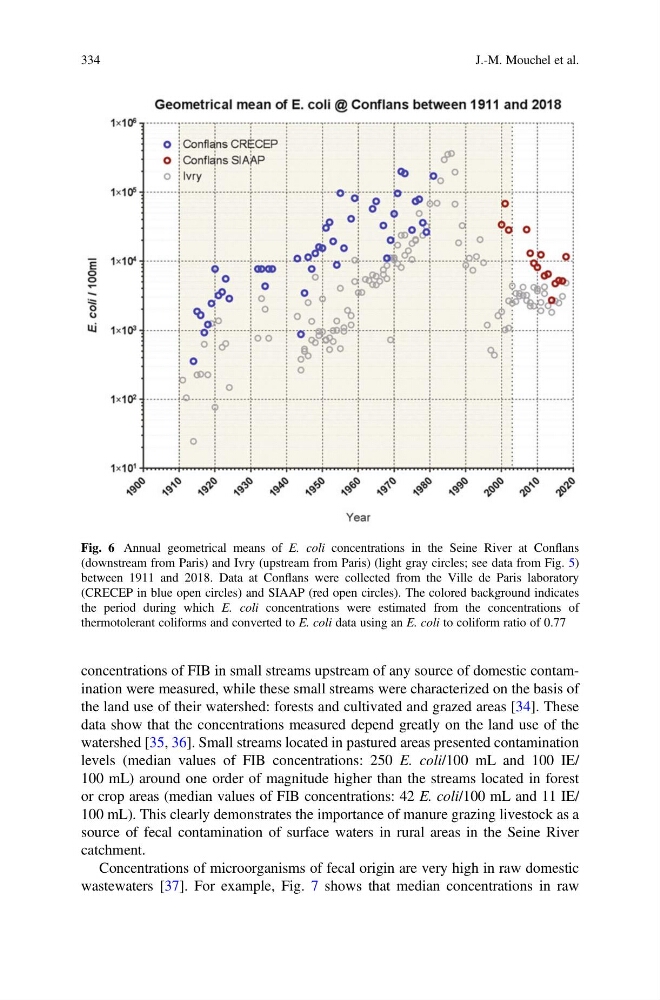
Fig. 6 Annual geometrical means of E. coli concentrations in the Seine River at Conflans
(downstream from Paris) and Ivry (upstream from Paris) (light gray circles; see data from Fig. 5)
between 1911 and 2018. Data at Conflans were collected from the Ville de Paris laboratory
(CRECEP in blue open circles) and SIAAP (red open circles). The colored background indicates
the period during which E. coli concentrations were estimated from the concentrations of
thermotolerant coliforms and converted to E. coli data using an E. coli to coliform ratio of 0.77
334
J.-M. Mouchel et al.
the land use of their watershed: forests and cultivated and grazed areas [34]. These
data show that the concentrations measured depend greatly on the land use of the
watershed [35, 36]. Small streams located in pastured areas presented contamination
levels (median values of FIB concentrations: 250 E. coli/100 mL and 100 IE/
100 mL) around one order of magnitude higher than the streams located in forest
or crop areas (median values of FIB concentrations: 42 E. coli/100 mL and 11 IE/
100 mL). This clearly demonstrates the importance of manure grazing livestock as a
source of fecal contamination of surface waters in rural areas in the Seine River
catchment.
Concentrations of microorganisms of fecal origin are very high in raw domestic
wastewaters [37]. For example, Fig. 7 shows that median concentrations in raw
Fig. 6 Annual geometrical means of E. coli concentrations in the Seine River at Conflans
(downstream from Paris) and Ivry (upstream from Paris) (light gray circles; see data from Fig. 5)
between 1911 and 2018. Data at Conflans were collected from the Ville de Paris laboratory
(CRECEP in blue open circles) and SIAAP (red open circles). The colored background indicates
the period during which E. coli concentrations were estimated from the concentrations of
thermotolerant coliforms and converted to E. coli data using an E. coli to coliform ratio of 0.77
334
J.-M. Mouchel et al.